What Is ABAC?
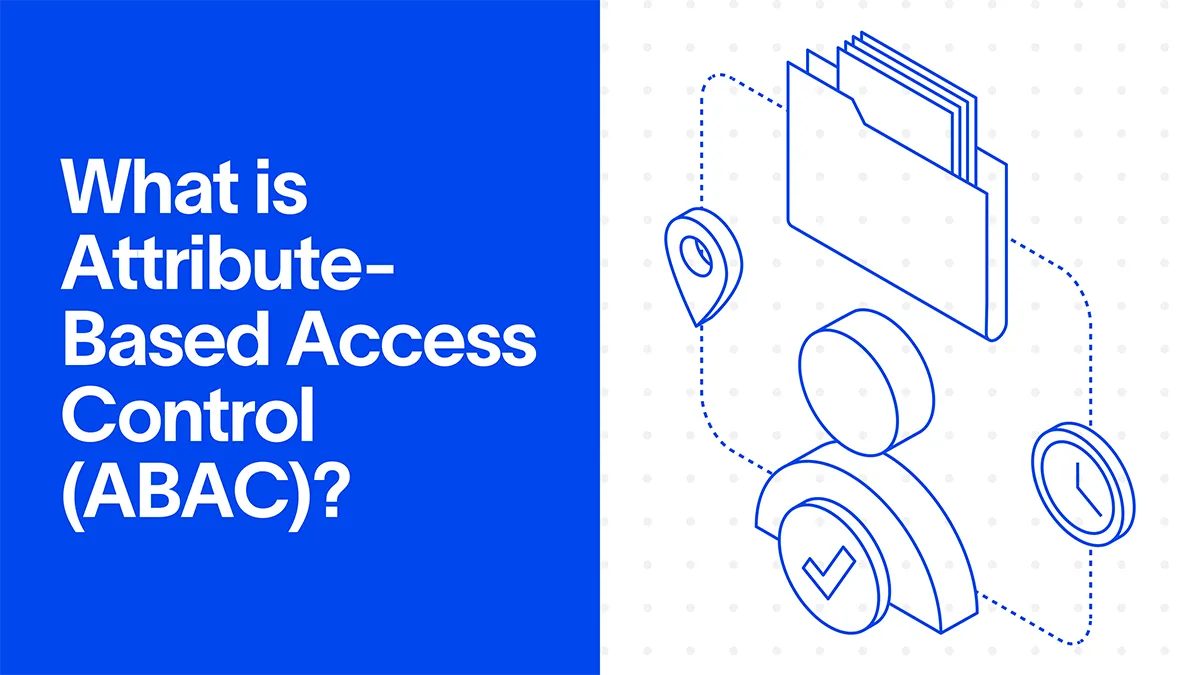
Attribute-based access control (ABAC) grants or denies access by evaluating attributes associated with users, resources, actions, and environmental conditions against a set of policy rules. Rather than relying on static role assignments, ABAC makes dynamic, context-aware decisions in real time. Organizations adopt the model to enforce least privilege access, reduce permission sprawl, and meet regulatory requirements in complex, distributed environments.
The National Institute of Standards and Technology (NIST) formalized the model in NIST Special Publication 800-162, defining ABAC as a method for controlling access based on attributes of the subject, object, requested operations, and environment conditions. The Federal Identity, Credential, and Access Management (FICAM) Roadmap, coordinated by the Federal CIO Council in 2011, identified ABAC as a recommended authorization model for federal agencies. Since then, the approach has become a standard part of enterprise identity and access management strategies.
ABAC is also known as policy-based access control (PBAC) or claims-based access control (CBAC), depending on the deployment context. Regardless of terminology, the underlying mechanism remains the same: evaluating multiple attributes per request instead of matching a user to a predefined role.
The Four Types of ABAC Attributes
Every ABAC policy evaluates four categories of attributes. Each category provides a different dimension of context that the policy engine considers before making a decision.
A single access request might evaluate a combination such as: subject.department = "Engineering" AND resource.classification = "Confidential" AND action = "Download" AND environment.location = "Corporate Network." If all conditions match a policy rule, access is granted. If any condition fails, the request is denied.
| Attribute Type | Description | Examples |
|---|---|---|
| Subject | Properties of the user or entity requesting access | Job title, department, clearance level, risk score |
| Resource | Properties of the data or system being accessed | Data classification level, file owner, sensitivity tag, record type |
| Action | The operation being requested | Read, write, delete, download, share |
| Environment | Contextual conditions at the time of the request | Time of day, device posture, IP address, geographic location |
How ABAC Policies Work
The eXtensible Access Control Markup Language (XACML) specification defines the standard architecture for ABAC policy evaluation. Four components coordinate every access decision:
- Policy Administration Point (PAP): Where security teams author and manage access policies, defining which attribute combinations result in allow or deny decisions.
- Policy Decision Point (PDP): The engine that evaluates incoming requests against active policies by receiving attribute values, applying Boolean logic, and returning a decision.
- Policy Enforcement Point (PEP) intercepts access requests at the point of interaction, such as an application gateway or API endpoint, and enforces the PDP's decision.
- The Policy Information Point (PIP) retrieves attribute values from external sources such as HR systems, directory services, and data governance platforms, feeding real-time data into the PDP.
This separation of concerns allows organizations to update policies centrally without modifying individual applications. NIST SP 800-162 describes a related but distinct architectural model; the XACML-based PEP/PDP/PIP/PAP framework is the most widely adopted in practice.
How Does ABAC Differ From RBAC?
Role-based access control (RBAC) assigns permissions to predefined roles, and users inherit those permissions by role membership. ABAC takes a fundamentally different approach by evaluating multiple contextual attributes per request without requiring the creation or management of roles.
The distinction matters most at scale. Organizations serving hundreds of business units, contractor types, and data sensitivity levels often face role explosion under RBAC, where the number of required roles grows exponentially to account for every unique permission combination. A healthcare system might need separate roles for "daytime ER nurse," "nightshift ICU nurse," and "weekend surgical nurse," each with slightly different access rights. ABAC handles these scenarios through attribute combinations rather than individual role definitions.
| Dimension | ABAC | RBAC |
|---|---|---|
| Access basis | Attributes of user, resource, action, and environment | User’s assigned role |
| Granularity | Fine-grained; policies evaluate multiple conditions per request | Coarse-grained; permissions tied to role membership |
| Scalability | Scales through attribute combinations; no role explosion | Role count grows with organizational complexity |
| Context awareness | Real-time; considers time, location, device, and data sensitivity | Static; does not change based on context |
| Setup complexity | Higher initial effort; requires attribute taxonomy and policy design | Lower initial effort; roles are simpler to define |
| Maintenance | Lower ongoing cost; policies adapt as attributes change | Higher ongoing cost; roles must be manually updated |
| Compliance fit | Strong; maps directly to regulatory requirements | Adequate for basic compliance; struggles with granular mandates |
| Best for | Large, distributed organizations with complex access needs | Smaller teams with well-defined, stable job functions |
When To Choose ABAC Over RBAC
Organizations should consider ABAC when they face role explosion across business units, need to enforce location- or time-based access restrictions, operate under strict compliance mandates such as HIPAA or GDPR, or manage access to resources with varying sensitivity levels. RBAC remains a practical choice for smaller organizations with clearly defined job functions and stable access patterns. Most enterprises adopt a hybrid approach: RBAC for broad role assignments and ABAC for fine-grained policy refinement within those roles. To go back to the healthcare example, if the daytime ICU nurse picks up a nightshift in the ER, they need permissions that they otherwise wouldn’t, which changes the access controls.
Key Benefits of ABAC for Enterprise Security
Access control decisions that account for context reduce both security risk and operational friction. ABAC offers several advantages over static permission models.
- Fine-grained authorization: Policies can express conditions that static roles cannot, such as restricting access to personally identifiable information (PII) based on the requestor's department, the data's classification, and the time of request simultaneously.
- Reduced role sprawl: Attribute combinations replace the need for hundreds or thousands of individual roles, simplifying administration.
- Dynamic enforcement: access decisions adapt in real time as conditions change. An employee flagged by HR as departing can have access automatically restricted without manual intervention.
- Regulatory alignment: ABAC maps directly to frameworks such as HIPAA, GDPR, and PCI DSS, where access must be tied to data sensitivity, purpose, and context rather than a generic role.
- Audit precision: Every decision is logged with the full set of evaluated attributes, providing detailed audit trails for compliance teams and incident response workflows.
ABAC and Zero Trust Architecture
ABAC aligns naturally with zero trust principles. NIST SP 800-207, Zero Trust Architecture, calls for access decisions based on identity, device health, and context evaluated continuously. These are precisely the types of attributes ABAC evaluates.
Where zero trust defines the philosophy ("never trust, always verify"), ABAC provides the mechanism. A zero trust architecture that relies only on RBAC cannot enforce contextual conditions such as "deny access to classified documents from personal devices outside business hours." ABAC can. For security teams building zero trust architectures, ABAC serves as the policy enforcement engine that makes continuous, context-aware verification operational.
The CISA Zero Trust Maturity Model v2.0 identifies identity and data as two of its five pillars, both of which benefit from attribute-based access decisions.
Common ABAC Use Cases and Examples
The gap between theory and practice narrows when examining how specific industries apply ABAC to solve real access control challenges.
| Industry | Use Case | Key Attributes Used | Compliance Driver |
|---|---|---|---|
| Healthcare | Restrict patient record access by provider, shift, and location | Subject: role, shift; Resource: record type; Environment: location | HIPAA |
| Financial services | Enforce transaction approval thresholds based on amount and role | Subject: authority level; Action: approve; Resource: transaction value | SOX, PCI DSS |
| Government | Control classified document access by clearance and need-to-know | Subject: clearance level; Resource: classification; Environment: network | CMMC, NIST 800-53 |
| Cloud/SaaS | Tag-based access to cloud resources across multi-tenant environments | Subject: project tag; Resource: resource tag; Environment: account type | Supports FedRAMP alignment |
| Enterprise data security | Prevent data exfiltration based on data sensitivity and user risk | Subject: risk score; Resource: sensitivity; Action: download | GDPR, internal policy |
ABAC for Data Protection and Compliance
ABAC intersects most directly with data protection through its ability to use data sensitivity as a resource attribute. An ABAC policy can grant or deny access based on whether a file contains protected health information, intellectual property, or financial records, combined with who is requesting access and under what conditions.
This approach requires accurate, up-to-date classification of sensitive data. The effectiveness of any ABAC policy depends on the quality of the attributes it evaluates. Stale or incomplete sensitivity labels mean the policies built on them cannot enforce meaningful protections. Modern data security posture management platforms address this gap by continuously discovering and classifying data, generating the attribute layer that ABAC engines consume. When organizations pair data loss prevention with ABAC, they gain both preventive access controls and detective monitoring of how data moves after access is granted.
See how data lineage creates the granular attributes modern access policies depend on.
Challenges of Implementing ABAC
ABAC's flexibility introduces complexity that simpler access control models avoid. Organizations considering ABAC should anticipate several challenges:
- Policy design complexity requires defining attribute taxonomies, establishing naming conventions, and mapping business requirements to Boolean logic. Poor policy design can create either over-permissive or over-restrictive access.
- Attributes must be accurate, current, and available to the PDP at decision time. Attribute management across HR systems, directory services, asset inventories, and classification platforms demands integration and ongoing governance.
- Performance overhead from real-time attribute evaluation adds latency to access decisions. Policy engines must be optimized for the throughput requirements of the environment, particularly in high-transaction systems.
- Testing ABAC policies is harder than validating simple role-permission mappings because policies interact across multiple attribute dimensions. Thorough testing requires simulating realistic attribute combinations.
- Older applications may not support attribute-based authorization natively, requiring middleware or proxy-based enforcement for legacy integration.
How To Overcome ABAC Complexity
A phased approach reduces deployment risk. Start with high-value resources where ABAC's granularity provides the greatest benefit, such as access to regulated data or privileged administrative actions. Build the attribute taxonomy incrementally, beginning with attributes already available in existing directory services and HR systems. Adopt a hybrid RBAC+ABAC model that uses roles for broad access tiers and ABAC for contextual refinements within those tiers. Automate attribute provisioning through integration with authoritative sources rather than relying on manual updates.
ABAC vs RBAC vs PBAC: Comparing Access Models
Three access control models dominate enterprise authorization design, each operating on different principles.
| Feature | ABAC | RBAC | PBAC |
|---|---|---|---|
| Decision basis | Multiple attributes (user, resource, action, environment) | Role membership | Centralized policy rules |
| Granularity | Fine-grained, per-request context | Coarse, per-role | Fine-grained, rule-based |
| Scalability | High; attribute combinations replace role proliferation | Limited by role count | High; centralized policy management |
| Setup complexity | High; requires attribute taxonomy | Low to moderate | Moderate to high |
| Dynamic context | Full support for real-time conditions | No dynamic context | Depends on policy engine capabilities |
| Standards | XACML, NGAC, OPA | NIST RBAC model | Vendor-specific approaches |
| Best suited for | Complex, distributed environments | Small to mid-size with stable roles | Centralized organizations with strong policy governance |
PBAC shares significant overlap with ABAC, and some deployments treat them as interchangeable. The distinction is architectural: PBAC emphasizes a centralized policy engine governing all access decisions, while ABAC focuses on the attribute evaluation model itself. In practice, most ABAC deployments include a centralized policy engine, blurring the boundary between the two approaches.
How To Implement ABAC in Your Organization
Successful ABAC adoption follows a structured approach that balances ambition with practical constraints.
- Define objectives and scope. Identify which resources, user populations, and compliance requirements justify ABAC's added complexity. Not every access decision needs attribute-level granularity.
- Inventory available attributes. Map the attributes already present in directory services, HR systems, asset management tools, and data classification platforms. Gaps in attribute availability often determine the adoption timeline.
- Design the policy model. Start with broad policies and refine based on testing. NIST SP 800-162 provides a framework for structuring ABAC policies across core and hierarchical models.
- Select standards and tools. XACML provides an XML-based policy language and reference architecture for enterprise deployments. ALFA (Abbreviated Language for Authorization) offers a simplified syntax contributed to the OASIS XACML Technical Committee. NGAC (Next Generation Access Control), an ANSI/INCITS standard developed with NIST leadership, defines an alternative architecture. Open Policy Agent (OPA), a graduated CNCF project, uses the Rego language and is widely adopted in cloud-native environments.
- Deploy in phases. Begin with monitor-only mode to evaluate policy decisions without enforcement. Validate against historical access patterns before activating enforcement.
- Monitor and refine. Continuously review decision logs, flag policy conflicts, and adjust attribute sources as organizational structures evolve.
ABAC Implementation Best Practices
Layer ABAC policies on top of existing RBAC roles rather than replacing the entire authorization model at once. Clear ownership for the attribute taxonomy is critical; attributes managed by multiple teams without governance quickly become unreliable. Test policies against realistic data before enforcement, and build automation for attribute lifecycle management including provisioning, updates, and deprovisioning.
As AI agents and automated workflows take on more actions within enterprise environments, attribute-based authorization becomes increasingly important for governing non-human access. These entities require the same attribute-level scrutiny as human users, with policies that evaluate what data an agent is accessing, why, and under what conditions. Organizations that invest in ABAC as part of their information security architecture can position themselves to govern both human and machine access as complexity grows.
Frequently Asked Questions
What is the difference between ABAC and RBAC?
RBAC assigns permissions to predefined roles, and users inherit access through role membership. ABAC evaluates multiple attributes per request, including user properties, resource sensitivity, the requested action, and environmental conditions such as time and location. ABAC provides finer-grained control and eliminates role explosion, but requires more upfront policy design. Most enterprises use a hybrid of both models.
What are the four types of attributes in ABAC?
NIST SP 800-162 defines four attribute categories for ABAC. Subject attributes describe the user (role, department, clearance). Resource attributes describe the data or system (classification, owner). Action attributes specify the requested operation. Environmental attributes capture contextual conditions such as time, location, and device posture.
How does ABAC support compliance with HIPAA and GDPR?
ABAC maps access policies directly to data sensitivity and regulatory requirements. In healthcare, ABAC restricts patient record access by provider type, shift schedule, and physical location, supporting HIPAA's minimum necessary standard. For GDPR, ABAC enforces purpose-based access that ties data handling to the stated processing purpose. Every decision is logged with the full attribute context, providing the audit evidence regulators require.
When should an organization choose ABAC instead of RBAC?
ABAC is typically the stronger choice when an organization faces role explosion across business units, needs context-aware access decisions based on location, time, or device, operates under strict compliance mandates, or manages resources with varying sensitivity levels. Organizations with smaller teams, stable roles, and straightforward access requirements often find RBAC sufficient. A hybrid approach using RBAC for broad tiers and ABAC for contextual refinements fits most enterprises.
What standards support attribute-based access control?
eXtensible Access Control Markup Language (XACML) from OASIS provides the primary XML-based policy language and reference architecture for ABAC. NIST published SP 800-162 as the foundational ABAC definition and planning guide. NGAC (Next Generation Access Control), published as an ANSI/INCITS standard with NIST leadership, defines an alternative access control architecture. Open Policy Agent (OPA), a graduated CNCF project, uses the Rego language and has wide adoption in cloud-native environments.


.avif)
.avif)