See Every Move Your Data Makes
Most security programs can find data at rest. Cyberhaven traces the full lifecycle of your data: every copy, paste, rename, and transfer across endpoints, SaaS applications, cloud environments, and AI tools. That visibility is the foundation for real data security.
Why Data Visibility Is Harder Than It Should Be
The tools most organizations use were built to inspect data at a point in time. Data doesn't cooperate.
Data Moves Faster Than Labels Can Follow
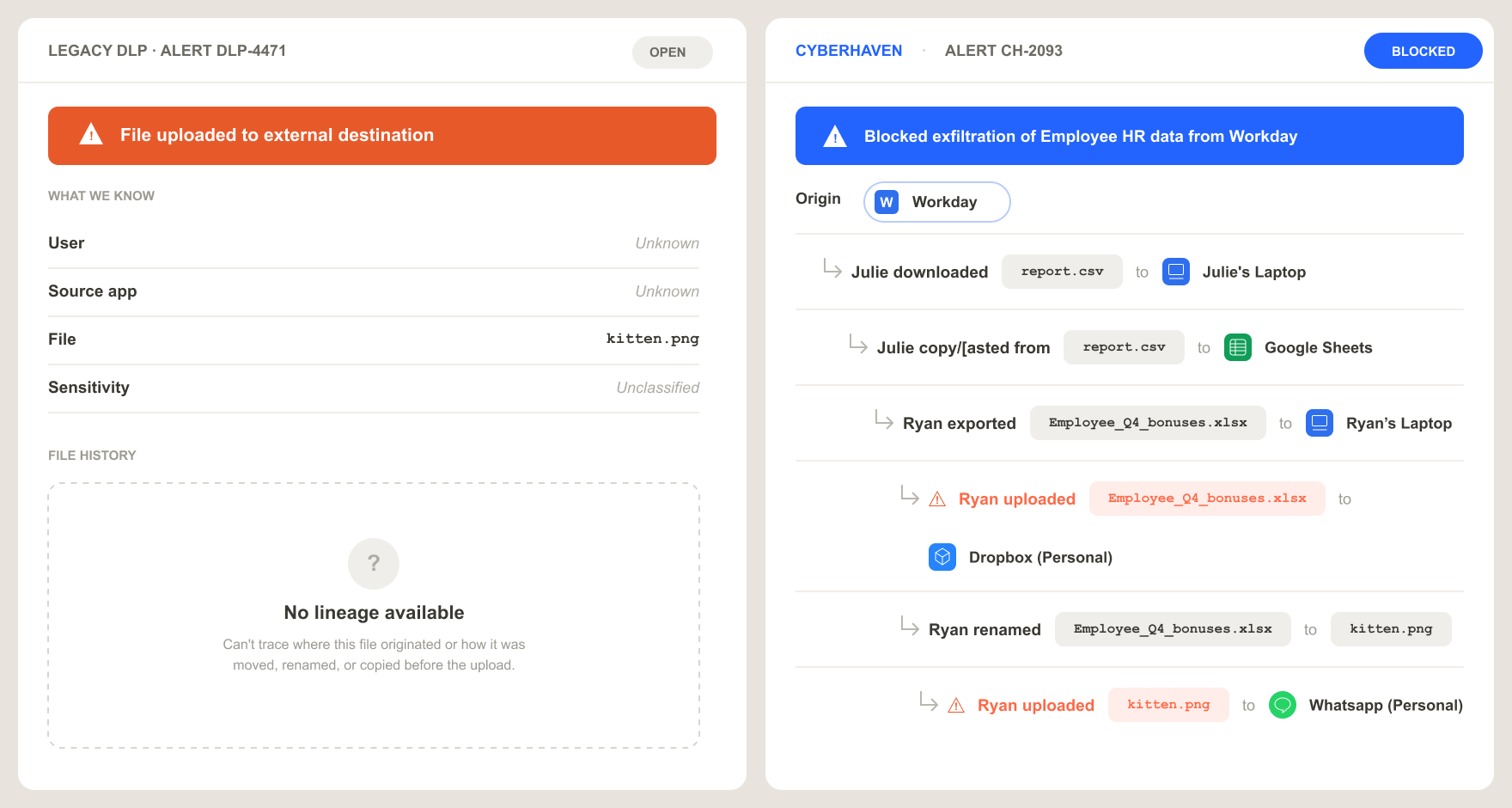
When sensitive information is copied into a new file, pasted into a chat message, renamed, or reformatted by agentic AI, it escapes legacy classification rules entirely. Content-inspection tools see what data looks like at a single moment, but lose track when data changes shape.
Scans show where data lives,
not where it goes
DSPM and inventory tools are good at cataloging data at rest. They answer the question "what do we have and where is it stored?" They cannot answer "who accessed that file last week, what did they do with it, and did any of it leave?"
Fragmented Coverage Creates Blind Spots Across The Investigation
When data moves across endpoints, SaaS applications, email, cloud storage, and AI tools, point products can only see their confined coverage scope. Piecing together what happened to a sensitive file across five tools means starting from scratch every time.
How Cyberhaven Maps Data From Origin to Outcome
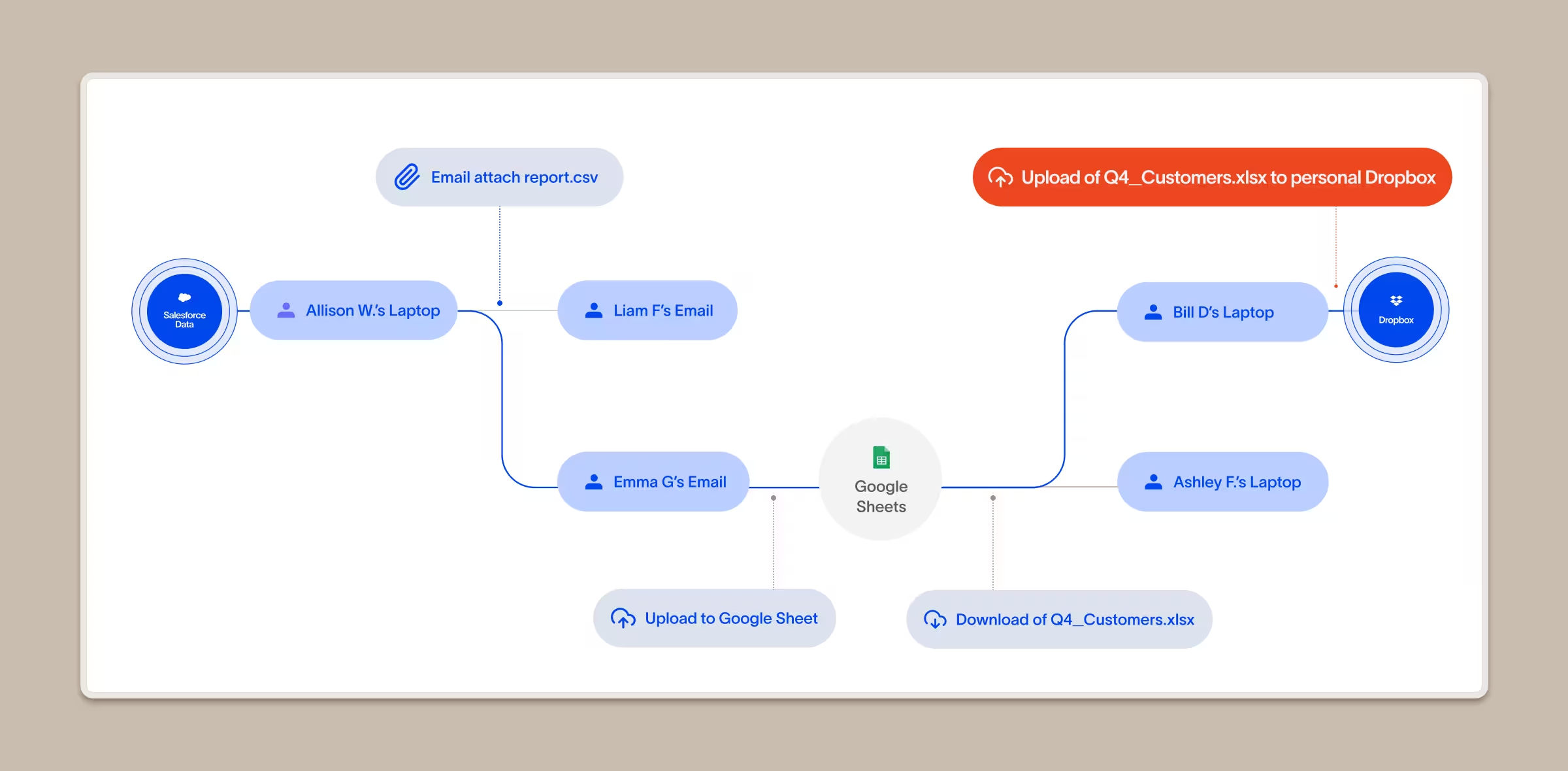
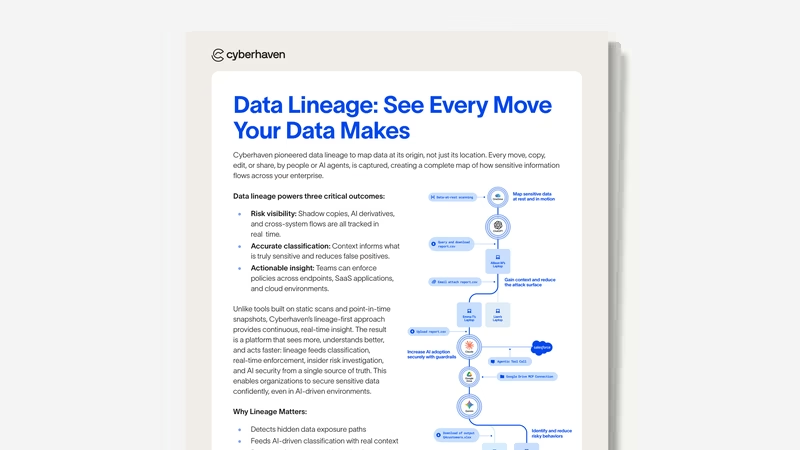
Cyberhaven's Data Lineage Graph captures the complete history of how data originates, moves, transforms, and arrives at its final destination, across every system through which it travels.

Lineage in Action
Data lineage isn't an abstract concept. Here's what it looks like when a real workflow puts sensitive data at risk.
The data flow visibility features that give security teams a complete picture of how sensitive information moves through the enterprise.
Data Lineage Graph
A continuous, real-time record of how every piece of sensitive data originates, moves, transforms, and arrives at its destination. The foundational layer that powers all enforcement downstream.
Provenance and Ownership Context
Captures and preserves the origin of every data object, answering not just what data is, but who it belongs to. Provenance persists even when files are renamed, reformatted, or moved into new systems.
Content-Aware Tracking Across Transformations
Follows data through copy-paste, download, rename, and format conversion. Sensitive content retains its lineage context even after it no longer resembles the original file.
Cross-Environment Coverage
Tracks data movement across endpoints, SaaS applications, email, cloud storage, collaboration platforms, and AI tools, from a single unified graph.
AI-Powered Data Classification
Assigns labels informed by full lineage history, not just current content. Classification accuracy improves over time as the lineage graph grows, reducing false positives without manual tuning.
Linea AI
Uses behavioral analysis to detect anomalous data movements and prioritize the incidents that matter most, surfacing risks that static rules miss and giving analysts context for faster triage.
Policy Foundation for DLP, IRM, DSPM, and AI Security
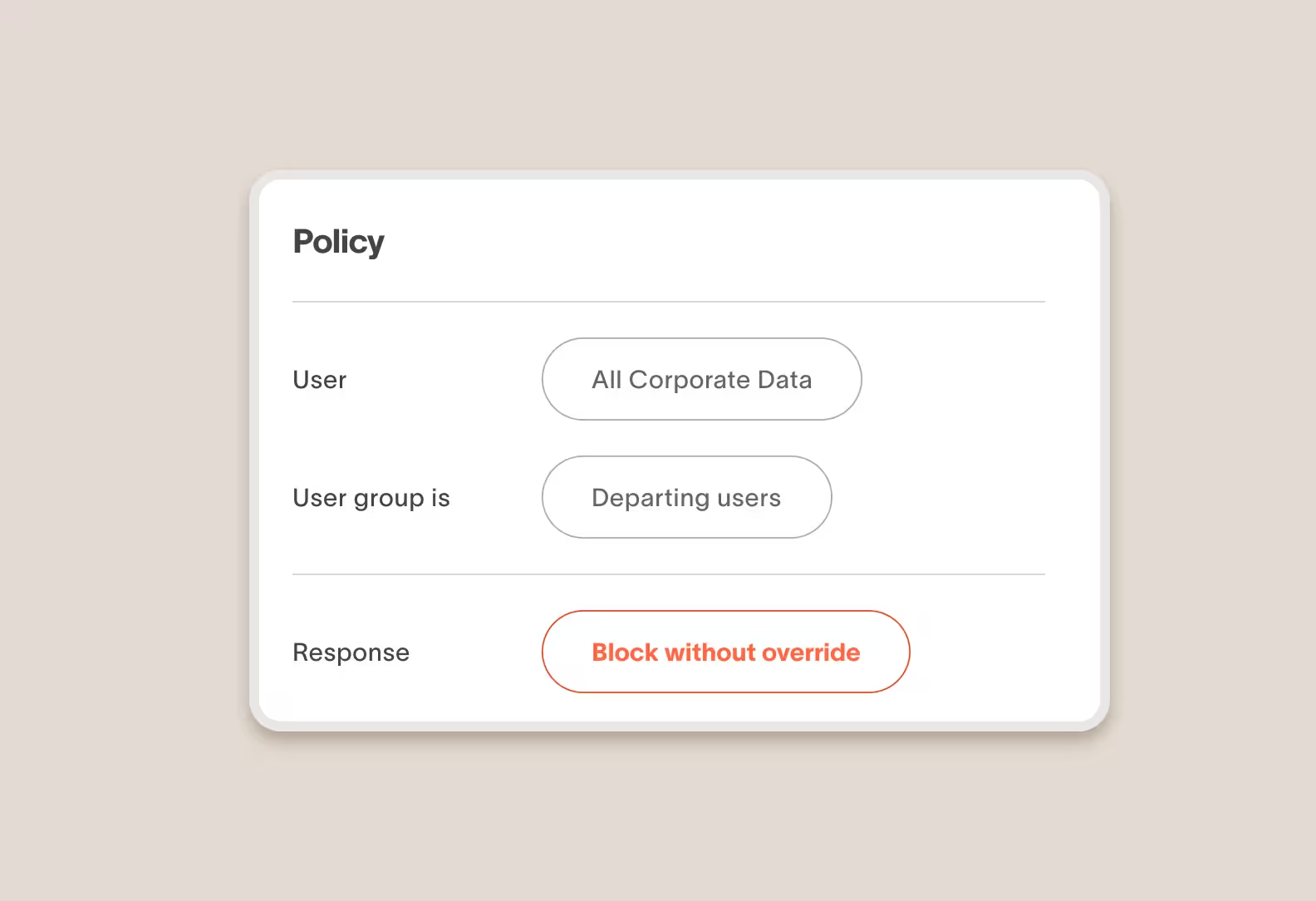
Lineage data is the enforcement context that powers Cyberhaven's DLP, insider risk, DSPM, and AI security capabilities. Every policy action carries the context of where data came from and how it moved.
What Makes Cyberhaven Different
Why Lineage Changes the Security Picture

See how someone got data they shouldn't have
Labels and content scans tell you data is overexposed. Data lineage tells you who accessed the overexposed data, what they did with it, and whether it left the environment.
Discover shadow applications before they become incidents
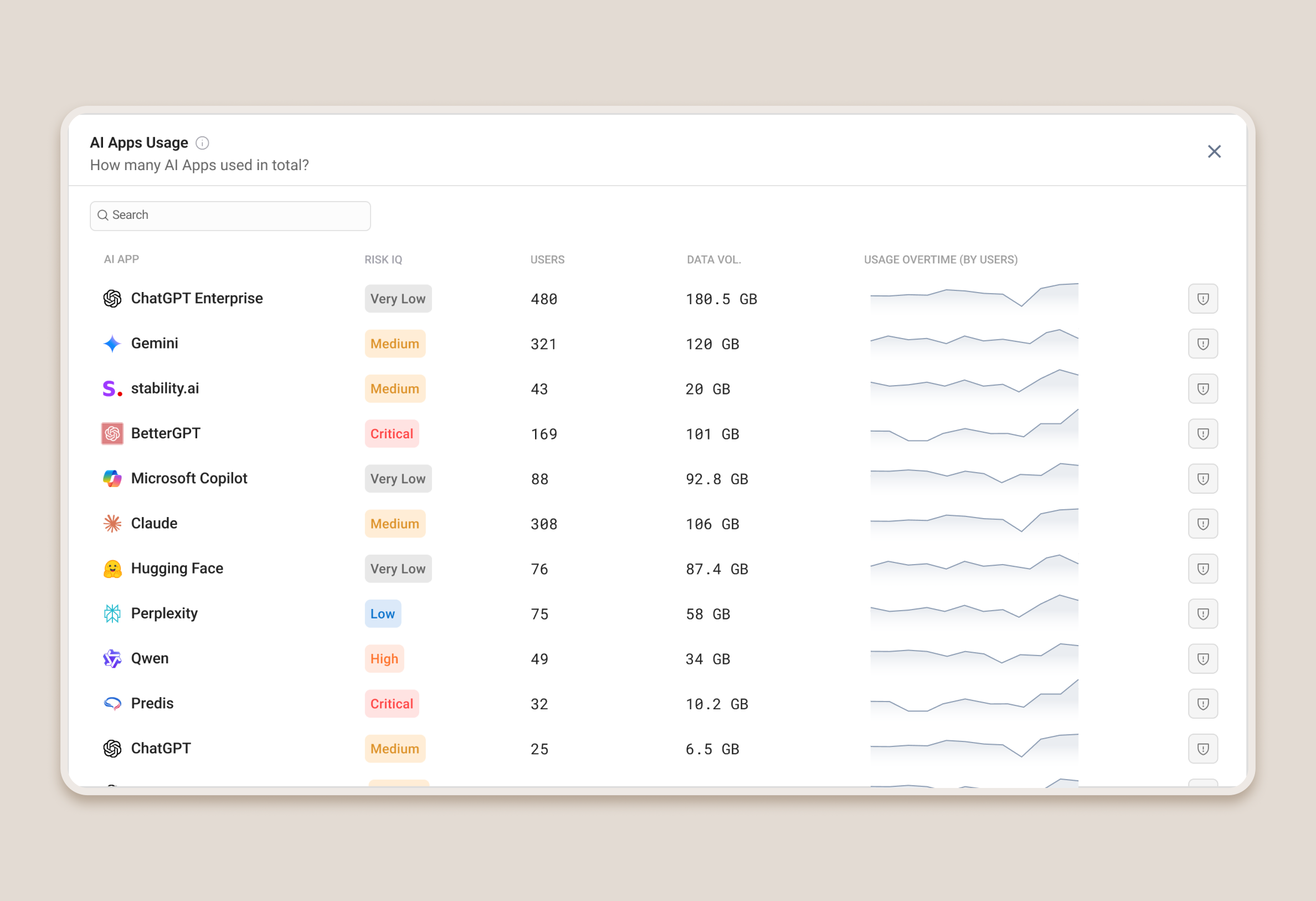
Cyberhaven surfaces the cloud and AI applications employees are using with sensitive data, not just the ones IT approved. Security teams can redirect employees to sanctioned alternatives, understand unmet tool needs, and close exposure gaps without blocking work.
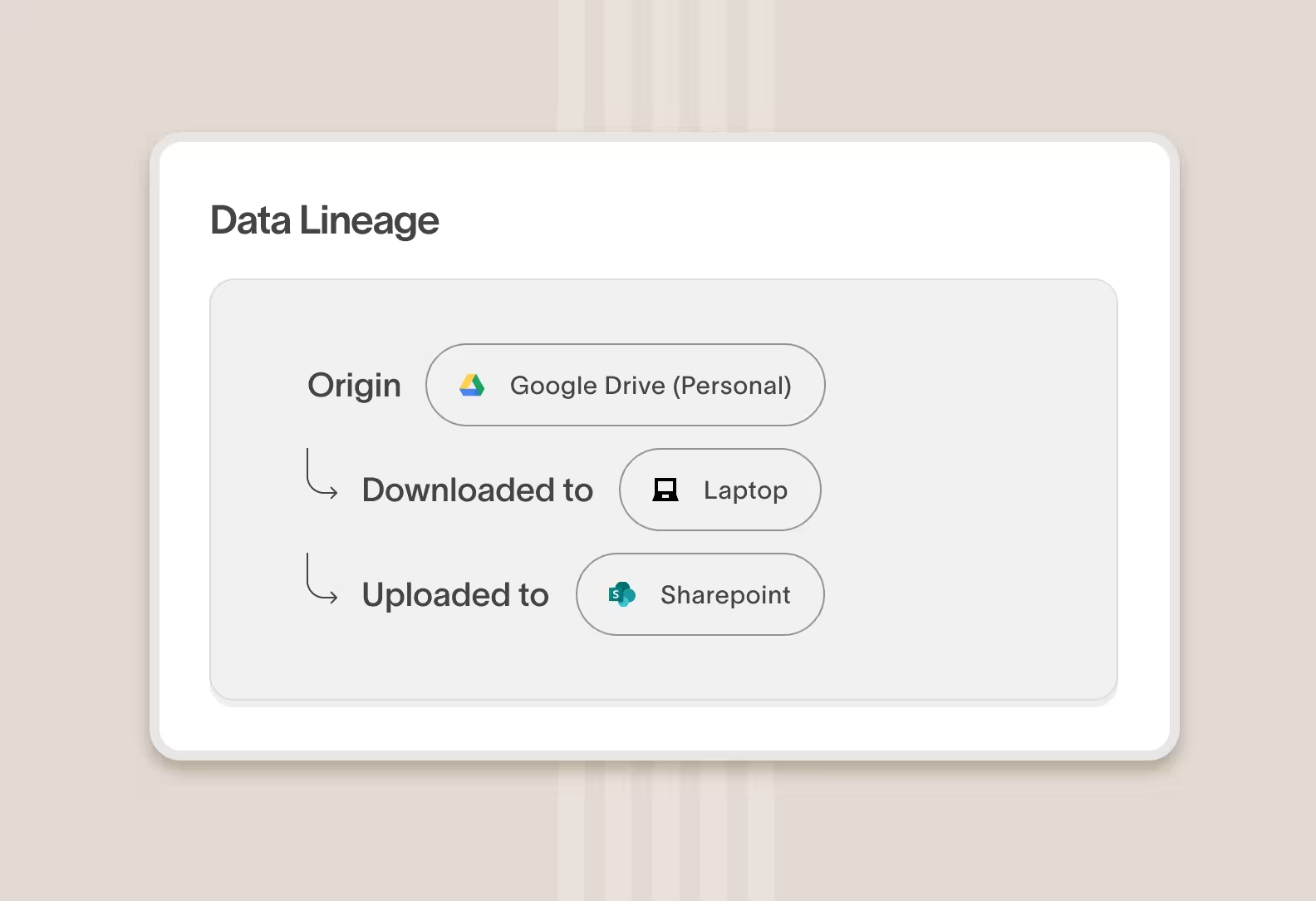
Track risky data ingress, not just egress
Cyberhaven records the source of all data entering the organization. IP brought from a former employer, content generated by external AI tools, files downloaded from personal accounts onto a corporate device: all of it is captured, classified, and surfaced.
Data Security for the Agentic Enterprise
Cyberhaven Flow traces the full lifecycle of data and adapts protection to changing context
Frequently Asked Questions
What is data flow visibility in enterprise security?
Data flow visibility is the ability to track how sensitive data moves across an organization's environment: who created it, who accessed it, how it was copied or transformed, and where it ended up. Complete data flow visibility requires tracking data through human actions (copy-paste, file transfer, email) as well as automated workflows and AI tool interactions, across endpoints, SaaS applications, cloud storage, and collaboration platforms.
Why can't traditional DLP tools track data flows?
Traditional DLP tools inspect data at a point in time using content patterns and labels. When data is copied into a new file, renamed, reformatted, or pasted into a different application, it often escapes classification rules because it no longer matches the original pattern. DLP tools designed around file-level inspection cannot follow content through transforms or maintain context across multiple steps.
What is data lineage and how does it differ from data discovery?
Data discovery identifies what sensitive data exists and where it is stored. Data lineage tracks how that data moves over time: from its origin through every copy, transfer, transformation, and destination. Discovery answers "what do we have?" Lineage answers "what happened to it?" Both are necessary for a complete security picture, but lineage is required for detecting how incidents actually unfold.
What is data provenance and why does it matter for security?
Data provenance is the record of where data originated and who it belongs to. Two files can look identical in content but carry entirely different risk depending on whether the data originated from an internal CRM or from a personal device. Provenance context allows security teams to classify data accurately and enforce policies based on actual ownership and risk, rather than treating all structurally similar data the same way.
Can Cyberhaven track data that has been copied and pasted, not just file transfers?
Yes. Cyberhaven tracks data movement at the content level, not the file level. When a user copies content from a sensitive document and pastes it into a new file, email, or AI tool, the lineage of that content is preserved. The resulting artifact carries the classification and origin context of the original, even after the data has been detached from the source file.
How does data lineage support compliance and investigations?
Data lineage provides the chain of custody that compliance and investigation workflows depend on. When an incident is suspected, lineage data shows where the sensitive data originated, every action taken with it, and where it ended up, without requiring manual log correlation across disconnected systems. This reduces investigation time and provides the defensible, time-sequenced evidence record that auditors and incident response teams require.
.avif)
.avif)

Learn How to Secure the Agentic Enterprise
Our insights on protecting data across human and agent workflows, plus product news, event updates, and opportunities.