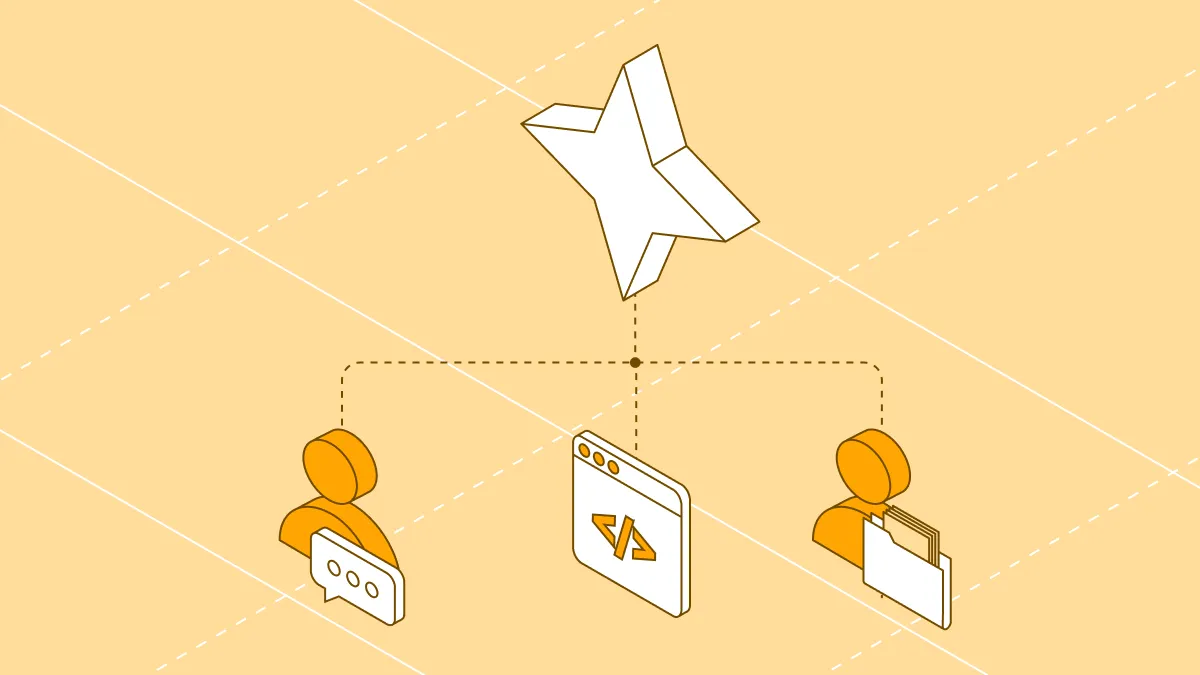
AI adoption does not happen uniformly across an organization. Some employees have integrated generative AI (genAI) tools into core parts of their workflow. Others have barely opened one. Most are somewhere in between, experimenting on an ad hoc basis, without consistent visibility into what data those tools handle or where it goes. That variance is the problem.
Security programs built around either universal AI adoption or zero AI adoption will miss most of the actual risk. The exposure lives in the gap between how much AI activity is occurring across the organization and how much security teams can actually see.
AI data exfiltration describes what happens when sensitive corporate data moves into external AI systems through the ordinary use of genAI or agentic AI tools. The channel is a prompt, a file upload, a pasted block of code. The data reaches a third-party system the organization may never have reviewed. Security teams frequently have no record it happened at all.
AI Data Exfiltration Defined
AI data exfiltration occurs when sensitive data leaves a controlled environment through interactions with AI tools. That data can take many forms: intellectual property, source code, personally identifiable information (PII), financial projections, legal documents, and strategic plans. The destination is an external large language model (LLM) or AI platform operating outside organizational control. While the scale of AI data exfiltration is difficult to measure, it’s known that 39.7 percent of all AI interactions involve sensitive data, and roughly 44% of AI use happens through personal accounts where visibility is more obscured, the scale of exfiltration could be massive.
What separates this category of data loss from traditional exfiltration is intent. Classic data theft involves a deliberate actor removing data with full awareness of what they are doing. AI data exfiltration is almost always incidental. An employee using a genAI tool to summarize a client contract is focused on getting the summary, not the security. Data governance is not part of that mental model.
The data moves regardless.
Three Vectors Security Teams Are Underestimating
AI data exfiltration happens across overlapping channels that most legacy security programs were never designed to monitor. These channels include:
- Personal AI accounts used for work tasks: Many employees access AI assistants through personal accounts rather than enterprise-licensed versions backed by data agreements. Sensitive content entered through a personal session may be stored, logged, or used for model training under the platform's standard terms of service. Security teams have neither visibility nor contractual recourse when the access occurs outside corporate accounts.
- Shadow AI adoption: The AI tool landscape expands constantly, and employees adopt new tools faster than security teams can assess them (the average organization utilizes 54 GenAI applications). Each unsanctioned tool is an ungoverned data egress channel. Organizations that have completed a thorough discovery exercise consistently find far more AI tools in active use than anyone anticipated, including tools embedded in productivity platforms and third-party integrations, creating an ongoing shadow AI problem.
- Embedded AI features: AI risk does not live only in standalone chat interfaces. Writing assistants built into email clients, code completion tools integrated into development environments, and AI features native to productivity suites all process sensitive data as part of routine use. These embedded tools are harder to identify than discrete applications and rarely appear on approved software lists. Agentic AI compounds this problem, especially in organizations that are developer heavy, such as the tech industry, where adoption of agentic AI may be more pronounced.
Explore security risks created by agentic AI and GenAI in-depth.
Legacy Security Tools Were Not Built for AI Data Movement
Data loss prevention (DLP) solutions were originally built to stop known data patterns from moving across known, common egress channels: Social Security numbers, credit card formats, specific file types, outbound email, USB transfers. Data security posture management (DSPM) tools were built to discover and classify sensitive data at rest. Both categories solved real problems for the environments they were designed for.
AI data exfiltration operates on different assumptions entirely.
The egress channel is a browser-based AI interface or an endpoint-based AI agent, and most legacy DLP tools have no way to inspect what an employee types into a web application prompt in real time. They cannot monitor data flowing in and out of endpoint AI agents either. The data itself is often unstructured. A paragraph lifted from a board presentation does not trigger a regex pattern. This problem is amplified by the fact that the sensitivity is contextual, and rules-based controls have no mechanism to evaluate context.
DSPM has a related gap. It can tell a security team where sensitive data lives. It cannot tell them where that data went after an employee fed it into an AI tool. Discovery and classification without movement visibility leaves the most consequential part of the risk unaddressed.
The rate of change compounds both problems. By the time a security team has assessed a new AI tool, categorized its risk, and written a policy for it, employees have typically been using it for weeks. Static controls written in advance cannot account for tools that did not exist when the rules were written.
Closing this gap requires a different approach: One that tracks data in motion across AI interactions, not just data at rest in known repositories.
The Data Types That Move Most Often
Certain categories of sensitive data appear more frequently in AI-related exposure scenarios. Security teams should prioritize visibility into these types specifically.
- Source code is among the most commonly exposed. Developers working with AI coding assistants share internal code to get suggestions, debug logic, and refactor functions. The volume can be substantial, and the intellectual property implications are significant.
- Customer and employee PII surfaces regularly in AI interactions. Employees drafting communications, analyzing records, or building reports with AI assistance include personal data in prompts without recognizing the compliance exposure. GDPR, HIPAA, and CCPA violations do not require malicious intent.
- Financial and strategic information moves through AI tools used for document summarization, analysis support, and report generation. Unreleased earnings data, merger and acquisition materials, and competitive intelligence all appear in these workflows.
- Legal documents and contracts carry higher risk than they appear to. Legal teams and professional services users working with AI-powered document tools expose contract terms, settlement language, and privileged communications when using AI to draft, review, or summarize.
See how manufacturing, professional services, and the financial services industry adopt and use AI.
What AI Data Exfiltration Prevention Requires
Addressing AI data exfiltration requires controls matched to how AI tools actually work.
Inventory Comes Before Policy
Security teams cannot govern tools they do not know exist. The starting point is a complete, continuously updated picture of AI tools in active use across the organization, including tools adopted without review, embedded AI features, browser extensions, and API-connected integrations.
Policy written against a partial inventory has predictable gaps. Build the inventory first, then write policy against a complete picture.
Data Lineage Closes the Context Gap
Knowing that a document contains sensitive data is useful. Knowing where that document went is the actual security requirement needed. Data lineage gives security teams the ability to trace data movement across its full path: which file it originated from, which user moved it, which application processed it, and which AI tool ultimately received it.
That traceable chain changes what investigations look like. Security teams can determine whether a specific AI interaction involved sensitive data from a protected source based on evidence, not inference.
Risk-Based Controls Scale With the Tool Landscape
Blanket AI blocking is not a functional security strategy. Employees work around overly restrictive controls, and organizations forfeit the productivity value that makes governing AI adoption worthwhile to begin with.
Controls need to be calibrated to risk. Each AI tool carries a different profile across data handling practices, compliance certifications, user access controls, and security infrastructure. A corporate-licensed enterprise AI tool with appropriate data processing agreements warrants different treatment than an unsanctioned consumer tool with no data protection commitments. Policy should reflect that difference.
Enforcement Has to Happen at the Moment Data Moves
Weekly reports and after-the-fact audits document exfiltration. They do not prevent it. Effective enforcement means detecting sensitive data entering an AI prompt and acting before the interaction completes, which requires a fundamentally different technical approach than scanning outbound email or monitoring file transfers.
Solving AI Data Exfiltration Requires AI-Native Security
Treating AI risk solely as a policy problem or an employee awareness challenge consistently falls short. The volume and variability of AI tool usage in a modern enterprise makes training programs an insufficient primary control. Policies written against a partial inventory leave predictable gaps.
Organizations building durable defenses invest in security infrastructure built for how AI tools actually operate: Platforms that discover the full landscape of AI tools in active use, trace data movement across the modern data estate, assess risk at the tool level, and enforce controls at the moment of AI interaction.
Cyberhaven’s AI & Data Security Platform gives security teams a unified view across the entire data estate, including the AI tools employees use every day. Shadow AI discovery surfaces unsanctioned tools before they become ungoverned egress channels. Data lineage tracks how sensitive information moves through AI interactions, from the originating file to the external system that received it. Risk-calibrated policy enforcement applies controls proportionate to each tool’s actual risk profile. Together, these capabilities address what legacy point solutions cannot: the full scope of how data moves in an enterprise that has adopted AI.
Read the O’Reilly guide: how to govern agentic AI systems before they act on your data.
See how leading organizations are transforming their data security strategy for the age of AI with IDC's report.
Frequently Asked Questions
What is the difference between AI data exfiltration and a traditional data breach?
A traditional breach involves an external attacker gaining unauthorized access. AI data exfiltration involves an authorized user moving data into an external system through normal work activity. The actor is inside the perimeter. The security consequence is unintended.
Is AI data exfiltration a compliance violation?
It can be. When PII, protected health information, or other regulated data enters an unsanctioned third-party system, it may constitute a violation of GDPR, HIPAA, or CCPA regardless of whether the employee intended to cause a compliance incident.
Do enterprise AI licenses prevent AI data exfiltration?
Enterprise licenses with appropriate data processing agreements reduce risk for the covered tools. They do not address shadow AI adoption. Employees use unsanctioned tools alongside sanctioned ones. A complete prevention strategy requires visibility across all AI tools in active use, approved or otherwise.
What data types surface most often in AI-related exposure incidents?
Source code, financial documents, customer PII, and strategic planning materials appear most frequently. These categories also carry the most significant regulatory, legal, and competitive consequences if exposed.

.avif)
.avif)

Insights for the agentic enterprise
New guides, reports, and insights on data security, sent as they publish.