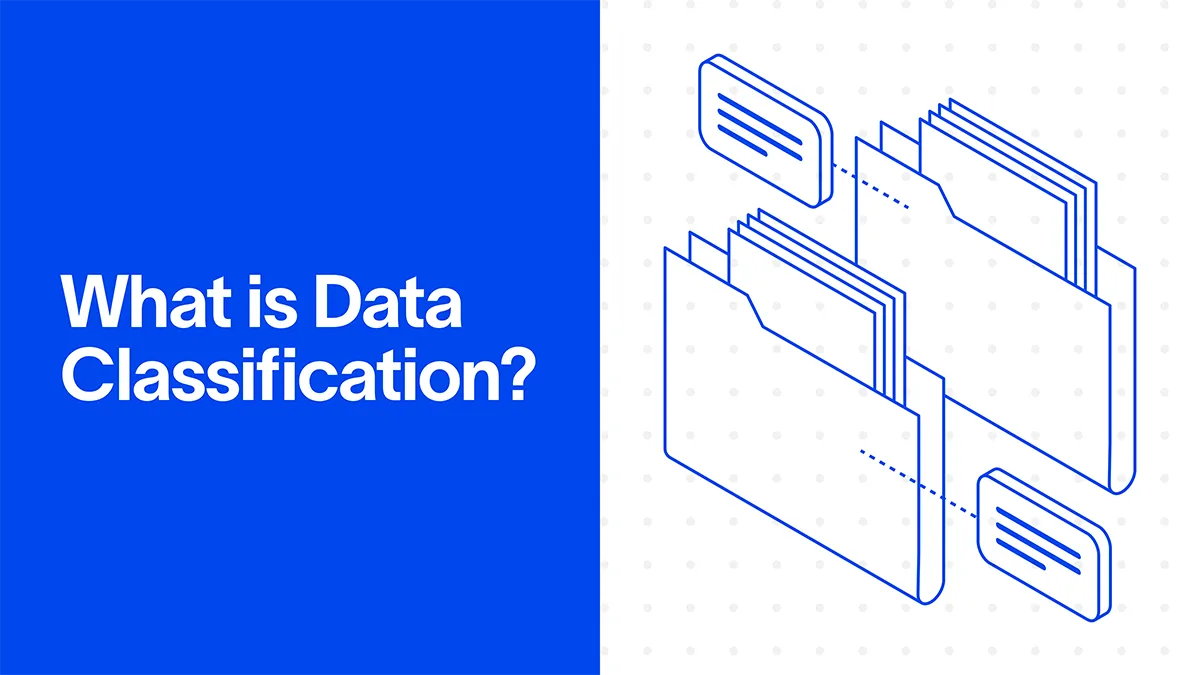
- Data classification is the process of labeling data by sensitivity, regulatory status, and business value so the right security controls apply.
- A data classification policy is the formal document that defines classification levels, assigns ownership, and specifies the controls each level triggers.
- Most organizations use four levels in their data classification scheme: Public, Internal, Confidential, and Restricted.
- Data discovery and data classification are related but distinct: discovery finds and inventories data, while classification labels it by sensitivity.
- Frameworks including GDPR, HIPAA, PCI DSS, and ISO 27001 either require or strongly recommend a documented classification policy.
- Cyberhaven's DSPM continuously discovers and classifies data across environments, closing the gap between policy and how data actually moves.
What Is Data Classification?
Data classification is the process of organizing and labeling an organization's data assets according to their sensitivity, regulatory status, and business value. Labels then determine who can access data, how it must be stored and transmitted, and what security controls apply.
This same discipline is sometimes called data security classification, since the categories exist specifically to determine those controls. Without classification, all data is treated the same, so sensitive records end up either over-protected at great cost or under-protected at great risk.
The practice predates digital computing. Government agencies have classified documents as confidential, secret, and top secret for over a century. Modern enterprise data classification applies the same logic to structured databases, unstructured files, email, and cloud storage. What changed is scale: manual review is no longer viable at the volume of data most organizations generate, which is why automated classification tools have become a core component of security programs.
Data classification works in concert with data governance, access controls, and DLP to form the policy layer of a mature security architecture, answering the question "what is this data?" so every downstream system knows how to treat it.
How Data Classification Works
Data classification moves through three repeating phases: discovery, labeling, and enforcement. Discovery identifies and inventories data; classification assigns each discovered asset a sensitivity label. The two work in sequence, not interchangeably.
Phase 1: Discovery
Before data can be classified, it must be found. Discovery tools scan repositories, endpoints, email systems, cloud storage, and databases to build an inventory of data assets, surfacing what files exist, where they live, and what content they contain. This phase surfaces shadow data: copies, backups, and orphaned files no one knew existed.
Phase 2: Labeling
Once discovered, data receives a classification label using one of three methods:
| Method | How it works | Best suited for |
|---|---|---|
| Content-based | Scans file content for patterns (credit card numbers, Social Security numbers, health identifiers) | Structured sensitive data with predictable formats |
| Context-based | Uses metadata signals: who created the file, which application generated it, where it is stored | Unstructured data where content inspection is insufficient |
| User-based | A knowledgeable employee manually reviews and labels the asset | Highly specialized or ambiguous content that automated tools cannot reliably categorize |
Most mature programs use a hybrid approach: automated tools handle volume, human review handles edge cases.
Phase 3: Enforcement
Classification labels drive enforcement. A file labeled Restricted might trigger automatic encryption, block external sharing, and generate an alert on a copy attempt. Enforcement is what turns classification into an actual security control; without it, classification is documentation, not protection.
Types of Data Classification
There are two dimensions to the classification of data: the sensitivity level assigned to each asset, and the method used to determine that level.
Data Classification Levels
There are four widely used data classification levels, though the exact names vary by industry and framework:
| Level | Description | Typical examples | Common controls |
|---|---|---|---|
| Public | No harm if disclosed | Marketing materials, press releases, published research | No restrictions |
| Internal | Intended for employees; limited harm if leaked | Operational policies, internal directories, training materials | Basic access controls; not for external sharing |
| Confidential | Significant harm if disclosed | Customer lists, financial forecasts, contracts, source code | Encryption, role-based access, audit logging |
| Restricted | Severe legal, financial, or reputational harm if exposed | PII, PHI, payment card data, trade secrets | Strict access, encryption at rest and in transit, DLP monitoring |
Some frameworks add a fifth tier, often labeled Top Secret or Highly Restricted, for data whose exposure would constitute an existential business or legal threat. The full set of tiers, criteria, and rules an organization adopts is called its data classification scheme.
Organizations also choose how classification decisions get made in the first place, using the content-based, context-based, and user-based methods described above, usually in combination.
Data Classification Examples by Data Type
Data classification examples are easiest to understand when tied to the specific record types an organization actually holds, rather than the level names alone.
| Data type | Example | Typical level |
|---|---|---|
| Marketing and public content | Press releases, published pricing, approved website copy | Public |
| Internal operational data | Meeting notes, internal memos, project plans | Internal |
| Customer and business data | Contracts, sales pipeline data, unreleased product roadmaps | Confidential |
| Regulated personal data | PII such as Social Security numbers, PHI, payment card data | Restricted |
| Intellectual property | Source code, product designs, trade secrets | Restricted |
| Internal policies and procedures | Security policies, incident response runbooks, HR procedures | Internal or Confidential, depending on the sensitivity of what the document describes |
That last row matters more than it looks. A policy or procedure document takes on the classification of the most sensitive process it describes, not a fixed level. A password reset procedure with no credentials is typically Internal; an incident response runbook documenting system architecture is usually Confidential.
What Is a Data Classification Policy?
A data classification policy is a formal document that establishes how an organization categorizes its data by sensitivity, value, and risk, and specifies the handling rules for each category: who is responsible for classifying data, what criteria determine a record's level, and what controls (access restrictions, encryption, retention, disposal) apply at each tier. It is the mechanism that turns the levels above from a taxonomy into an enforceable program.
The policy differs from data governance in scope. Governance covers the full lifecycle of data management, including quality, ownership, and stewardship. A classification policy is narrower, as it answers how sensitive a given piece of data is and what that sensitivity means for how it must be treated.
Data classification policy frameworks
Different regulatory regimes approach classification requirements differently:
| Framework | Classification requirement | Practical implication |
|---|---|---|
| GDPR (Article 32) | Proportionate measures by processing risk; special-category data needs higher protection | Map personal data to levels; document lawful basis per level |
| ISO 27001 (Control 5.12) | Mandatory classification scheme with labeling and handling rules | Prerequisite for certification audits |
| NIST SP 800-60 | Maps information types to high, moderate, or low impact | Federal baseline, widely adapted commercially |
| PCI DSS v4.0 | Cardholder data must be classified and protected | Usually assigned to the Restricted level |
How to Build a Data Classification Policy
Building an effective data classification policy requires six steps, and the process is not purely technical: it requires business alignment before configuration begins.
- Define scope and governance: Establish which data types, systems, business units, and regions the policy covers. Name a governance committee, assign data owners per category, and define IT and security custodian responsibilities.
- Define levels and criteria: Document each level with a plain-language definition, its regulatory or business driver, concrete examples, and the questions an employee should ask when uncertain.
- Run discovery before finalizing the policy: Do not write a policy against an assumed data inventory. Run a discovery scan first, since the results often surface data categories that were not anticipated during drafting.
- Choose classification tools and methods: Select software that supports content-based, context-based, and user-based methods, and that integrates with your DLP platform, DSPM, and identity management systems.
- Map levels to handling rules: For each level, document required controls across storage, transmission, sharing, retention, and disposal, so enforcement is deterministic rather than discretionary.
- Train employees and establish a review cadence: Cover what each level means and how to handle uncertain cases, then schedule an annual review for regulatory changes and shifts in the threat landscape.
Why Data Classification Matters for Data Security
When data classification is absent or inconsistent, security programs operate without a foundation. This is why data categorization is required as a first step, not an afterthought: DLP policies cannot distinguish sensitive transfers from routine ones, and auditors have no evidence that regulated data was handled appropriately.
- Compliance and regulatory readiness: GDPR, HIPAA, CCPA, and ISO 27001 all require organizations to know where sensitive data is and demonstrate protections. A documented classification policy is typically the first evidence auditors request during a breach investigation.
- DLP accuracy and risk prioritization: Without classification labels, DLP relies entirely on content inspection, generating false positives on benign files and missing data that has been reformatted or partially copied. Labels also let security teams focus on Restricted and Confidential data while routing lower-risk files through lighter-weight controls.
- Incident response: When a breach occurs, classification data tells responders immediately which assets were at risk and what notification obligations apply, rather than turning every incident into a discovery exercise first.
- AI tool exposure: Employees paste documents, customer records, and source code into AI tools, often without recognizing the sensitivity of what they're sharing. Cyberhaven Labs found that the average employee enters sensitive data into an AI tool once every three days. A classification policy that extends to AI usage sets clear rules for what external AI services may process.
Common Data Classification Challenges
- Stale or inaccurate labels
Classification is not a one-time exercise. A document that was Internal last year may now contain customer PII after a merge with another system, and organizations that classify once and never revisit end up with label drift. - Unstructured data at scale
Structured databases are relatively straightforward to classify. The harder problem is unstructured data, such as email, slide decks, and chat exports, which typically accounts for the majority of an enterprise's total data volume. - Overly complex schemas
Classification schemes with seven, eight, or more levels, often born from different business units wanting their own taxonomy, create inconsistency: employees and tools make different judgment calls at the margins. - Shadow data and unknown repositories
Classification tools can only classify data they can find. Orphaned cloud buckets and unauthorized collaboration tools create shadow data that sits outside the classification perimeter, and every downstream control with it. - No enforcement connection, no clear owner
A label has no security value unless something acts on it, and that gap widens further when no designated owner is accountable for keeping a category's classification accurate.
How Cyberhaven Addresses Data Classification
Cyberhaven's DSPM approaches classification as a continuous, automated process rather than a periodic audit, discovering data across cloud storage, endpoints, SaaS applications, and on-premises systems without agents or manual inventories, then classifying it using content inspection and contextual signals from Cyberhaven's Data Lineage, which tracks data from its origin through every copy and format transformation. When an employee copies a row from a Restricted database into a personal email draft, the lineage graph records that chain of custody even with no direct text match to the original, so the DSPM surfaces unclassified or miscategorized data that has traveled outside approved channels.
Cyberhaven's DLP then enforces classification-based handling rules in real time: when a user tries to upload a Confidential document to a personal cloud account or paste a Restricted record into an AI tool, DLP policies built on classification labels trigger a warning, a business-justification prompt, or a hard block.
Frequently Asked Questions
What is data classification?
Data classification is the process of organizing data assets into categories based on their sensitivity, regulatory status, and business value. Each category receives a label that determines which security controls, access policies, and compliance requirements apply, so that sensitive data gets the strongest protections while low-risk data isn't burdened with unnecessary controls.
What are the main data classification levels?
Most organizations use four standard levels: Public (no harm if disclosed), Internal (for employees only), Confidential (significant harm if exposed, such as financial data or customer records), and Restricted (severe harm if exposed, such as PII, PHI, or trade secrets). Some regulated industries add a fifth level for data whose exposure would carry criminal or catastrophic consequences.
What is a data classification policy?
A data classification policy is a formal document that defines an organization's classification levels, the criteria for assigning each one, who owns classification decisions, and what controls each level requires. It is the governance layer that makes classification consistent and auditable across business units, since without a written policy, classification decisions vary by team and cannot be demonstrated to auditors.
What is the difference between data classification and data discovery?
Data discovery and data classification are sequential but distinct steps. Discovery finds and inventories data across an organization's repositories, answering what data exists and where it lives. Classification comes after discovery and assigns a sensitivity label to each asset, answering how sensitive it is and what controls should apply. Discovery without classification produces an inventory with no risk context; classification without discovery has nothing to label.
What is the difference between data classification and data governance?
Data classification is one component of data governance, the broader program of policies, roles, and processes that determine how data is managed across its full lifecycle, covering quality, ownership, retention, and compliance. Classification specifically addresses how data is categorized by sensitivity and what controls apply. A governance program without classification lacks the sensitivity labels needed to enforce access and security policies accurately.
What is an ISO 27001 data classification policy?
An ISO 27001 data classification policy is a written classification scheme meeting the requirements of Control 5.12 of ISO/IEC 27001:2022. It must define categories relevant to the organization's legal and business needs, assign responsibility for classifying information assets, and specify labeling and handling procedures. Certification auditors verify that the policy exists, that employees understand it, and that controls are consistently applied.
What are some examples of data classification?
Common data classification examples include marketing content and press releases (Public), internal memos and meeting notes (Internal), contracts and unreleased product plans (Confidential), and regulated data such as PII, PHI, and payment card numbers (Restricted). Internal policy and procedure documents are usually classified based on the sensitivity of the systems or processes they describe, rather than a fixed level.


.avif)
.avif)