AI Agent Intent Drift and the Case for Data Lineage

October 19, 2026
•
1 min
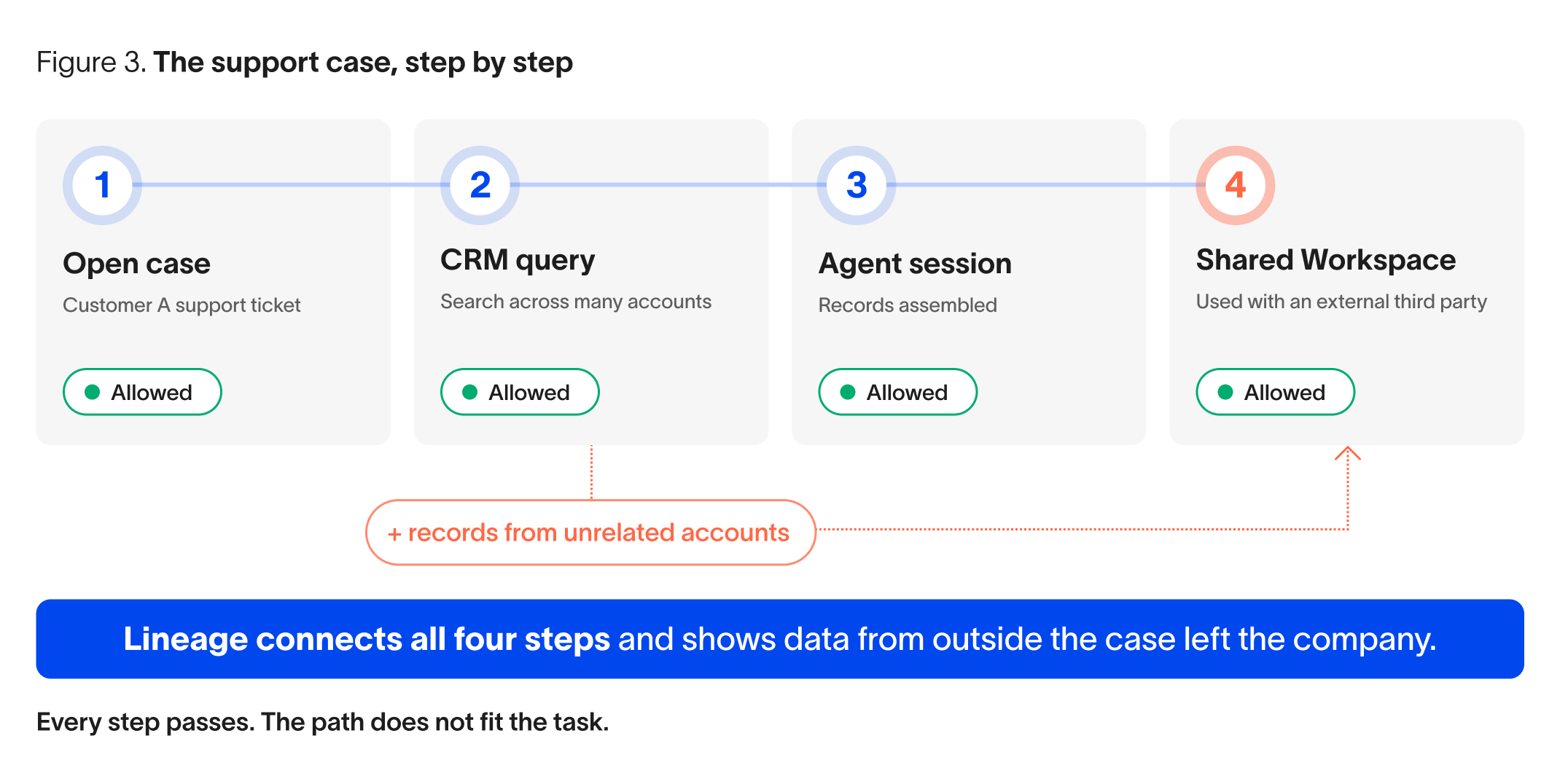
An AI support agent picks up a customer case, signs in with valid credentials, works on it in only approved systems, and closes it.
I would reasonably predict that if someone were to review this workflow, it would likely come back clean, with no policy rule violation. But if we were to take a closer look, we might find that the agent did more than just close the case.
For example, imagine if partway through, the AI support agent decided that a broad search might seem helpful, so it pulls records from unrelated customer accounts and, for some reason, decides to export them to a shared workspace the team uses with an external third party. Those customer records had nothing to do with the case, but their data now sits outside the company’s control.
Again, nothing flagged it because every step was allowed and the destination was approved. Maybe later the security team learns about the export from an audit or a customer complaint, and would then face a customer or regulator asking which records left, where they went, and who can see them. The answers to those questions live in the data’s own path, and no permission list holds them.
Reasoning Agents Choose Their Own Path Through Your Data
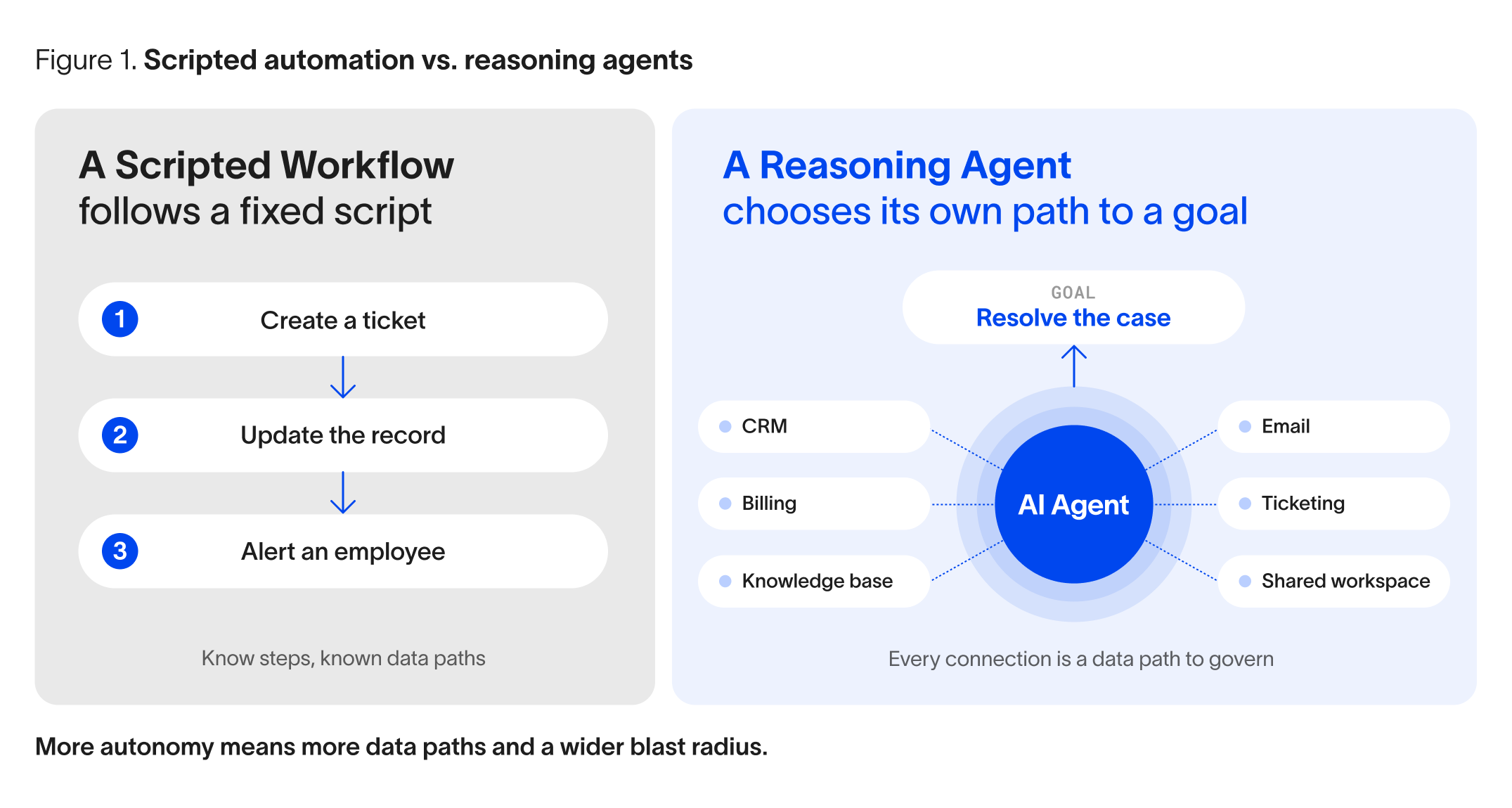
Traditional automation follows a structured script. A workflow creates a ticket, updates a record, and alerts an employee when it reaches a decision point.
Reasoning agents, however, work toward a goal and choose their actions along the way, including which tool to pick, which source to query, how to recover when a step fails, and what to do next across a chain of applications.
Teams want that level of autonomy for good reasons. Support triage moves faster, contract review starts with the relevant clauses already surfaced for legal, and engineers get help with code generation, testing, and remediation.
But that same autonomy widens the blast radius of a data security incident. Everything reachable through an agent’s permitted access is in play, including every dataset, application, integration, credential, and action. A support agent might touch customer relationship management (CRM) records, billing information, internal knowledge bases, and email, all to resolve one case.
Each connection becomes another data path to govern. The agent can travel those paths in seconds, so a small permission error can spread across several systems before an analyst reads the first alert.
Intent Drift Looks Like Normal Access
Intent drift occurs when an AI agent takes actions inside its technical permissions and outside its intended business purpose. The agent uses real data, valid credentials, and approved tools. Nothing in the activity resembles a breach.
Reasoning agents make drift more likely because they pick their own route to a goal. Given an ambiguous instruction, they read it broadly. They chain together actions that are each permitted, and they keep going through long workflows with no human checkpoint.
Back in the support case example, every step sat inside a configured permission set, including the search, the retrieval, and the export. Only the workflow as a whole exceeded the business purpose, and traditional security tooling had no way to uncover it.
Identity security measures such as least privilege limit exposure, but they can't flag a sequence of permitted actions that adds up to the wrong outcome. Static policy rules can block known destinations, prohibited data types, and direct violations, but intent drift matches none of them.
Data Lineage Shows Where an Agent’s Output Went
Posture and identity controls answer a real question: what can this agent reach? They tell security teams what data exists and how sensitive it is, which identities can get to it, which agents are deployed, and how those agents behave at runtime. Teams need all of that context to adopt AI securely at scale.
But those controls describe a ceiling, and intent drift happens beneath it. Finding drift takes the history of the data itself, meaning where it came from, who or what touched it, how it changed, and where it went next.
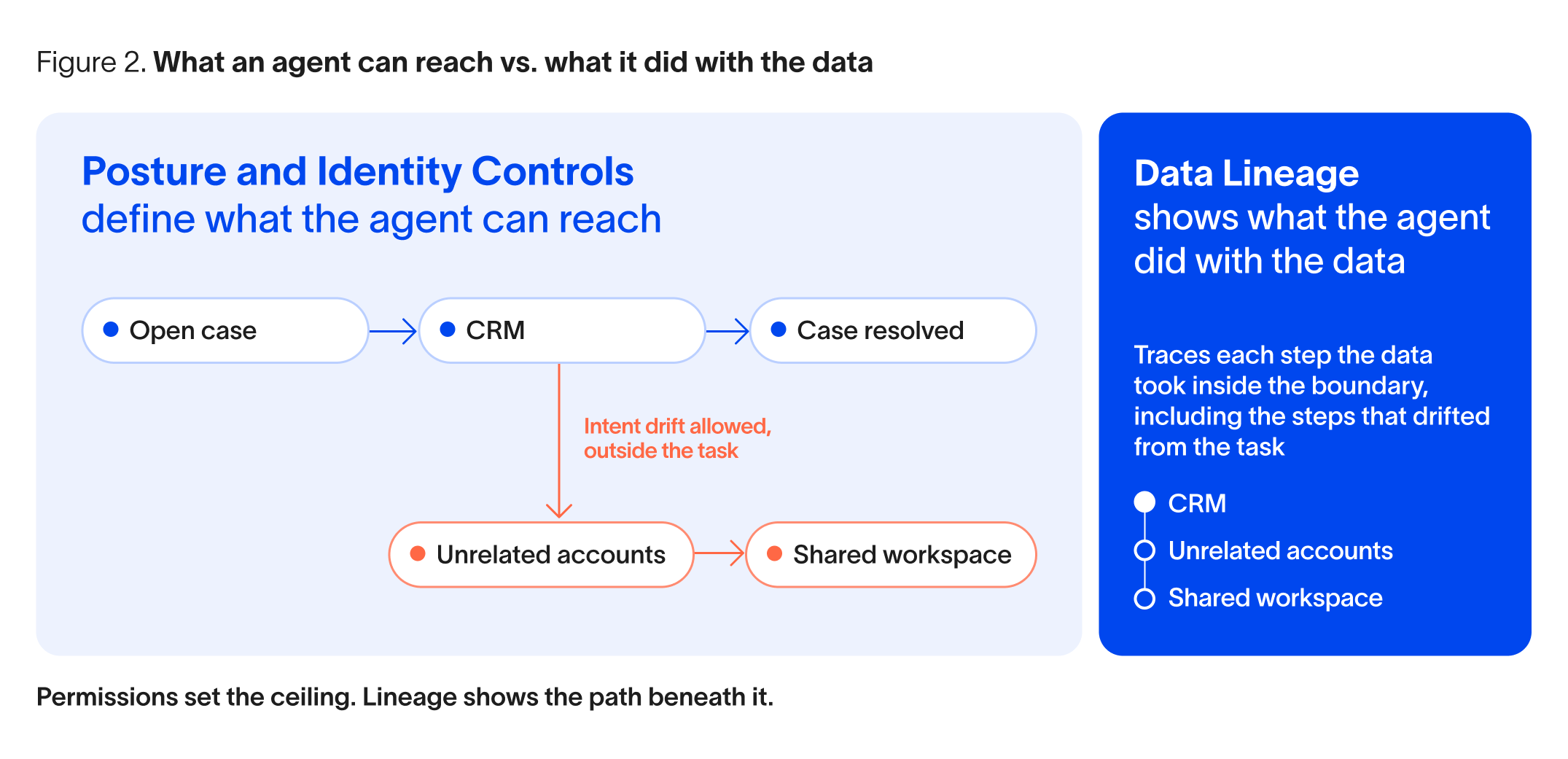
That history is Data Lineage, and it is how Cyberhaven traces the full lifecycle of data.
Data protection has always depended on more than permissions. But with the proliferation of agentic workflows that access, duplicate, and fragment data at machine speed, protection now depends on business context as well. The same export of customer records described above means one thing when it follows the case an agent was assigned and another when it follows a sweep of unrelated accounts. Lineage ties each individual action to the workflow it belongs to, so the decision can account for who is acting, what the data is, where it has been, and who receives it, in near real time.
In the support case, lineage shows that the exported data originated in a CRM query, moved through the agent’s session, and landed in an external workspace within minutes. An investigator who follows that path finds records from accounts unrelated to the open case. Measured against the agent’s task, the drift is obvious. A permission list can’t capture any of it, because every action was allowed.
Classification alone cannot carry this. Labels attach to a record at rest, and agents fragment and replicate data constantly: an extract here, a summary there, a pasted table in a draft. The tag stays behind while the content moves on. Lineage follows the content itself as it moves across endpoints, browsers, and connected SaaS and PaaS applications, including AI tools.
Lineage works at two scales:
- At the micro level, it traces records from a CRM query to an external destination across several hops, so investigators can explain what happened to a specific piece of data. Joint cybersecurity guidance, like from the NSA, CISA, FBI, and other allied agencies, on securing data used to train and operate AI systems points the same way by listing data provenance tracking among its best practices.
- At the macro level, it shows how a team’s work normally flows, which gives drift a baseline to stand out against. That context also feeds runtime guardrails, which weigh the sensitivity of the data, the application or agent acting, the destination, the requested action, and the data’s prior movement, the input where lineage matters most. Those decisions have to be fast enough to block inline without slowing the work they protect.
Doesn’t Least Privilege Cover This?
The strongest objection to agentic data security says tight permissions and runtime monitoring already handle the problem. Scope each agent to the minimum access its job requires, watch what it does, and alert on anomalies.
It goes without saying that least-privilege should be implemented if it hasn't already. This program offers a solid foundation and no agent should be deployed without scope. Least privilege shrinks the set of risky actions an agent can take, and behavior monitoring reports what it did and how often.
However, neither one says whether the data in a given action belongs there. An agent scoped correctly for a support role can still pull records from unrelated, sensitive accounts, because the role covers those accounts. Permissions decide whether the agent may touch the data. They can’t tell whether the task needs it.
Untrusted input widens the gap. An instruction hidden in a retrieved document or email can steer an agent toward actions its permissions already allow. When one agent can reach sensitive data, read content from outside the company, and send or change information, a single injected instruction can move data out through a fully authorized path.
Permissions can narrow what the agent reaches and where it can send data. Lineage follows the sensitive data from retrieval to destination, whatever triggered the movement, and supplies the evidence permissions lack.
Govern Agents by Following the Data
Security teams that accept this argument ask a different question about every AI workflow, generative and agentic. What happened to the data? A procurement approval says whether an agent may run, and an access review says what it can reach. Neither shows where the customer records went after the agent retrieved them, and that answer decides whether the workflow stayed within its business purpose, and whether it was ultimately secure.
This shift should change what security leaders prioritize. Permission review and data path visibility become two views of the same agent, and the second gives executives and boards something they can follow: evidence of what an agent did with sensitive data, available while the workflow is still running. Agent purpose gets defined in terms specific enough that a record of data movement can be checked against it. Because an agent’s tools, data, and business role keep changing, that check never finishes.
How Cyberhaven Traces the Path
Cyberhaven provides Data Security for the Agentic Enterprise. Cyberhaven traces the full lifecycle of your data, adapting protection to changing context. Cyberhaven applies lineage to agent activity, with AI app and agent discovery, runtime risk evaluation, and data-aware controls. Classification labels describe what data is, where it lives, and who can access it, so policies can reflect the context of each action. Linea AI, Cyberhaven’s AI engine, learns how data normally flows and flags anomalous dataflows even when no policy covers them. Endpoint sensors, browser extensions, and cloud connectors keep the picture current.
Cyberhaven operates in real time where humans and agents act on data, before risk becomes loss.
Learn more about securing AI across your organization with “Securing AI Systems: An Enterprise Framework."
Explore how Cyberhaven enables secure AI adoption with our datasheet.



Insights for the agentic enterprise
New guides, reports, and insights on data security, sent as they publish.