Secure AI Adoption Across the Enterprise
Know your AI tools and the agents in use. Get full visibility into what your organization is running, and reduce risk by understanding how each tool accesses, uses, and moves sensitive data.
Why AI Is Increasingly Difficult to Adopt and Secure
AI Adoption Is Outpacing Visibility
Employees already use AI tools and agents that connect to sensitive data, including source code, contracts, and customer information, often with no oversight.
AI Agents Rapidly Expand Data Risk
Security teams need visibility into what each agent can reach, which sensitive data it touches, what it does with that data, and where that data flows downstream.
Increasing Risk Is Slowing Down Enterprise AI Adoption
Blocking AI holds back the business, but allowing it without visibility leaves sensitive data exposed as agentic workflows spread across teams and systems.
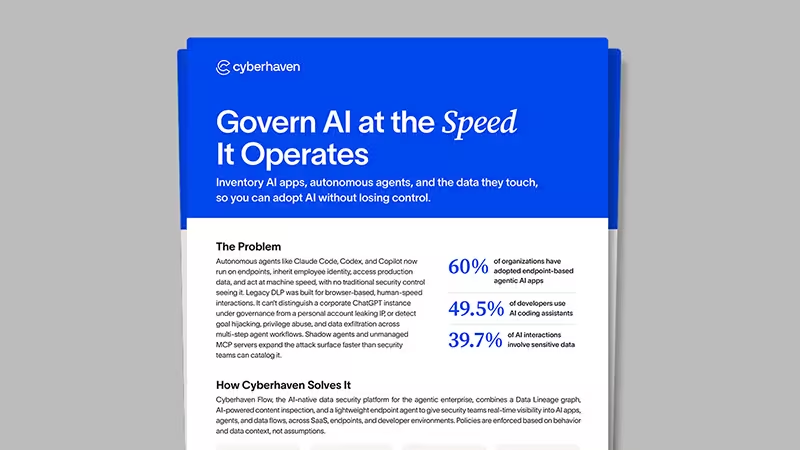
AI Adoption by the Numbers
of developers use AI coding assistant
of all data shared with AI is sensitive
year-over-year increase in data movement events into and out of GenAI SaaS
How to Secure AI with Cyberhaven
Cyberhaven traces the full lifecycle of your data across generative and agentic AI, so you can see where risk emerges, act in real time, and help your teams adopt AI with confidence.
Govern AI Adoption with Comprehensive Visibility
Know what AI tools and agents are in use and where risk is emerging.
Reduce Data Risk Across Agent Workflows
Understand how agents interact with sensitive data and act before risky patterns become data loss.
Accelerate AI Adoption
Reduce risk without making security the reason approved AI initiatives stall.
Key features
The Capabilities You Need to Safely Enable AI Adoption
Inventory AI apps and agents across your organization and enforce risk-based controls to adopt AI aggressively while keeping data safe
See Cyberhaven’s full capabilities→Shadow AI Discovery
Inventories AI agents running across endpoints, browsers, CLIs, and IDEs, including tools that cloud-only security solutions cannot see.
Agentic AI Observability
Reconstructs the full execution lifecycle of every agent interaction, capturing tool calls, data access, and multi-turn conversation context in a single view.
AI Risk IQ Scoring
Assigns risk scores across five dimensions to every AI application and agent in your environment.
Data Lineage for AI Interactions
Connects every agent action to the data it touched, providing context about where the data originated and where it went next, so alerts become actionable investigations.
“The provenance that Cyberhaven provides is critical to building your data program for AI, or for any cybersecurity measures.”
Data Security for the Agentic Enterprise
Cyberhaven Flow traces the full lifecycle of data and adapts protection to changing context
See How Cyberhaven Secures AI Use Across Your Enterprise
Know which generative and agentic AI tools your employees use, trace the sensitive data moving into them, and stop risky actions in real time so your teams can adopt AI with confidence.
Frequently Asked Questions
How can Cyberhaven help us inventory the AI tools and agents in use, including shadow agents, and understand what data they access?
Shadow AI Discovery builds a continuously updated registry of AI tools and agents in use, across endpoints, browsers, CLIs, IDEs, and MCP servers, including shadow agents and embedded copilots that cloud-only tools miss. Each entry gets an AI Risk IQ score and a Data Lineage trail showing exactly what data it touches.
How should an organization secure sensitive data when employees use AI tools?
The recommended approach is to apply risk-based controls at the moment employees interact with and share data with AI, instead of blocking tools outright. Broad, blanket blocking tends to push usage toward unsanctioned tools and personal accounts, where it’s harder to govern. Cyberhaven identifies sensitive data as it moves into AI tools, then warns or blocks based on policy and coaches employees by explaining why, so they learn the right behavior in the moment.
How can Cyberhaven help govern sensitive data moving through AI prompts, responses, and workflows?
Cyberhaven enforces controls at the point of AI interaction, detecting sensitive data as it enters a prompt or gets surfaced in a response, and applying block, warn, or redact actions in real time. DSPM and DLP share a single classification foundation, so posture findings about where sensitive data lives feed directly into the policies that act on it. That pairing extends across full agentic workflows, so multi-step actions stay covered as data moves between tools, beyond single prompt-and-response exchanges.
.avif)
.avif)

Learn How to Secure the Agentic Enterprise
Our insights on protecting data across human and agent workflows, plus product news, event updates, and opportunities.