- Shadow agents are AI agents deployed inside an organization without IT or security approval, operating with real permissions and zero governance oversight.
- Unlike passive shadow AI tools, shadow agents act autonomously: they query databases, call APIs, move files, and send data to external services without a human reviewing each step.
- Traditional security tools cannot see shadow agents because they run locally on endpoints, use employee credentials, and leave no footprint in SaaS discovery scans.
- Every shadow agent is a potential data exfiltration pathway: Cyberhaven Labs found that 39.7% of all AI interactions already involve sensitive data, and agents operate at machine speed across dozens of actions per workflow.
- Governing shadow agents requires a continuous agent inventory, least-privilege access controls, and data lineage capable of tracing what each agent accessed and transferred.
What Are Shadow Agents?
Shadow agents are unauthorized AI agents deployed inside an enterprise without the knowledge, approval, or oversight of IT and security teams. They operate autonomously across enterprise systems, querying databases, invoking APIs, transferring files, and triggering downstream services using the deploying employee's credentials or personal API keys. Because they are never registered, reviewed, or integrated into governance frameworks, security teams have no visibility into what they are doing or what data they are touching.
The term builds on shadow IT and shadow AI but describes a meaningfully different threat: Autonomous actors that execute multi-step workflows without a human prompt.
According to the Cisco State of AI Security 2026 report, 83% of organizations plan to deploy agentic AI, but only 24% have agent guardrails in place. The gap between deployment velocity and governance readiness is where shadow agents thrive.
How Shadow Agents Work
Shadow agents follow the same perception-reasoning-action loop as sanctioned AI agents. The security difference is the absence of any organizational knowledge that the agent exists.
A typical shadow agent deployment unfolds in four stages:
- Deployment: An employee builds or downloads an agent using an open-source framework, a personal API key, and their local workstation or a personal cloud account. No security review occurs. The agent is not registered in any asset inventory.
- Credential inheritance: The agent accesses enterprise systems using the employee's existing permissions: file shares, databases, email, internal SaaS platforms. From an access log perspective, the activity appears to originate from a legitimate user.
- Autonomous execution: The agent executes a workflow across multiple systems without per-step human direction. A single workflow might read a CRM export, summarize it using an external model, draft and send a follow-up email, and log the outcome in a project management tool.
- External data transfer: The agent sends data to a third-party model provider or external service, carrying whatever sensitive information it ingested. The transfer is typically encrypted, bypassing content-inspection controls.
Why Detection Is Difficult
Shadow agents are harder to detect than traditional shadow IT because they exploit three structural gaps:
| Gap | Why it matters |
|---|---|
| Endpoint-only execution | Agents running locally generate no SaaS login events, making cloud-based discovery tools blind to them. |
| Credential sharing | Agents inherit employee permissions, so access logs show legitimate user activity, not agent activity. |
| Dynamic behavior | Unlike fixed applications, agents adapt their behavior based on context, making behavioral baselining difficult. |
Types of Shadow Agents
Shadow agents vary by deployment method and intended function. The categories below help security teams prioritize which patterns to monitor first.
| Type | How it is deployed | Primary data security risk |
|---|---|---|
| Local coding assistants | Developer installs an open-source agent framework or desktop AI tool without IT approval | Source code and API keys flow to external model providers outside sanctioned channels |
| Custom workflow agents | Analyst builds a task-automation agent using a low-code platform, personal API key, or locally hosted open-weight model | Sensitive business data (CRM records, financial data, HR files) is processed outside SaaS-layer controls |
| MCP-connected agents | Developer connects an agent to internal data stores via Model Context Protocol without registering the connection | Agent gains persistent read/write access to enterprise data with no audit trail |
| Multi-agent pipelines | Multiple agents orchestrated to complete complex workflows with inter-agent data handoffs | Sensitive data passes between agents calling external tools; blast radius scales with chain length |
Why Shadow Agents Matter for Data Security
Shadow agents represent a category of risk that traditional data loss prevention (DLP) architectures were not built to address because the agents that matter most are invisible to the tools organizations rely on most.
Legacy DLP monitors browser interactions, email traffic, and file transfers triggered by human actions. It cannot reconstruct a multi-step agent workflow in which an agent reads 200 files, summarizes them using an external model, and exports structured data through an API call with no readable file attachment. The agent's output does not resemble the source material; content inspection finds nothing to flag.
The data exposure at stake is substantial. According to Cyberhaven Labs, 39.7% of all AI interactions involve sensitive data, and the average employee shares sensitive data with AI tools once every three days. Agents amplify this by operating continuously and at machine speed, processing entire folders or database exports where a human would paste a single document.
Compliance risk compounds the data security risk. Regulations including GDPR, HIPAA, and the EU AI Act impose transparency and accountability requirements on organizations processing personal and sensitive data. A shadow agent that transfers personal data to an unapproved third-party provider can trigger a reportable breach without the organization ever knowing the transfer occurred. Audit teams cannot produce records for data flows that no governance system ever captured.
Common Challenges in Detecting and Governing Shadow Agents
Security teams running established AI governance programs still encounter shadow agents for several non-obvious reasons.
- SaaS discovery misses endpoint agents. Most AI discovery tooling relies on SaaS login telemetry and OAuth grant monitoring. Agents running locally on a developer's workstation generate none of these signals. An agent built with an open-source framework and a personal API key is structurally invisible to cloud-layer discovery.
- Legitimate and unauthorized agent activity looks identical. Both use real credentials, call APIs, and access file systems. Distinguishing a sanctioned agent from a shadow agent requires a baseline of known-approved agents. Without one, anomaly detection has no reference point.
- Agent-generated data derivatives evade content inspection. Shadow agents rarely exfiltrate raw files. They produce summaries, transformed outputs, or structured extracts that share no token-level overlap with the source. Content-inspection DLP, which matches patterns against known sensitive data formats, cannot flag these derivatives.
- Many organizations treat shadow agents as a future problem. Cisco's 2026 State of AI Security data shows only 31% of organizations deploying agentic AI feel equipped to secure it. Shadow agents are already running before most governance programs are designed.
How to Build an AI Agent Governance Program
Governing shadow agents effectively requires three sequential capabilities: knowing what is running, understanding what it is doing with sensitive data, and enforcing controls before damage occurs.
1. Establish a Continuous Agent Inventory
Agent governance starts with discovery. Automated inventory must cover both SaaS-registered agents and endpoint-resident agents. SaaS discovery scans OAuth grants and API registrations. Endpoint discovery monitors for processes calling model provider APIs or establishing outbound connections to AI infrastructure. The inventory must update continuously, not on a quarterly audit cycle.
2. Classify Agents by Risk Tier
Not all unregistered agents carry equal risk. Triage each discovered agent against: the data stores it can access, the external services it calls, and whether its behavior has been reviewed. Agents with access to regulated data warrant immediate action; agents with read-only access to public documentation can follow a standard review cycle.
3. Apply Least-Privilege Access at the Agent Level
Each sanctioned agent should operate under a dedicated service identity with the minimum permissions its task requires, not inherited broad employee credentials. This limits the blast radius if an agent is compromised and creates a distinct audit trail separating agent activity from human activity.
4. Enforce Data Lineage Across Agent Workflows
Data lineage tracks information from its origin through every transformation, API call, and handoff an agent performs. Where content-inspection DLP sees a summary that looks nothing like the source, data lineage traces the chain from source document through agent processing to outbound destination, providing the visibility needed to investigate incidents and detect out-of-scope access.
5. Build Human-in-the-Loop Checkpoints for High-Risk Actions
Not all agent actions should be fully autonomous. Identify categories that require a human confirmation step before execution: transferring regulated data externally, deleting records, or sending communications on behalf of the organization. These checkpoints ensure that the highest-risk actions remain human-accountable without eliminating the productivity benefit of agents.
6. Create a Self-Service Registration Path
Shadow agents often exist because employees had no clear path to get an agent approved. A lightweight intake process covering the agent's purpose, data access requirements, and external integrations makes it easier to register than to deploy without oversight. When registration is fast, fewer employees bypass the process.
Explore Governing the Autonomous Enterprise: A Security Framework for Agentic AI for the three-pillar visibility, observability, and controls framework for endpoint-based agents.
How Cyberhaven Addresses Shadow Agents
Cyberhaven's AI Security capability addresses shadow agents at the point where they are most dangerous: the endpoint, where locally installed agents operate outside the reach of SaaS-based discovery.
Cyberhaven's AI Security provides continuous inventory of AI agents across endpoints, SaaS environments, and developer toolchains, including locally installed agents that leave no OAuth grant or SaaS login event. Proprietary AI Risk IQ scoring evaluates each discovered agent across data sensitivity, model integrity, and compliance adherence, updating automatically.
Where traditional DLP sees individual file events, Cyberhaven's Data Lineage reconstructs the full execution lifecycle of an agent workflow: which files the agent read, which APIs it called, and where data landed. If a shadow agent reads a folder of contracts and exports a structured summary to an external tool, Data Lineage surfaces the connection between source and destination even though the export bears no textual resemblance to the originals.
Context-aware guardrails enforce policy at the prompt and response level, blocking or warning when an agent attempts to transfer sensitive data to an unapproved destination.
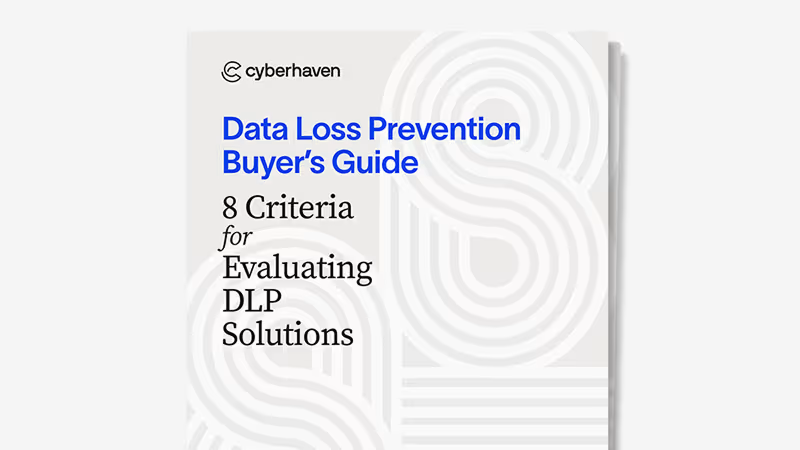
AI Security Buyer's Guide covers six criteria for evaluating AI security programs built for shadow agents, endpoint-based agents, and the agentic era.
Frequently Asked Questions
What Is a Shadow Agent?
A shadow agent is an AI agent deployed inside an organization without approval from IT or security. Shadow agents operate autonomously across enterprise systems, using the deploying employee's credentials or personal API keys to access data, call APIs, and transfer information to external services. Because they are never registered or reviewed, security teams have no visibility into what they are doing or what data they are handling.
How Are Shadow Agents Different from Shadow AI?
Shadow AI typically refers to unauthorized use of AI tools, where an employee pastes data into a public AI assistant or uses an unapproved AI application. Shadow agents go further: they are autonomous systems that act without per-step human involvement, executing multi-step workflows across multiple enterprise systems continuously. The risk is greater because agents can process far more data, operate at machine speed, and leave a much larger and harder-to-trace footprint than a human using a chat tool.
Why Are Shadow Agents Hard to Detect?
Shadow agents are hard to detect because they run on endpoints where SaaS discovery tools have no visibility, use legitimate employee credentials so access logs look normal, and behave dynamically so behavioral baselines are difficult to establish. Additionally, agent-generated outputs such as summaries and reformatted exports share no textual overlap with source documents, so content-inspection DLP cannot identify them as derived from sensitive data.
What Data Security Risks Do Shadow Agents Create?
Shadow agents transfer sensitive data to unapproved model providers, process regulated personal data outside sanctioned governance controls, inherit excessive permissions from the employees who deploy them, and produce no audit trail. Each risk can individually trigger a compliance violation; together, they create a persistent exposure that continues until the agent is discovered and removed.
How Can Organizations Find Shadow Agents Already Running?
Key detection signals include unusual API call volume to known model providers, OAuth grants established by individual employees rather than IT, file system access patterns inconsistent with a user's role, and outbound data transfers at off-hours. Continuous agent inventory tools that monitor endpoint processes against a known-agent baseline provide the most reliable ongoing detection.
What Is the Relationship Between Shadow Agents and AI Agent Governance?
Shadow agents are the enforcement gap that AI agent governance programs are designed to close. AI agent governance establishes policies, registration processes, risk classifications, and controls that define which agents are authorized and under what conditions. Shadow agents are those that operate outside this framework. A mature governance program reduces them by making the approved path faster and clearer than the unauthorized alternative.
.avif)
.avif)