Teams evaluating whether to replace or extend an existing DLP stack often run into the same question: Is this actually a different category of tool, or just DLP with an AI feature bolted on? The two security categories overlap enough to cause real confusion in a buying cycle, and many may think that once will, by extension cover the other.
However, Legacy DLP was designed around a fixed set of channels and file-based policies, while enterprise AI security was designed around how data moves through generative and agentic AI tools specifically. This is now a different monitoring problem, and getting that distinction right matters before a security team commits budget to either upgrading a DLP contract or evaluating a new category of tool.
What Is Enterprise AI Security?
Enterprise AI security is the practice of protecting sensitive data across every generative and agentic AI tool an organization uses, based on how that data moves and who or what touches it, rather than which application it happens to pass through.
AI security replaces static, content-based inspection with continuous tracking of data from the moment it is created through every AI interaction that follows. For a DLP program built around fixed policies and known file types, adopting this model means rethinking detection logic and coverage from the ground up.
AI: Where Legacy DLP's Coverage Ends
Legacy DLP policies are built around content inspection such as regex patterns, keyword matching, and file fingerprinting applied to a fixed set of channels such as email, USB drives, and cloud storage uploads. That approach works for a file leaving through a known exit. It has less to work with once the sensitive material is a sentence typed into a prompt box or a summary pasted into a chat message, since neither of those carries the filename or classification tag a legacy policy is built to match against.
That gap between file-based policy and prompt- or chat-based movement is why coverage that stops at the file no longer maps to where data moves, and is where blind spots become security risk points.
What Changes When AI Agents Act Without a Person in the Loop
Agentic AI adds a second gap on top of the first: autonomous agents that take actions on a user's behalf, often chaining several systems together to finish a task with no person reviewing any individual step. An agent summarizing a support ticket might pull customer PII from a CRM, paste it into a shared document, and hand that document to a connected tool, all within a single automated workflow.
Detection logic built to flag a person's copy-paste or upload behavior has no equivalent for agent-to-agent movement like the above, because there is no distinct human action to flag. That means sensitive data could leave the environment, or risky actions could occur without the security team or tooling ever noticing it happened.
Signs Your DLP Program Is Falling Behind AI Adoption
A few patterns tend to appear before a legacy DLP program falls noticeably behind:
- Security and IT cannot produce a current list of every generative and agentic AI tool touching company data.
- Data loss alerts still cluster around older channels like email and USB, while AI-related exposure goes largely unmeasured.
- Every new AI tool approved for use requires weeks of manual policy tuning before coverage catches up.
- Investigating a potential exposure takes days because analysts have to reconstruct data movement by hand across disconnected logs.
Any single pattern here is manageable on its own. Seeing several at once usually means the DLP program was designed around a threat model the business has already outgrown.
What to Evaluate When Comparing Legacy DLP to AI-Native Data Security
Teams deciding whether to replace or augment an existing DLP stack should look past feature checklists and instead focus on how each option handles AI-specific movement. Coverage matters most, and security teams must ask, does the tool monitor generative AI prompts and agentic workflows, or only file-based channels?
To explain the value of coverage, imagine a tool that flags every instance of a keyword like "confidential," generating alert volume analysts eventually learn to ignore. However, a tool that tracks where data originated and how it has moved since can distinguish routine use from genuine risk, providing actionable insights to security teams, allowing them to both stop risk and improve posture simultaneously.
Ten years ago, that distinction between content and context mattered less because data simply moved through fewer places, and was touched by fewer hands along the way. Today, evaluating data lineage capability, agent-level visibility, and how quickly policies adapt to newly approved AI tools should sit at the center of any DLP replacement decision.
How Cyberhaven's DLP Enables Enterprise AI Security
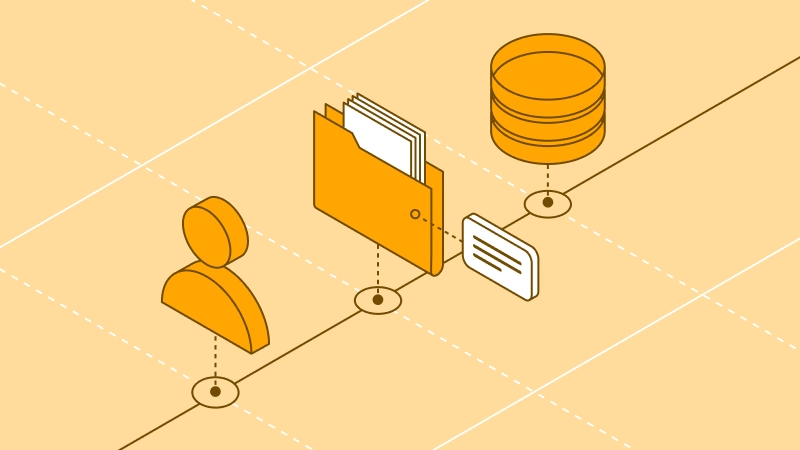
Cyberhaven builds data security for the agentic enterprise: tracing the full lifecycle of sensitive data and adapting protection to context as that data moves, instead of inspecting content at a single fixed checkpoint. Data Lineage records where data originates and every system, application, and agent it touches afterward, across both generative and agentic AI use.
That continuous record lets DLP policies act on how data is actually being used rather than what a file happens to look like at a checkpoint. For programs that need one policy set to cover both agent activity and generative AI prompts, this is the model built specifically for it, rather than file-based detection extended to try to reach it.
Enterprise AI security comes down to whether a security program can see how data moves once generative and agentic AI tools are part of daily work. Programs that pair DLP with data lineage catch that movement early. Programs that rely on content inspection alone tend to find out about it after the fact.
Understand how AI-native, modern DLP can secure your AI-centric enterprise with “Securing AI Systems: An Enterprise Framework”
Frequently Asked Questions
What is the difference between enterprise AI security and legacy DLP?
Legacy DLP inspects file content at a fixed set of channels like email, USB, and cloud storage. Enterprise AI security tracks how data moves and gets used across generative and agentic AI tools specifically, using data lineage rather than file signatures. The two cover different data movement patterns, and most programs need both rather than swapping one for the other.
Does enterprise AI security replace DLP, or work alongside it?
DLP is one capability inside a broader enterprise AI security approach. Most organizations keep their existing DLP investment in place while extending policy coverage and visibility to generative and agentic AI activity that legacy tools cannot see.
Is legacy DLP still useful once an organization adopts AI tools widely?
Legacy DLP still catches known file-based exfiltration through email, USB, and cloud storage. Its coverage gap is specific to AI-driven data movement, so it works best paired with a lineage-based approach rather than left to cover AI risk on its own.
What is the difference between DSPM and enterprise AI security?
DSPM focuses on discovering and classifying sensitive data across cloud environments at rest. Enterprise AI security extends that visibility to how data moves and gets used across generative and agentic AI tools, which DSPM alone does not track.
How does data lineage help detect AI-related data exposure?
Data lineage records where a piece of data originated and every system or agent it has passed through since. That history lets a security team distinguish an agent's routine use of a data set from a movement pattern that signals genuine exposure.
Can a legacy DLP stack be upgraded to handle AI risk, or does it need to be replaced?
Some legacy DLP platforms can add AI-specific detection modules, though these typically still rely on content inspection rather than lineage. Whether an upgrade or a replacement makes sense depends on how much of the existing policy investment can carry over to a context-aware model.

.avif)
.avif)

Insights for the agentic enterprise
New guides, reports, and insights on data security, sent as they publish.