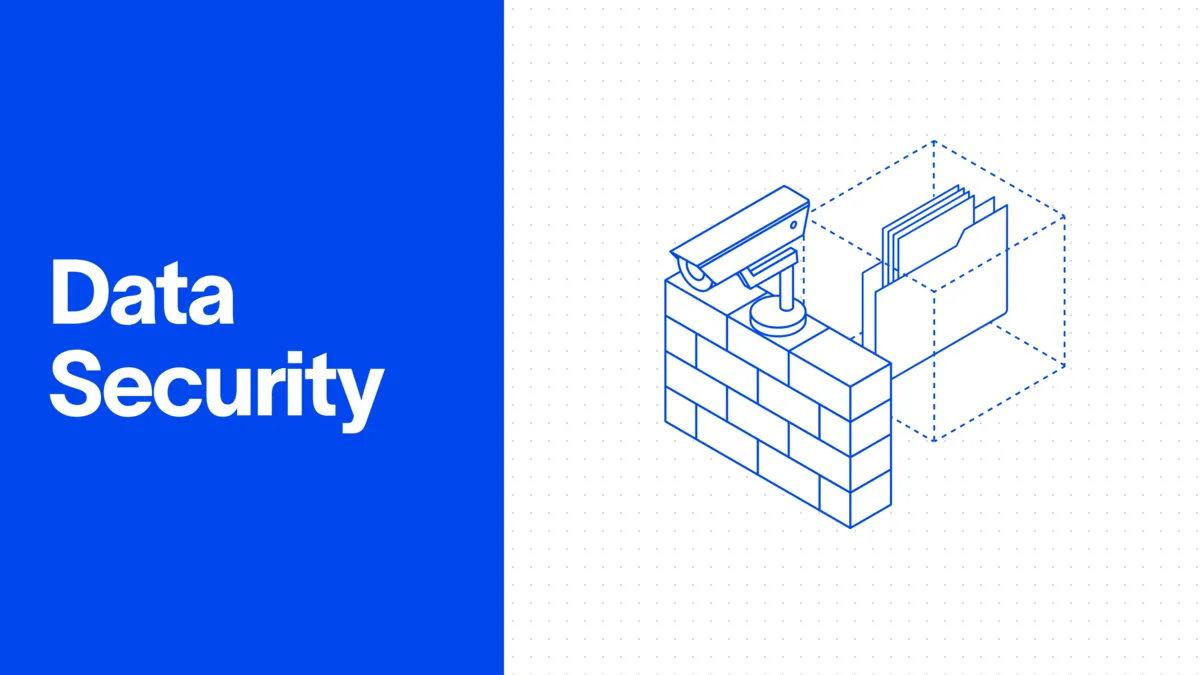
- Data security protects sensitive information across its full lifecycle, from creation and storage through use and deletion.
- Weak data security exposes organizations to breaches, regulatory penalties, and lost customer trust, with breach costs now averaging nearly $5 million globally.
- Effective data security combines technical controls, such as encryption, access management, and data loss prevention, with organizational policy and employee training.
- Data security and data privacy address related but distinct problems: security protects data from unauthorized access, while privacy governs how data is collected, shared, and used.
- Cyberhaven traces the full lifecycle of data in real time, adapting protection to context rather than relying on content inspection alone.
What Is Data Security?
Data security is the practice of protecting digital information from unauthorized access, corruption, loss, and theft throughout its lifecycle. It combines technical controls, such as encryption and access management, with policies that govern how data is collected, stored, used, and disposed of. Organizations apply data security to protect regulated information, intellectual property, and customer data from external attackers and insider misuse.
The discipline covers everything from encrypting a file at rest to controlling who can view a single database record, and it sits alongside the broader practice of data protection, which also addresses backup, resiliency, and data lifecycle management. As organizations shift workloads to the cloud and adopt generative AI tools, data now moves across more applications, devices, and third-party services than ever before, which expands the potential points of exposure. Data security has evolved accordingly. Modern approaches increasingly track data based on its content and behavior, following a file as it moves, copies, or transforms, rather than relying on a fixed network perimeter. This matters because sensitive information rarely stays in one place: a single customer record can travel from a CRM to a spreadsheet to an AI chatbot within minutes, and each hop introduces new risk if it goes unmonitored.
How Data Security Works
Data security works by layering technical and administrative controls that identify, protect, and monitor sensitive information across its lifecycle. The process typically follows five steps:
- Discovery and classification: Automated tools locate data across cloud storage, endpoints, and SaaS applications. This step depends on accurate data classification, which tags files and records by sensitivity so later controls can apply proportionate protection instead of treating all data the same way.
- Access control and authentication: Organizations apply permissions based on the principle of least privilege, often paired with multi-factor authentication (MFA) and role-based access control (RBAC), so only authorized users and systems can reach sensitive data.
- Encryption: Data is encrypted both at rest and in transit, converting readable information into ciphertext that is unreadable without the correct decryption key.
- Monitoring and detection: Security teams track how data moves and who touches it, watching for anomalies such as large downloads, unusual transfers, or access from unfamiliar locations or applications.
- Response and remediation: When a policy violation or anomaly is detected, controls can block the action, quarantine the file, or alert a security analyst for investigation.
Traditional approaches apply these steps based mostly on where data sits, such as a specific folder or network segment. Newer approaches apply them based on what the data is and how it has been used, which allows protection to travel with the data itself as it moves across applications and devices.
Types of Data Security
Organizations typically combine several types of data security to cover the full range of risks. The main categories include:
| Type | What it does | Typical use case |
|---|---|---|
| Encryption | Converts data into unreadable ciphertext that only authorized keys can decrypt | Protecting data at rest in databases and data in transit over networks |
| Access control | Restricts who can view, edit, or share data based on role or need | Enforcing least privilege across employees, contractors, and applications |
| Data loss prevention (DLP) | Monitors and blocks unauthorized movement of sensitive data | Preventing exfiltration through email, USB drives, or cloud uploads |
| Data security posture management (DSPM) | Continuously discovers and assesses risk across cloud data stores | Finding shadow data, misconfigurations, and overexposed cloud repositories |
| Data masking | Replaces sensitive values with realistic but fictitious data | Letting developers test against production-like data without exposing PII |
| Backup and resiliency | Maintains redundant, recoverable copies of data | Restoring operations after ransomware or hardware failure |
Data loss prevention (DLP) and data security posture management (DSPM) are often discussed together because they address complementary problems: DSPM finds where sensitive data lives and how exposed it is, and DLP enforces policy on how that data can move once it is found.
Data Security vs. Data Privacy
Data security and data privacy are closely related but answer different questions. Data security asks how data is protected from unauthorized access, using tools like encryption, access control, and DLP. Data privacy, by contrast, governs how organizations collect, use, and share personal information, often in response to regulations like the General Data Protection Regulation (GDPR) and the California Consumer Privacy Act (CCPA).
| Data security | Data privacy | |
|---|---|---|
| Definition | Protecting data from unauthorized access, corruption, or theft | Governing how data is collected, used, and shared |
| Primary function | Technical and administrative controls | Policy, consent, and regulatory compliance |
| Scope | All sensitive data, regardless of type | Primarily personal and regulated information |
| Typical tools or frameworks | Encryption, access control, DLP, DSPM | GDPR, CCPA, consent management, data subject rights processes |
| Key limitation | Strong security does not guarantee privacy compliance | Strong privacy policy does not guarantee the data is technically secure |
In short: data security protects the data, and data privacy governs how it is used. Organizations need both, since a system can be technically secure but still violate privacy obligations, or have sound privacy policies undermined by weak technical controls.
Why Data Security Matters for Business
When data security controls fail, the consequences show up quickly on the balance sheet. The global average cost of a data breach reached $4.99 million in 2026, according to IBM's Cost of a Data Breach Report. Identity-based attacks now account for 30% of intrusions, and 25% of attacks exploit public-facing applications, per IBM's X-Force Threat Intelligence Index. On the insider side, Fortinet's 2025 Data Security Report found that 77% of organizations experienced an insider-driven data loss incident in the prior year.
Beyond direct financial loss, weak data security carries reputational and regulatory consequences. Customers who lose trust after a breach often take their business elsewhere, and regulators increasingly treat inadequate data security as a compliance failure in its own right.
Data Security Standards and Regulations
Most industries are subject to at least one framework that mandates specific data security controls. Common examples include GDPR and CCPA for personal data, the Health Insurance Portability and Accountability Act (HIPAA) for health records, the Payment Card Industry Data Security Standard (PCI DSS) for payment data, the Sarbanes-Oxley (SOX) Act for financial reporting controls, and the National Institute of Standards and Technology (NIST) Cybersecurity Framework as a widely adopted voluntary baseline. Noncompliance can carry direct fines in addition to the cost of the underlying incident.
Common Data Security Challenges
- Expanding attack surface: Cloud adoption, SaaS sprawl, and generative AI tools mean sensitive data now passes through more applications and endpoints than security teams can track manually.
- Shadow AI and shadow IT: Employees frequently paste sensitive data into unapproved AI tools or use unsanctioned applications, creating gaps that sit outside existing security controls entirely.
- Legacy tools lack context: Many organizations assume content-inspection-based tools catch sensitive data reliably, but in practice these tools generate high false-positive rates because they cannot distinguish a legitimate business use from a risky one.
- Insider risk: Not every incident involves an external attacker. Employees and contractors with legitimate access can expose data accidentally or intentionally, and these cases are often harder to detect than external intrusions.
- Fragmented visibility: Security, IT, and compliance teams frequently work from different views of where sensitive data lives, which slows down both prevention and incident response.
Data Security Best Practices
Organizations can reduce data security risk by following a consistent set of practices:
- Discover and classify data first
You cannot protect what you cannot see. Start by identifying where sensitive data lives and tagging it by sensitivity level. - Apply least-privilege access control
Grant users and systems only the access they need to do their jobs, and review permissions regularly to catch privilege creep. - Encrypt data at rest and in transit
Encryption limits the damage of a breach even if an attacker gains access to storage or network traffic. - Monitor data movement continuously
Track how data moves across applications and endpoints so unusual activity can be flagged before it becomes a loss event. - Build an incident response plan
Test backup and recovery procedures before an incident occurs, not during one. - Train employees regularly
Human error remains one of the leading causes of data exposure, and ongoing training on secure data handling reduces avoidable mistakes.
Data Security Tools and Software
Most data security programs combine several categories of tooling rather than relying on a single product: encryption and key management platforms, DLP software for monitoring and blocking data movement, DSPM software for cloud data discovery and posture, identity and access management (IAM) tools for authentication and authorization, and backup or disaster recovery software for resiliency. The right combination depends on where an organization's sensitive data lives and how it moves, which is why data discovery and classification typically come first.
How Cyberhaven Addresses Data Security
Cyberhaven is the leader in Data Security for the Agentic Enterprise. Rather than inspecting content in isolation, Cyberhaven traces the full lifecycle of data, from the moment it is created through every copy, transformation, and share, and adapts protection as the context around that data changes. This connects lineage, identity, and behavior so security teams understand not just what a piece of data looks like, but where it came from and how it is actually being used.
Data lineage is the mechanism behind this approach. Cyberhaven follows sensitive data as it moves across applications, endpoints, and AI tools, distinguishing a routine business workflow from a genuine risk in real time. This reduces the false positives common with content-inspection-only DLP, since policy decisions are based on data behavior and context rather than pattern matching alone. Cyberhaven's data loss prevention and data security posture management capabilities build on this same lineage foundation, giving security teams a single, consistent view of risk across endpoints and cloud data stores rather than separate, disconnected tools.
Frequently Asked Questions
What Is Data Security?
Data security is the practice of protecting digital information from unauthorized access, corruption, loss, and theft throughout its lifecycle. It combines technical controls such as encryption and access management with policies governing how data is collected, stored, used, and disposed of, and it applies to any organization handling sensitive, regulated, or proprietary information.
Why Is Data Security Important?
Data security is important because weak controls lead directly to financial loss, regulatory penalties, and reputational damage. The global average cost of a data breach reached $4.99 million in 2026, and identity-based attacks now account for 30% of all intrusions, according to IBM. Strong data security also underpins compliance with regulations like GDPR, HIPAA, and PCI DSS.
What Is the Difference Between Data Security and Data Privacy?
Data security protects data from unauthorized access using tools like encryption and access control. Data privacy governs how organizations collect, use, and share personal data, typically in response to regulations such as GDPR and CCPA. The two work together: strong security does not guarantee privacy compliance, and strong privacy policy does not guarantee technical protection.
What Are the Main Types of Data Security?
The main types of data security include encryption, access control, data loss prevention (DLP), data security posture management (DSPM), data masking, and backup or resiliency measures. Organizations typically combine several of these types, since each addresses a different point in the data lifecycle.
What Is the Difference Between Data Security and Cybersecurity?
Cybersecurity is the broader discipline of protecting networks, systems, and devices from attack, while data security is a specific subset focused on protecting the data itself, regardless of where it resides. A strong cybersecurity program includes data security as one of its core components alongside network, endpoint, and application security.
What Are Data Security Best Practices for Businesses?
Data security best practices include discovering and classifying sensitive data first, applying least-privilege access control, encrypting data at rest and in transit, monitoring data movement continuously, maintaining a tested incident response plan, and training employees regularly on secure data handling. Organizations that skip discovery and classification often struggle to apply the remaining controls effectively.

.avif)
.avif)