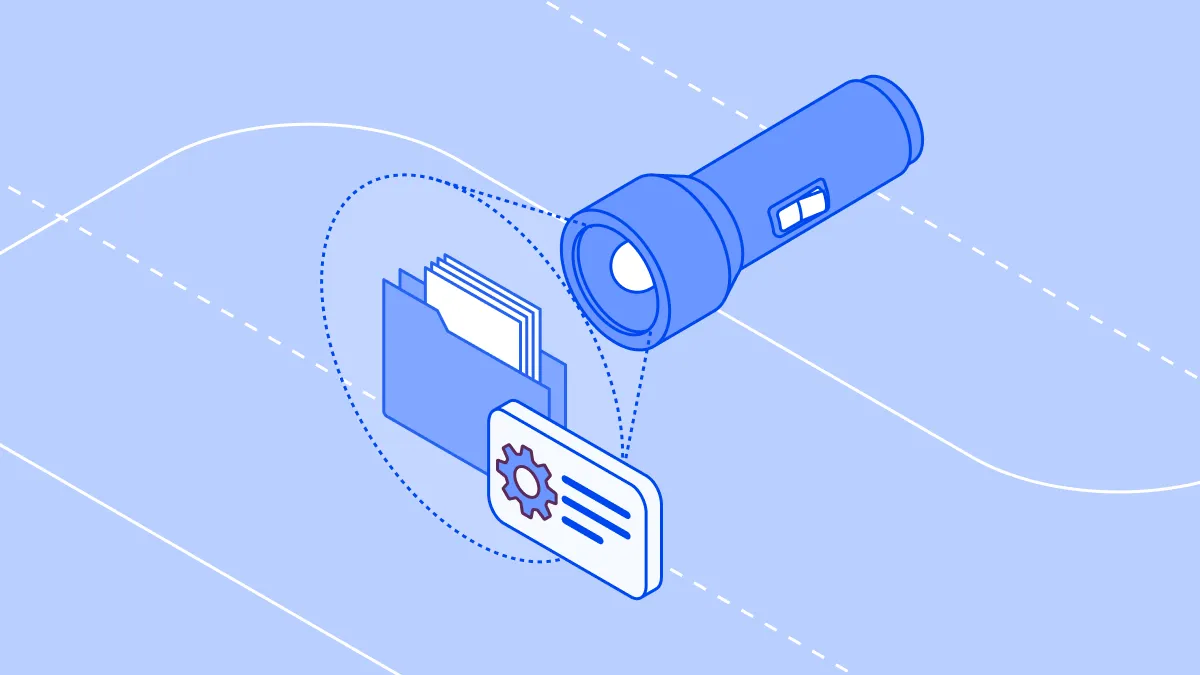
Most DLP rollouts stall in the same place. The classifier flags a file as "confidential," but nobody, including the DLP solution itself, can say why, where it came from, or whether that label still matches what's inside the file six months later.
Data discovery and data classification get bundled together in nearly every vendor pitch, but they solve different problems, and the gap between them is where false positives, stale labels, and missed exfiltration events live. Understanding where discovery ends and classification begins, and where both fall short on their own, changes how you scope a rollout and where you should be spending review time to prevent data loss and exfiltration.
What Is the Difference Between Data Discovery and Data Classification?
Data discovery is the process of locating and inventorying sensitive data across an environment; data classification is the process of labeling that data by sensitivity and applying rules to it.
Discovery answers"where does this data live and what is it," scanning SaaS apps, cloud storage, databases, and endpoints to build an inventory. Classification takes that inventory and assigns a category, such as public, internal, or restricted, so policies can be enforced consistently.
One without the other leaves either a map with no legend or a legend with no map.
How Data Discovery Works Across SaaS, Cloud, and Endpoints
Discovery tools scan structured sources like databases and unstructured sources like Slack messages, shared drives, and email attachments. Two architectural choices determine what a scan catches.
The first is agent-based versus agentless deployment. Agentless scanning connects via API and pulls samples back to the vendor's environment for analysis. This kind of scanning is fast to deploy but often means sensitive data leaves your infrastructure, which matters under GDPR, HIPAA, or any data residency requirement. Agent-based or in-environment scanning keeps analysis local and sends back only metadata, at the cost of more deployment overhead.
The second is the detection method. Pattern matching (regex, dictionaries) is fast but brittle. It catches a nine-digit number that looks like a Social Security number and misses a customer list embedded in a product spec that has no obvious pattern at all. Machine learning-based classifiers add context, but they still operate on a point-in-time snapshot.
Neither approach tells you how a file got to where it is or who touched it along the way, which is the piece that matters most once an investigation starts.
How Data Classification Turns Discovered Data into Enforceable Labels
Classification assigns each discovered asset a sensitivity tier, commonly public, internal, confidential, and restricted, then maps each tier to a policy, including who can access it, whether it can be shared externally, whether it needs encryption at rest. This is what turns a spreadsheet full of file paths into something a DLP engine or access control system can act on to prevent exfiltration.
In practice, classification runs on one of three models:
- Manual tagging by data owners
- Automated tagging from the discovery scan
- A hybrid method where automated tags are reviewed before they become enforceable.
Manual tagging is the most accurate at the moment it happens and the first thing to fall out of date. Fully automated tagging scales but inherits every false positive from the underlying classifier, which is how security teams end up with thousands of files marked "restricted" that nobody will ever review.
Where Static Classification Breaks Down in Practice
This is where most DLP and DSPM programs quietly stop working, even though the dashboard still shows green.
- Labels go stale: A file classified as "internal" at creation becomes "confidential" the moment a customer's Social Security number gets pasted into it three months later. Point-in-time scans do not catch that transition unless they rerun constantly, and most environments cannot afford to rerun full scans on that cadence.
- Context gets lost at the point of copy: A classified file gets copied into a new document, split across three spreadsheets, or pasted into a Slack thread. The label does not travel with the content unless the tool tracks the data itself rather than the file container.
- False positives create alert fatigue: Regex-heavy classifiers flag test data, internal IDs, and formatted strings that only resemble sensitive data. Analysts start tuning out alerts from a source that cries wolf, which is exactly when a real exfiltration event gets missed.
- Ownership and provenance is unclear: Discovery can tell you a file contains PII. It cannot tell you who is supposed to have access to it now, which makes remediation a manual investigation every time.
Why Data Lineage Closes the Gap Discovery and Classification Leave Open
Discovery and classification both describe a snapshot of what data exists and how sensitive it is right now. Neither one, by design, tracks what happened to that data before or after the scan. Data Lineage is the record of where sensitive data originated, every system and file it has moved through, and every user who has touched it along the way.
That history changes what an analyst can do with an alert. Instead of asking "is this file sensitive?" the analyst has the right information, such as "this file inherited its sensitivity from a customer database three hops upstream, and it just got shared externally by a user who does not normally touch that database." That is a materially different, and more actionable, alert than a static classification tag can produce on its own.
How Cyberhaven Addresses Data Discovery and Classification Gaps
Cyberhaven pairs continuous discovery with Data Lineage tracking rather than relying on point-in-time classification alone. As data moves across SaaS apps, endpoints, cloud storage, and agentic workflows, Cyberhaven tracks its origin and every transformation it goes through, so a label follows the content even after it is copied, renamed, or split across new files. DLP policies then act on that lineage: a policy can trigger not because a file matches a pattern, but because sensitive data that originated in a restricted system is about to leave through an unapproved channel. This reduces the false positive load that comes from pattern-only classification and gives analysts the "how did it get here" context that a static label cannot provide on its own.
Understand why, when it comes to comprehensive data discovery and classification, you need DLP, DSPM, and AI security.
Frequently Asked Questions
Is Data Classification Part of Data Discovery, or a Separate Step?
They are separate but sequential. Discovery locates and inventories data across an environment. Classification takes that inventory and assigns sensitivity labels and policies. A program needs both; discovery without classification produces a map with no legend, and classification without discovery has nothing to label.
Can Data Classification Be Fully Automated?
Yes, but full automation inherits the accuracy limits of the underlying classifier. Pattern-based classifiers automate well but generate false positives; context-aware or lineage-based approaches automate more accurately but require more setup. Most mature programs use automated tagging with periodic human review rather than one extreme or the other.
Why Does a File's Classification Become Outdated?
Classification reflects a point-in-time scan. If new sensitive data gets added to a file, or the file gets copied and combined with other content, the original label no longer describes what is actually inside it. Static classification tools miss this unless they rescan constantly, which most environments cannot sustain at scale.
What Is the Difference Between DSPM and Data Classification?
Data Security Posture Management (DSPM) is a broader practice that includes discovery and classification as components, alongside access analysis and risk scoring. Classification is one input DSPM uses to prioritize which exposed data represents the highest risk.
Does Data Lineage Replace the Need for Classification?
No. Classification still determines sensitivity tiers and policy mapping. Lineage adds the history behind that classification, tracking where the data came from and how it moved, which makes alerts more accurate and investigations faster.

.avif)
.avif)

Insights for the agentic enterprise
New guides, reports, and insights on data security, sent as they publish.