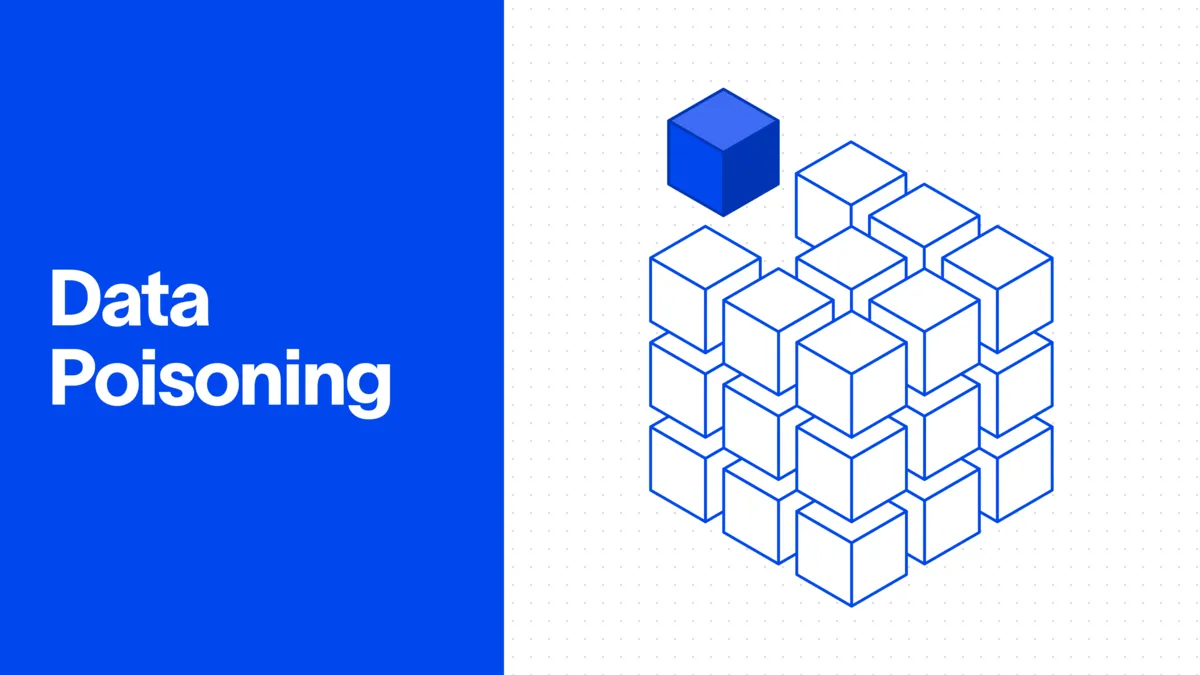
- Data poisoning corrupts the training data behind an AI or ML model, not the model's code or infrastructure.
- Attacks fall into two categories: targeted, which manipulate a specific output, and non-targeted, which degrade overall accuracy.
- Generative AI and LLM systems are especially exposed because they train on large volumes of scraped, third-party, and user-submitted data.
- Poisoned datasets are difficult to clean up after the fact, which makes prevention and provenance tracking more effective than after-the-fact detection.
- Cyberhaven's Data Lineage traces the origin and movement of training data, surfacing unauthorized or unverified sources before they reach a model.
What Is Data Poisoning?
Data poisoning is a type of cyber attack in which an adversary intentionally corrupts the training data used to build or fine-tune an AI or machine learning (ML) model. Attackers inject false data, alter existing records, or delete portions of a dataset before training completes, with the goal of manipulating outputs, introducing hidden vulnerabilities, or degrading accuracy once the model is deployed.
Data poisoning falls under a broader category of attacks known as adversarial AI, activity designed to inhibit or mislead AI and ML systems. Training data comes from many sources, including public web scrapes, internal records, and third-party providers, and models trust that data by default. That trust is what data poisoning exploits: a model cannot easily distinguish a legitimate data point from a deliberately corrupted one, especially when the manipulation is subtle.
How Data Poisoning Attacks Work
Data poisoning works by targeting the training phase of the AI development lifecycle, before a model is deployed or, in the case of continuous learning systems, during ongoing retraining. An attacker needs access to the training dataset itself, which can come through a compromised data pipeline, a public dataset seeded with corrupted samples, or an insider with legitimate access to the data.
Once access is established, the attacker manipulates the data in one of three ways: injecting fabricated data points, modifying existing labels or values, or deleting records that the model would otherwise rely on. Because most models retrain or fine-tune periodically, even a small number of poisoned samples introduced early can compound over successive training runs, making the corruption harder to trace back to its source the longer it goes undetected.
Types of Data Poisoning Attacks
Data poisoning attacks are generally classified by intent, targeted or non-targeted, and by technique.
| Type | How it works | Primary risk |
|---|---|---|
| Targeted attack | Manipulates the model's behavior toward one specific input or outcome, such as misclassifying a single file as safe | Narrow but high-impact; can go undetected because overall model performance is unaffected |
| Non-targeted attack | Degrades the model's overall accuracy or reliability across all inputs | Broad performance loss, easier to notice but harder to trace to a root cause |
| Label flipping | Swaps correct labels in training data with incorrect ones | Model misclassification, most common in AI model poisoning of image and text classifiers |
| Data injection | Adds fabricated data points to steer model behavior in a specific direction | Skewed decision-making, common in LLM poisoning of chatbots and generative AI applications |
| Backdoor attack | Embeds a hidden trigger that causes the model to misbehave only under specific conditions | Model behaves normally otherwise, making the backdoor difficult to detect through standard testing |
| Clean-label attack | Poisoned data keeps a correct-looking label, evading standard validation checks | Among the hardest to catch, since the data appears legitimate on inspection |
Why Data Poisoning Matters for Generative AI and LLMs
Generative AI and large language models raise the stakes for data poisoning because they train on volumes of data far larger than a typical database ever held, much of it scraped from the open internet or contributed by users. A single organization deploying a fine-tuned model on top of a foundation model inherits the integrity of every dataset in that chain, not just the data it collected directly.
The consequences extend beyond a wrong answer. A poisoned cybersecurity model might learn to ignore a specific type of malware. A poisoned customer-facing chatbot might be manipulated to leak information or produce biased recommendations. As organizations expand their use of AI in cybersecurity and generative tools across the business, unmanaged shadow AI usage widens the attack surface further: employees feeding internal data into ungoverned AI tools creates additional, unmonitored paths for poisoned or leaked data to enter a training pipeline.
Signs and Challenges of Detecting Data Poisoning
Detecting data poisoning is difficult because AI models evolve constantly, so a change in behavior does not automatically point to an attack. Watch for the following signs:
- Unexplained model degradation: Accuracy or precision drops over time without a clear cause in the deployment environment.
- Unintended or unexpected outputs: The model produces results the training team cannot explain from the intended training objective.
- A rise in false positives or false negatives: Detection or classification accuracy shifts noticeably, especially in security and fraud-detection models.
- Biased or skewed results: Outputs trend toward a particular direction or demographic that was not present in the original design.
- Unusual internal activity: An employee shows unexplained interest in the training data or the security controls protecting it, a common indicator of an insider-driven attack.
How to Defend Against Data Poisoning Attacks
- Validate and sanitize training data before use
Screen datasets for anomalous or suspicious data points before they enter the training pipeline, since cleaning up a poisoned dataset after training is far more costly than preventing contamination. - Track data provenance
Maintain a record of where every training data source came from and when it was modified. This does not stop an attack on its own, but it dramatically shortens recovery time and helps identify the individual responsible. - Apply strict access controls
Limit who can modify training datasets and repositories, following the principle of least privilege, and monitor for insider threat activity around sensitive data sources. - Monitor continuously after deployment
Ongoing auditing and anomaly detection help catch performance drift or unusual outputs that indicate a compromised model. - Control what data reaches AI pipelines in the first place
A data loss prevention (DLP) policy that flags sensitive or unauthorized data before it moves into a training or fine-tuning pipeline reduces the pool of data an attacker can tamper with. - Use adversarial training where appropriate
Introducing known adversarial examples into training helps a model learn to recognize and resist manipulated inputs.
How Cyberhaven Addresses Data Poisoning Risk
Cyberhaven addresses data poisoning risk through a unified data security platform that combines Data Lineage and AI Security to track training data from its origin through every stage of use, giving security teams visibility that data validation alone cannot provide. Unlike tools that scan a dataset once before training, Cyberhaven's platform maintains continuous visibility into where training data came from and how it has been touched since.
Data Lineage traces the origin and movement of data feeding into AI training and fine-tuning pipelines, flagging unverified or unauthorized sources before they reach a model. AI Security extends that visibility to how employees interact with AI tools directly, surfacing shadow AI usage that could introduce ungoverned data into a pipeline outside the organization's approved workflows.
Frequently Asked Questions
What is data poisoning?
Data poisoning is a cyberattack in which an adversary corrupts the training data used to build or fine-tune an AI or machine learning model. Attackers inject false data, alter records, or delete data points to manipulate a model's behavior or degrade its accuracy.
How does data poisoning work?
Data poisoning works by targeting a model during its training or retraining phase, when an attacker has access to the dataset through a compromised pipeline, a public dataset, or insider access. The attacker injects, modifies, or deletes data points so the resulting model behaves differently than intended once deployed.
What are the most common types of data poisoning?
Common types include targeted attacks, which manipulate a specific output, and non-targeted attacks, which degrade overall model accuracy. Specific techniques include label flipping, data injection, backdoor attacks, and clean-label attacks, each exploiting a different weakness in how models learn from data.
How can organizations detect data poisoning?
Organizations can detect data poisoning by watching for unexplained model degradation, unexpected outputs, rising false positive or false negative rates, and biased results. Continuous monitoring, anomaly detection, and data provenance tracking help identify these signs earlier than manual review alone.
What is the difference between data poisoning and prompt injection?
Data poisoning corrupts a model's training data before or during training, affecting its long-term behavior. Prompt injection manipulates a model's input at inference time, disguising malicious instructions as legitimate prompts to produce an unintended response in the moment.
How does data poisoning affect enterprise data security?
Data poisoning affects enterprise data security by undermining trust in AI systems that increasingly make or influence business decisions, from fraud detection to customer support. A poisoned model can leak sensitive data, produce biased outcomes, or miss real threats, and because poisoned data is difficult to fully clean up after the fact, prevention and provenance tracking matter more than remediation.


.avif)
.avif)