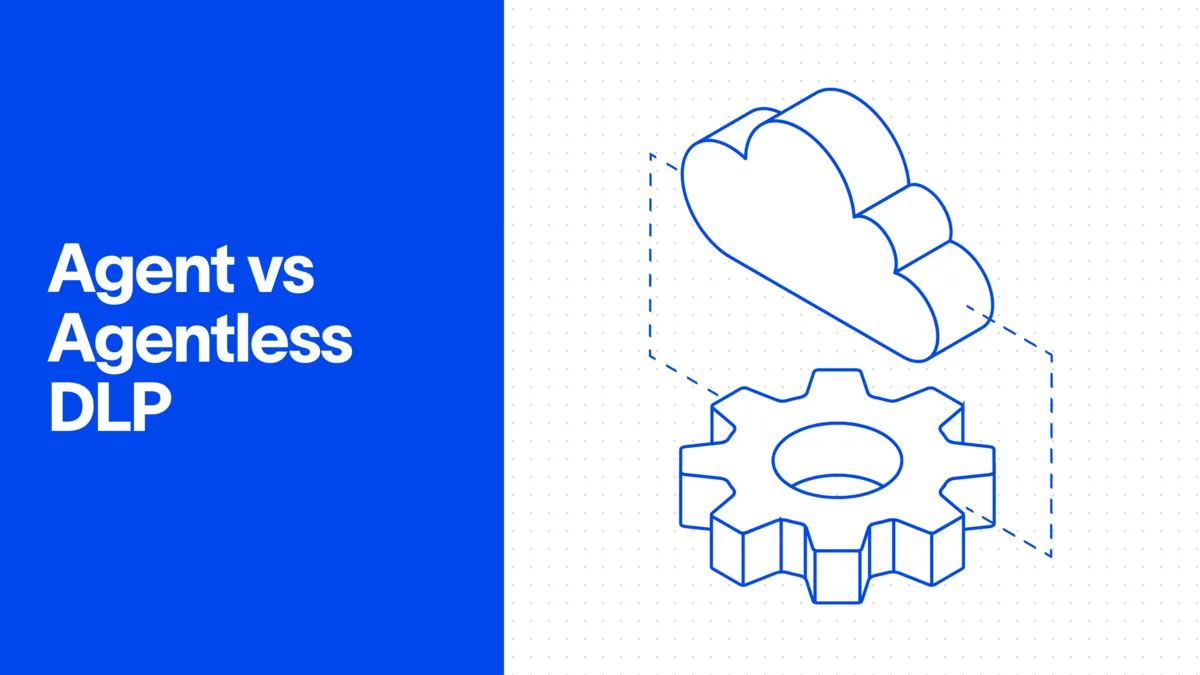
- Agent-based DLP installs software directly on managed devices to monitor local activity such as USB transfers, printing, and clipboard use.
- Agentless DLP connects to SaaS, cloud, and AI applications through APIs, requiring no device software and protecting data regardless of what device accesses it.
- Agent-based DLP gives deep, device-level control, while agentless DLP gives faster deployment and broader coverage across unmanaged and BYOD devices.
- Most enterprise data security programs combine both approaches rather than choosing one, since each closes gaps the other cannot cover.
- Most agentic AI activity, including local coding assistants and MCP-connected agents, runs directly on the endpoint and never routes through a network proxy or cloud API, which makes endpoint-level visibility essential for governing it.
What is agent-based vs. agentless DLP?
Agent-based DLP is data loss prevention (DLP) enforced by software installed on each managed device, and agentless DLP is DLP enforced through API connections to SaaS, cloud, and AI applications, requiring no device software. Agent-based DLP monitors local activity such as USB transfers and clipboard use, while agentless DLP protects data moving through email, cloud storage, and AI tools regardless of device.
Data loss prevention (DLP) began as a way to stop sensitive files from leaving managed laptops through USB drives, printers, or email attachments. That original model assumed most work happened on a corporate device connected to a corporate network. Today, employees create and share sensitive data across dozens of SaaS applications, cloud platforms, and AI tools that never touch an endpoint agent. The distinction between agent-based and agentless DLP reflects this shift in where data lives and moves. Security teams increasingly need to decide whether to enforce protection at the device level, the application level, or both, and the answer usually depends on workforce structure, device ownership, and how much of the business now runs through SaaS and AI tools.
How Agent-Based DLP and Agentless DLP Protect Data
Agent-based DLP and agentless DLP protect data through fundamentally different mechanisms, even though both aim to stop sensitive information from leaving the organization.
Agent-based DLP relies on a lightweight software agent installed on each managed device. Once deployed, the agent inspects local activity in real time, including file creation, clipboard use, USB transfers, printing, and screen capture. Because the agent runs directly on the device, it can enforce controls even when the device is offline or disconnected from the corporate network. This makes agent-based DLP well suited to endpoint security programs that need to monitor laptops used by employees who travel, work remotely, or handle regulated data outside a managed network.
Agentless DLP takes the opposite approach. Instead of installing software on devices, it connects directly to SaaS applications, cloud storage, email platforms, and AI tools through APIs. The DLP system monitors and enforces policy inside the application itself, which means protection applies no matter what device, browser, or operating system an employee uses to access it. Deployment typically takes hours rather than the weeks required to roll out endpoint agents across an entire workforce.
The practical difference comes down to where enforcement happens:
- Agent-based DLP protects the device
- Agentless DLP protects the application
Organizations with a large managed device fleet, strict local controls, and offline work scenarios tend to rely more on agent-based DLP. Organizations with significant SaaS, cloud, and contractor or BYOD usage tend to rely more on agentless DLP to close the gaps an endpoint agent cannot reach.
Agent-Based DLP vs. Agentless DLP: Feature and Coverage Comparison
| Attribute | Agent-based DLP | Agentless DLP |
|---|---|---|
| Deployment model | Software agent installed on each managed device | API connection to SaaS, cloud, and AI applications |
| Where enforcement happens | On the device | Inside the application |
| Device requirement | Requires a managed, agent-compatible device | Works on any device, including BYOD and contractor devices |
| Typical rollout time | Weeks, due to device-by-device installation | Hours to days, since no device software is needed |
| Works offline | Yes | No, requires a connection to the application |
| Best suited for | USB control, printing restrictions, local file monitoring, offline devices | SaaS security, cloud data protection, AI governance, BYOD coverage |
This comparison highlights why the two models solve different problems rather than competing for the same one.
Agent-based DLP gives granular, device-level visibility that agentless tools cannot replicate, since it can inspect activity even when a laptop is disconnected from the network. Agentless DLP gives broader reach across the applications where most collaboration now happens, since it does not depend on a specific device configuration.
Both models typically rely on similar underlying techniques for identifying sensitive content, including data classification, pattern matching, and contextual analysis, but they apply those techniques at different points in the data's journey.
Why the Agent vs. Agentless Decision Matters for Data Security Programs
The choice between agent-based and agentless DLP matters because it determines how much of an organization's actual data footprint gets covered. A security team that deploys only agent-based DLP protects managed laptops well but has no visibility into data moving through Slack, Salesforce, Google Workspace, or AI assistants unless those interactions happen to pass through a monitored device. A team that deploys only agentless DLP protects SaaS and cloud applications well but cannot enforce USB restrictions, printing controls, or local file monitoring on managed devices.
This gap matters more as organizations adopt data security posture management (DSPM) programs, which depend on complete visibility into where sensitive data lives across both endpoints and cloud environments. A DSPM program built on incomplete DLP coverage produces an incomplete picture of risk.
Compliance frameworks compound the stakes. Regulations such as HIPAA, PCI DSS, and GDPR expect organizations to demonstrate control over sensitive data regardless of where it resides, not just on company-owned devices. An organization that can only account for data on managed endpoints struggles to answer basic audit questions about data flowing through contractor devices, personal phones, or unmanaged SaaS accounts. Closing that gap is one of the main reasons enterprise data security programs increasingly treat agent-based and agentless DLP as complementary layers rather than a choice between two competing tools.
Common Challenges and Misconceptions About Agent-Based and Agentless DLP
Security teams evaluating agent-based and agentless DLP tend to run into the same set of misconceptions.
- Assuming it is an either-or decision: Agent-based and agentless DLP solve different problems. Treating the choice as a single either-or decision usually leaves a coverage gap on one side or the other.
- Underestimating BYOD and contractor exposure: Agent-based DLP cannot protect data on devices the organization does not own or manage, which is a growing share of the workforce. This blind spot is closely related to shadow IT, where employees use unsanctioned devices and applications the security team never approved.
- Overestimating agentless coverage of offline activity: Agentless DLP cannot see or control what happens on a device once it disconnects from the application it protects, such as a file saved locally and copied to a USB drive.
- Treating agent deployment as a one-time project: Endpoint agents require ongoing updates, compatibility testing, and maintenance across operating system versions, which adds sustained overhead that agentless tools avoid.
- Ignoring the maintenance cost of scaling agentless connectors: Each new SaaS or AI application requires its own API integration, and coverage gaps appear quickly if new tools are adopted faster than connectors are built.
How to Choose Between Agent-Based and Agentless DLP
Choosing between agent-based and agentless DLP, or deciding how to combine them, comes down to a handful of practical questions.
- Assess device ownership
Organizations with a largely company-managed device fleet get more value from agent-based DLP. Organizations with significant BYOD, contractor, or remote workforce usage need agentless coverage to reach devices that will never have an agent installed. - Map where sensitive data lives
Review whether sensitive data primarily sits in local files, or whether it flows through SaaS platforms, cloud storage, email, and AI tools. Most organizations find it is both, which points toward a combined deployment. - Evaluate offline and air-gapped requirements
If certain teams work disconnected from the network for extended periods, agent-based DLP is necessary to maintain protection during that time. - Account for agentic and GenAI usage
Most agentic AI activity, including locally installed coding assistants and MCP-connected agents, runs directly on the endpoint through OS-level processes and API calls that never touch a network proxy or cloud gateway. Endpoint-level visibility is what catches this activity; agentless tools alone typically miss it. - Factor in compliance requirements
Regulations that require demonstrable control over sensitive data across every location where it exists, not just managed devices, generally require both deployment models working together. - Plan for combined management
Look for a platform that unifies agent-based and agentless enforcement under one policy engine, rather than operating them as two disconnected tools with separate dashboards and separate incident queues.
Agent-Based and Agentless DLP in AI and Agentic Workflows
AI and agentic workflows have made the agent versus agentless question more urgent rather than less, but not in the direction many security teams assume. Employees now use AI coding assistants, IDE-embedded agents, and autonomous AI agents connected through Model Context Protocol (MCP) servers that retrieve, summarize, and act on company data without a human reviewing every step. Most of this activity runs directly on the endpoint. Local agents read files from the file system, spawn processes, and call model APIs straight from the device, and none of that traffic passes through a network proxy or cloud gateway that an agentless tool can inspect.
This is why agentic AI risk is primarily an endpoint visibility problem rather than an agentless one. A network-based or cloud-first tool can see where sensitive data lands in storage, but it cannot see a locally installed coding assistant reading a source code directory, an MCP server authorizing an agent to reach an internal database, or an agent chaining several tool calls together before writing output somewhere new. Detecting that activity requires OS-level presence on the endpoint itself: observing which processes correspond to AI agents, tracing what files and data sources they touch, and following where the data goes afterward. This overlaps closely with shadow AI, since agents installed without security review are frequently invisible to tools that only monitor the network or SaaS layer.
Agentless DLP still has a role in this picture, particularly for browser-mediated GenAI use where an employee pastes data into a web-based tool through a monitored SaaS connection, but the autonomous, multi-step activity that defines agentic AI is largely out of reach for agentless coverage alone.
How Cyberhaven Addresses Agent-Based and Agentless DLP
Cyberhaven addresses the agent-based versus agentless question through a unified data security platform that protects data across human and agentic workflows. It connects lineage, identity, and behavior to secure data as it moves across endpoints, browsers, and the cloud. Unlike vendors that treat endpoint and cloud protection as separate products, Cyberhaven applies one policy engine and one incident queue across all three, so security teams do not have to reconcile alerts from disconnected tools.
Cyberhaven's DLP capability runs as an endpoint-native agent that uses Linea AI and Data Lineage to trace sensitive data from the moment it is created through every copy, transformation, and transmission, rather than relying on content inspection alone. This context-aware approach reduces the false positives that make many agent-based tools difficult to operate at scale. DSPM extends that same visibility into SaaS applications and cloud storage, discovering and classifying sensitive data where an endpoint agent alone would not look.
AI Security builds on the same endpoint-native foundation to see agentic activity that agentless tools miss entirely: locally installed coding assistants, IDE-embedded agents, and MCP-connected agents operating at the OS level, correlated through Data Lineage to show what data an agent touched and where it went next.
Frequently Asked Questions
What is the difference between agent-based DLP and agentless DLP?
Agent-based DLP uses software installed on managed devices to monitor local activity such as USB transfers, clipboard use, and printing. Agentless DLP connects to SaaS, cloud, and AI applications through APIs, without installing anything on the device, and enforces policy inside the application itself. The core difference is where protection happens: on the device or inside the application.
Do organizations need both agent-based and agentless DLP?
Most enterprise data security programs use both. Agent-based DLP covers managed devices, offline scenarios, and local file controls that agentless tools cannot reach. Agentless DLP covers SaaS, cloud, and AI applications, along with BYOD and contractor devices that will never run an endpoint agent. Combining both closes the gaps either approach leaves on its own.
Is agentless DLP effective for BYOD environments?
Yes. Agentless DLP protects data inside SaaS and cloud applications regardless of what device accesses them, since enforcement happens at the application level rather than the device level. This makes it well suited to bring your own device (BYOD) and contractor environments where the organization cannot install or manage endpoint software.
How does agent-based DLP protect data on managed endpoints?
Agent-based DLP installs a software agent on each managed device that inspects local activity in real time, including file creation, USB transfers, clipboard use, printing, and screen capture. Because it runs directly on the device, agent-based DLP can enforce controls even when the device is offline or disconnected from the corporate network.
Does agent-based or agentless DLP better cover agentic AI risk?
Agent-based DLP generally covers agentic AI risk more effectively. Most agentic AI activity, including locally installed coding assistants and agents connected through Model Context Protocol (MCP) servers, runs directly on the endpoint through OS-level processes and API calls that never pass through a network proxy or cloud gateway. Agentless DLP still covers browser-based GenAI use mediated by a monitored SaaS connection, but it typically cannot see autonomous agent activity happening at the device level.
Which is better for compliance: agent-based or agentless DLP?
Neither is sufficient alone for most compliance requirements. Regulations such as HIPAA, PCI DSS, and GDPR expect organizations to demonstrate control over sensitive data wherever it resides, including SaaS applications and BYOD devices that agent-based DLP cannot reach. Combining agent-based and agentless DLP gives a more complete audit trail across managed and unmanaged environments.

.avif)
.avif)