Learn about the top alternatives to Broadcom (Symantec) DLP
Broadcom Symantec DLP is a leading data loss prevention solution lauded for its robust approach to cybersecurity. It offers comprehensive protection against data leakage on various endpoints, excelling in real-time monitoring and prevention of data loss. With its scalable architecture and seamless integration with other security solutions, it’s seen as a versatile choice for businesses seeking reliable data loss prevention software.
Why Look for a Symantec DLP Alternative?
While Symantec DLP remains a powerful and mature solution, many security teams evaluate alternatives for reasons like:
- Cloud-native visibility across APIs and SaaS apps
- Lower operational overhead and tuning effort
- Reduced false positives through smarter classification
- Simpler deployment and management
Understanding these trade-offs helps frame why newer DLP competitors are gaining traction.
Broadcom (Symantec) Data Loss Prevention Alternatives
1. Cyberhaven (Best overall)
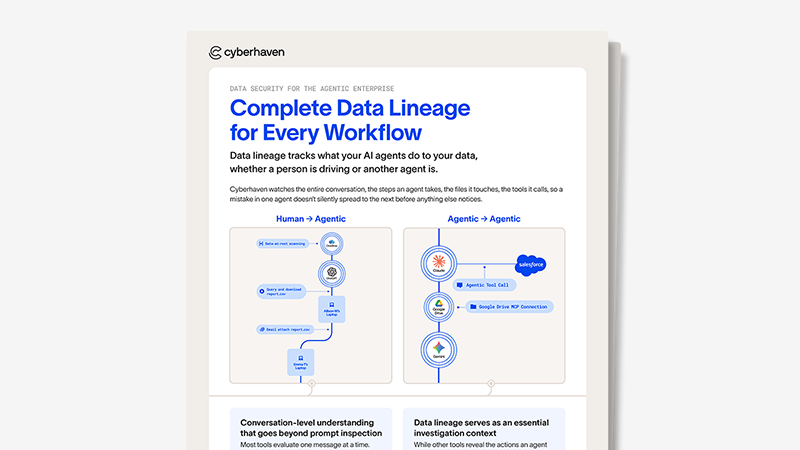
Cyberhaven is a comprehensive cloud-based data detection and response solution that seamlessly integrates traditional endpoint data loss prevention with incident response capabilities. It enables security administrators to identify real-time sensitive data exposure within applications and trace the sequence of end-user behaviors leading up to these incidents. The platform’s advanced system classifies content within files and monitors all file events, allowing for automatic logging and immediate intervention when a user engages in prohibited actions that result in incidents like insider threat. Cyberhaven stands out by leveraging browser data to enhance SaaS visibility, reinforcing security policies, and providing an additional layer of protection against data leakage and exfiltration threats. Because Cyberhaven leverages data discovery, metadata, and is also content-aware, its capabilities extend to the protection of intellectual property, ensuring valuable assets are safeguarded from potential threats.
2. Forcepoint DLP
Forcepoint Data Loss Prevention (DLP) is a DLP solution that provides comprehensive data security capabilities to help organizations prevent unauthorized access and loss of sensitive information. Well-known for its effective data leakage protection, Forcepoint DLP features fingerprinting, discovery tasks, email security, and device information theft protection. Users often praise its ease of incident identification and escalation, unified policy enforcement, and risk-adaptive protection based on user behavior templates built using some machine learning. The solution is highly scalable and customizable, allowing organizations to tailor its remediation functionalities to meet their specific objectives. However, potential users should be aware that while Forcepoint DLP offers powerful protection capabilities, it also requires a level of technical understanding for deployment.
3. McAfee/Trellix DLP
Trellix Data Loss Prevention, previously known as McAfee Total Protection for DLP, is a data protection solution that is noted for its scalability and customizability to fit the needs of different businesses. Key features include real-time scanning of content and context of files, forensic analysis support with export functions and event session reconstruction, and activity monitoring alerts that use rule-based triggers for sensitive data access requests. It allows the creation of custom policies and workflows via a centralized reporting engine and management platform, supports real-time decryption and re-encryption of information, and offers broad protocol support for diverse environments, including cloud and virtualization. The system can also manage multiple operating systems and device types, offering offline protection and support for actions such as block, move, quarantine, and delete in response to security violations. Despite these strengths, some users have found the IT administration aspect somewhat challenging.
4. Microsoft Purview DLP
Microsoft Purview DLP is a robust, cloud-oriented solution that shines in data loss prevention, fortifying businesses against data breaches and data leaks. Its core strength lies in its seamless synergy with Microsoft’s ecosystem, providing businesses a unified view into data governance, and bolstering their defensive stance against insider threats and enabling PCI and HIPAA compliance within Microsoft cloud services like Azure. Despite these advantages, Purview DLP’s Achilles’ heel is its lack of broad-based compatibility. Absence of support for Linux systems and Python libraries can curb its versatility, while challenges with integrating third-party sources underscore an area ripe for improvement. For example, coverage for Linux and Mac-based endpoints don’t have feature parity with Windows endpoints. Similarly, while Microsoft provides some plugin support for 3rd party browsers, it prioritizes support for the Edge browser as an “enlightened application.” Overall, while Purview DLP’s strengths make it an appealing choice within Microsoft-centric environments, its limitations signal a need for more flexibility in diverse tech landscapes.
5. Digital Guardian DLP
Digital Guardian’s endpoint DLP software offers comprehensive data classification, effective and reliable detection processes, and robust data monitoring capabilities, contributing to its strengths in database efficiency and endpoint protection. It also boasts flexible controls for business eligibility and a cloud-focused delivery model that enhances its efficiency. However, users have noted in some cases it can cause undesirable effects in other programs, generate excessive false positives if not properly tuned, and sometimes has high resource usage which impacts device RAM and CPU power.
How to Choose the Right DLP Alternative for Your Organization
When evaluating Symantec DLP alternatives, consider your organization’s priorities:
- Do you need cloud-API visibility versus traditional network/endpoint scanning?
- Are behavior and context signals important to reduce false positives?
- What level of management overhead is acceptable?
Answering these questions will help you balance protection depth with operational practicality and choose a solution that aligns with your security strategy.
Compare features like cloud app coverage, data classification sophistication, and API-first integrations to ensure your next DLP investment supports modern workflows.

.avif)
.avif)