Unified Data Security vs. Multiple Point Solutions: You Need One View of Data

October 26, 2026
•
1 min
“Threat Actors Combine Automated and Hands-on Hacking Tools to Steal Sensitive Data.” Security teams read headlines like this every week. When they learn about new threats from sources like CISA Cybersecurity Alerts & Advisories, each one prompts a check on whether current tools cover it.
And as these new threat vectors get published, some expose gaps that existing tools can’t cover. Teams respond by searching for products to address these risks. Each additional point solution helps, but the result is an increasingly complex security stack that becomes harder and harder to manage.
Multiple consoles, overlapping endpoint agents, competing alerts, and separate budgets all describe the same data in different ways. Teams that consolidate those capabilities onto one shared view of the data get faster investigations, fewer redundant licenses, and a clearer picture of risk. The question worth asking now is whether each capability still needs its own product.
Why Data Security-Focused Point Solutions Multiplied
The market for data security has grown to meet the challenges imposed by these new threat vectors. Each category formed around a specific problem, and each has done a reasonable job of solving it.
| Category | Primary purpose |
|---|---|
| Data loss prevention (DLP) | Keep sensitive data inside approved boundaries |
| Data security posture management (DSPM) | Discover, classify, and assess risk to data at rest |
| Insider risk management (IRM) | Identify risky user behavior and potential misuse |
| AI security | Govern data moving into and out of AI apps and agents |
The products add up. Research from Enterprise Strategy Group, now part of Omdia, found that 37% of organizations use more than 26 security products, and 10% use more than 51. Each product brings its own console and policies, and many keep their own version of the data inventory.
The trouble starts when these products run on separate data models with no shared context. Take one ordinary action, an employee uploading a sensitive file to an AI app, and follow how each tool sees it:
- The DLP tool flags a policy violation.
- The insider risk tool records a behavior signal.
- The AI security tool logs an unsanctioned upload.
- The classification tool sees a labeled document leaving its approved location.
In a fragmented stack, that can be four alerts in four consoles. In a unified architecture, it's one event that each team views through its own lens.

The Hidden Cost of Data Security Point Solutions Is Operational
Every Tool Keeps Its Own Version of the Truth
Separate products classify the same file differently, keep their own identity and asset inventories, and score risk on their own scales. When they disagree, an analyst has to work out which one is right before deciding what to do. That time goes to reconciliation instead of response.
Overlap Turns Into Redundant Spend and Overhead
Organizations often pay separately for overlapping capabilities, and each product brings its own console, integration work, policy framework, alert stream, renewal cycle, and vendor relationship. The team needs people who know each one well, and that expertise rarely transfers from one tool to the next.
Risk Lives in How Data Moves
Data risk doesn't sit inside a product category. It shows up in the movement and use of data. Understanding it means connecting what the data is, where it came from, who is using it, what happened to it, and where it's going next.
Point products each hold one piece of that story. Nobody sees the whole sequence until an analyst rebuilds it by hand, usually after the data has already moved.

What Unified Data Security Should Mean
Unified is easy to claim. Several acquired products under one logo and one invoice can still leave separate consoles, data models, and agents underneath.
The market is moving the same direction. In October 2026, Proofpoint agreed to acquire Varonis for $6.3 billion, betting that posture, access, insider risk, DLP, and AI governance belong together.
The deal also raises the question Cyberhaven CEO Nishant Doshi posed in his response: whether data-at-rest context and data-in-motion telemetry share one data model, or whether they're stitched together with tags after the fact. That distinction decides whether a team can trace what happened to data after a person or an AI agent touched it.
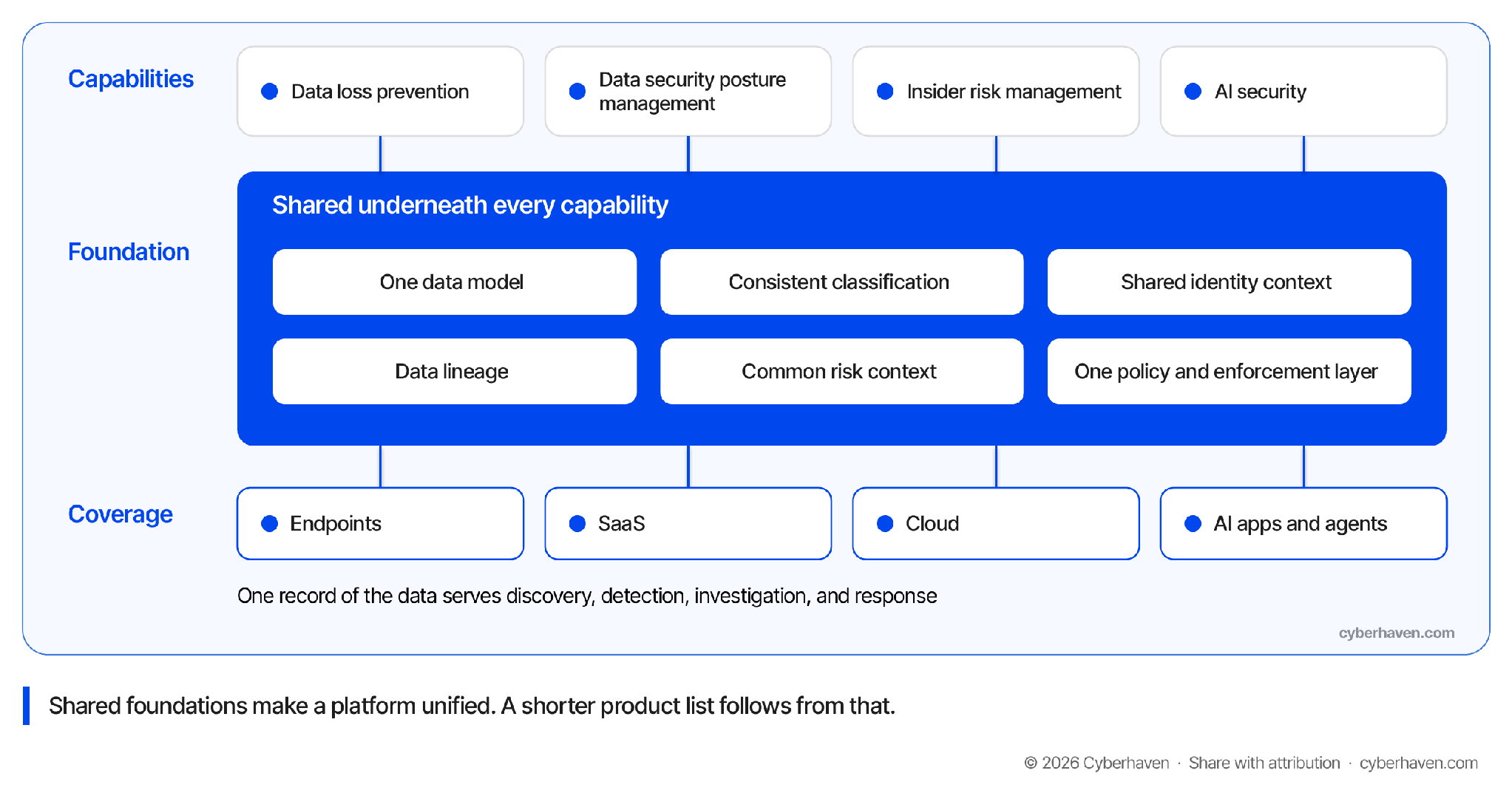
A unified data security platform shares the foundations that make each capability useful:
- One data model across discovery, detection, and response
- Consistent classification of what the data is
- Shared identity context for users, devices, and accounts
- Data lineage that follows content as people and agents copy, rename, and move it
- A common risk context with a single policy and enforcement layer
- Visibility across endpoints, SaaS, cloud, and AI environments
The measure of success is fewer disconnected security decisions. A shorter product list follows from that.
What Organizations Can Consolidate With Unified Data Security
Overlapping DLP, Insider Risk, DSPM, and Classification Tools
Discovery, classification, monitoring, and protection have historically been separate purchases. On a shared platform, they become stages of one workflow, which lets teams retire the products that duplicate each other.
The outcomes include maintaining fewer licenses and integrations, replacing several near-identical policy sets with one, and giving analysts a single place to investigate data risk. Consolidation is best measured by the capabilities a team retires, since a new bundle that shuts nothing off simply adds another console.
AI Security Without Another Product
AI tools, both generative and agentic, open new paths for data. Chat assistants, coding assistants, AI agents, Model Context Protocol (MCP) servers and extensions, enterprise AI platforms, and personal AI accounts all move data somewhere new. Cyberhaven Labs' 2026 AI Adoption Risk Report found that 39.7% of AI interactions involve sensitive data and that one-third of employees reach AI tools through personal accounts.
Treating AI as a separate security layer repeats the pattern that created the sprawl. AI apps and agents are new destinations for the same data, so existing data security controls should extend to them. The questions are familiar ones. What data is entering AI systems, who is sending it, and what happens to it afterward?
Teams that answer them from the same platform that protects the rest of their data can approve more AI use instead of defaulting to blanket blocks.
Fewer Endpoint Agents, With Existing Investments Intact
The endpoint is still where people open, edit, copy, and paste data, so it remains one of the most important places to understand and protect it. But security teams push back, reasonably, on adding an agent for every new risk.
A unified platform should reduce endpoint agent sprawl and still work alongside the tools that earn their place, including Microsoft Purview sensitivity labels, endpoint detection and response (EDR) platforms, and existing endpoint controls. Consolidation removes redundant tooling without ripping out the investments that still deliver value.
One Program Instead of Five Budgets
Point products tend to map to different owners. DLP sits with security, DSPM with data or cloud security, and insider risk with some mix of security, HR, and risk. Classification often belongs to data governance, while AI security draws from whatever emerging budget exists this year.
Running all of this as one data security program simplifies procurement, renewals, budget planning, implementation, and support. Savings matter, but they're rarely the only reason teams consolidate. In the IANS and Artico Search 2025 Security Software and Services Benchmark Report, about 70% of the 628 CISOs surveyed said they're consolidating or have consolidated multiple tools into integrated platforms, and another 13% plan to. They cite efficiency and data integration alongside cost.
The stronger business case is more security value from the budget already committed.
How a Unified Solution Complements the Rest of the Stack
A fair objection to consolidation is that one platform can't do everything well. That's correct, and a credible unified approach doesn't try to.
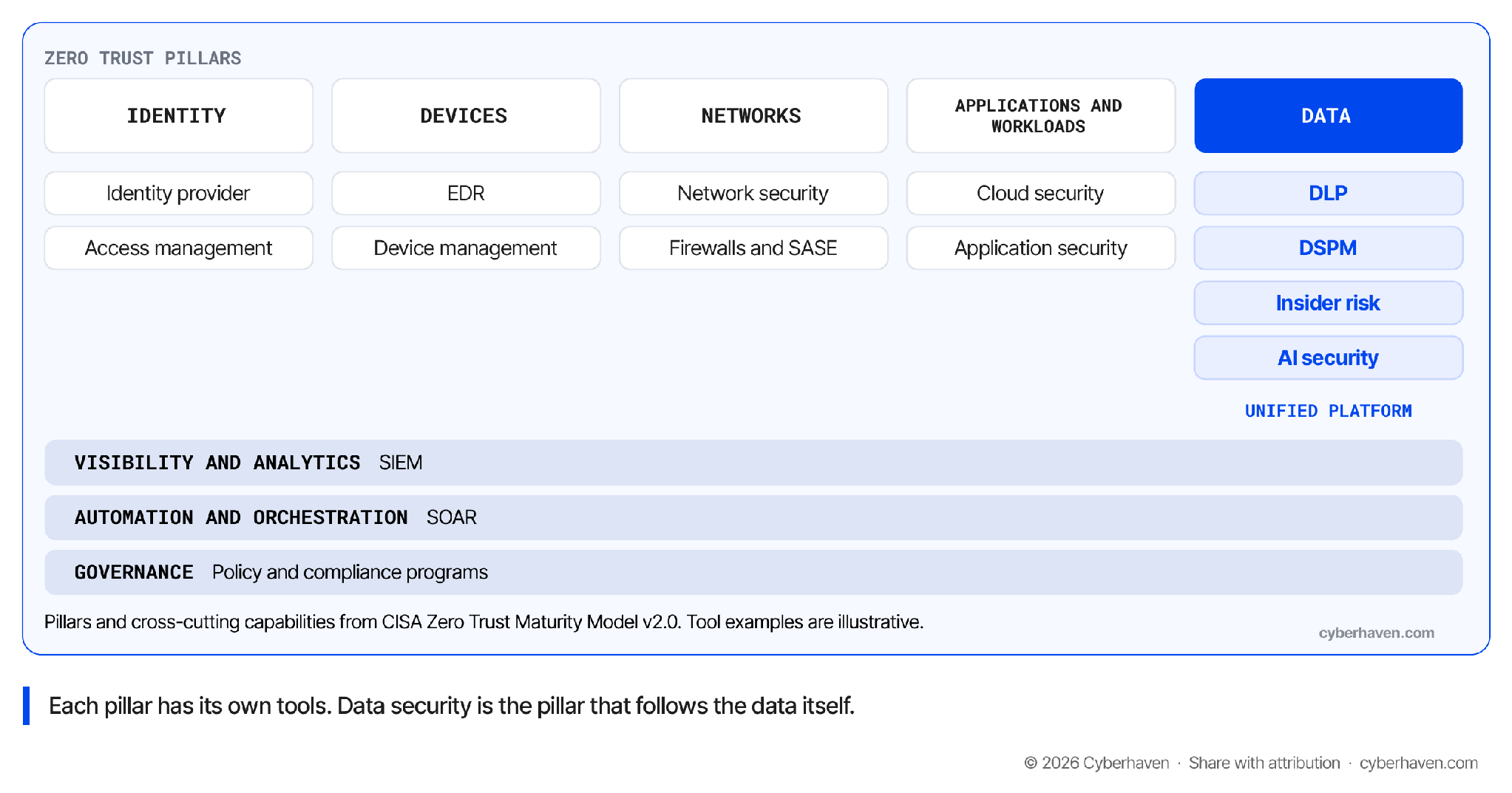
EDR, identity, cloud security, network security, security information and event management (SIEM), and security orchestration, automation, and response (SOAR) each solve a different problem, and each works best as a dedicated layer that data security feeds and draws from.
Keeping them separate holds up for practical reasons. CISA's Zero Trust Maturity Model treats identity, devices, networks, applications and workloads, and data as distinct pillars, each with its own maturity path, while visibility, automation, and governance cut across all of them. Separate layers also add defense in depth, so a gap or outage in one control doesn't become a gap everywhere.
Data security adds the context those layers don't track on their own: what the data is, where it came from, and where it's going. A unified data security platform should send that context to the SIEM and SOAR, so analysts see what was at stake in an incident, and draw on identity context to judge whether an action is risky.
The case for consolidation is narrower, and stronger, than one platform replacing everything. When two tools discover the same data, classify it differently, and alert on the same event, one of them is redundant.
Six Questions to Ask a Unified Data Security Platform
Marketing categories make most platforms sound unified. These questions separate shared architecture from shared branding.
- Which products can it retire? Look past category labels and name the tools in the current stack it would let the team shut off.
- Does it run on one data model? Classification, lineage, identity, behavior, and policy context should flow across every capability without translation. Ask whether at-rest and in-motion context were built on the same architecture or stitched together after an acquisition.
- Does discovery connect to enforcement? Teams should move from discovery to investigation and protection without handing the workflow between products.
- Does it treat AI as part of data security? Coverage should include AI apps, coding assistants, agents, MCP, and the workflows still emerging.
- Can it coexist with what stays? Ask how it works with Microsoft Purview, EDR, identity platforms, and the SIEM.
- Does it reduce analyst workload? If an analyst still investigates the same event across four consoles, nothing has been consolidated.
Data Security Should Follow the Data
Data no longer stays in databases and file shares. It moves from endpoints to SaaS apps, cloud storage, browsers, AI apps, and agents, then back to people. Security architecture organized around product categories struggles to follow that path.

Organizations still need every capability covered here, but they can deliver them through far fewer disconnected systems. That changes the planning question for security leaders. Count how many separate systems it takes to understand and protect the same piece of data, and build the roadmap around bringing that number down.
Timing matters too. AI tools, both generative and agentic, are spreading through the enterprise faster than a multiyear product integration can keep up, so the architecture a team chooses now determines how quickly it can protect the workflows already in use.
How Cyberhaven Approaches Unified Data Security
Cyberhaven Flow brings DLP, DSPM, insider risk management, and AI Security onto one platform built on Data Lineage, which traces data from creation through every copy, move, and transformation. One endpoint sensor, browser extensions, and cloud connectors feed a shared lineage graph, so a single event carries its classification, user, source, and destination for every team that reviews it. Linea AI uses that lineage to flag anomalous dataflows and prioritize incidents. Cyberhaven also reads existing Microsoft Purview sensitivity labels as classification signals, so teams keep the labeling work they've already done. Leading enterprises, including four of the five foundational AI labs, run their data security and insider risk programs on Cyberhaven.
Every new data risk will tempt another purchase. Teams that ask whether each new tool adds a capability or duplicates one already in place keep their analysts focused on risk instead of reconciliation.
Request a demo to see how Cyberhaven provides Data Security for the Agentic Enterprise by unifying DLP, DSPM, insider risk, and AI Security around one view of your data.



Insights for the agentic enterprise
New guides, reports, and insights on data security, sent as they publish.