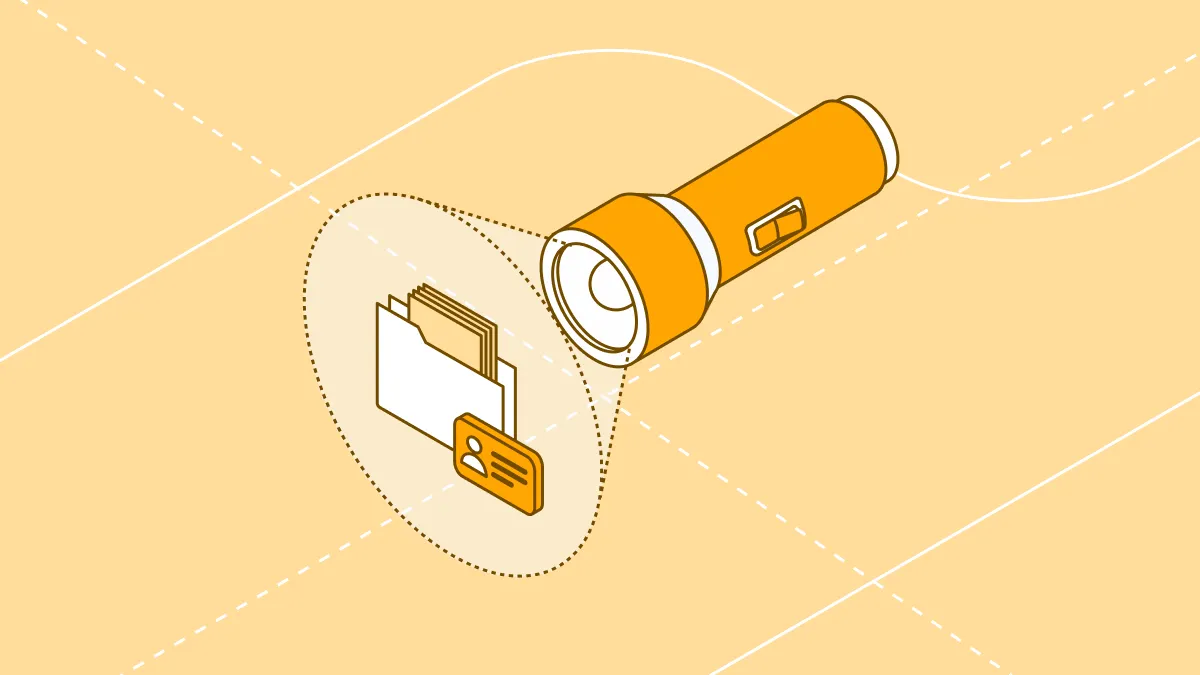
Security teams can spend years tuning DLP rules for the tools they know about. But, then an employee will paste a customer list into an AI assistant that did not exist on any policy six months ago, and the rule never fires. The tool was not on the list, and once the data returns as a summary, it no longer matches the pattern a rule was written for either, creating risk the security team is completely blind to.
A bigger rule set does not close this new risk gap. The problem is protection built to recognize fixed things, a known tool, a known pattern, in an environment where both change faster than any list can track. Closing it means judging the action itself.
What Is Context-Aware DLP?
Context-aware DLP is data loss prevention that evaluates the actor, the action, and the destination around a piece of data, not only the data's content, to decide in real time whether a given action puts sensitive data at risk. Instead of matching a file against a fixed pattern or blocking a fixed list of tools, it asks who is handling the data, what they are doing with it, and where it is going, then weighs that against what is normal for that person and that data.
That evaluation only works if the system knows what the data is, even after it has been summarized, reformatted, or moved through an AI tool.
Why Legacy DLP Can't Keep Up With How Workflows Move Today
Rule-based DLP was built for a world where sensitive data mostly stayed put. Policies matched a file against a pattern, or blocked a fixed list of destinations, and that held up as long as tools and file formats changed slowly enough for a security team to keep the list current.
Workflows do not move that way anymore. An employee's task now routinely crosses a sanctioned app, an unsanctioned AI tool, a personal device, and a shared drive within a single afternoon, and the data looks different at each stop. A rule written for the file's original format has nothing to match once an AI tool has summarized, translated, or restructured it. A rule written for a known destination has nothing to block once the data lands somewhere the list never anticipated.
Legacy DLP still catches known files moving through known channels. What it misses is the growing share of activity that starts as sensitive data and ends up somewhere, and in some shape, no static rule was written to expect.
Why Context-Aware DLP Depends on Lineage to Work
Context-aware DLP makes a real-time judgment call: is this action, by this person, toward this destination, is deemed risky. Making that call correctly depends on knowing one thing first, what the data is and where it originated, and that is where context runs into the same wall legacy DLP does.
Content matching used to answer that question with ease. A pattern or fingerprint told the system "this is a customer record" or "this is source code," and context could reason from there. But once an AI tool summarizes a document, rewrites a section of code, or folds several sources into one answer, the output carries the same sensitive material without carrying the same shape. Content matching has nothing left to recognize, so context inherits a blind spot: it can flag that a finance employee is doing something unusual, but not that the something is a customer database.
Data lineage is what closes that context gap. Lineage tracks a piece of data's origin and every action that has happened to it since, so lineage can continue to recognize the data by where it came from even after an AI tool has reshaped it beyond what content matching can follow.
That is the input context-aware DLP needs to do its job: lineage supplies what the data is, context supplies whether the surrounding action is risky given who is doing it, what they are doing, and where it is headed. Neither one replaces the other. Context without lineage is judging behavior blind to what is actually at stake.
DLP for AI: A New and Growing Risk Surface
AI has changed what companies need DLP software to catch, and it has done so on two fronts at once.
- Generative AI usage, where copy-and-paste into a chat window, a prompt, or an upload moves sensitive data out through an interaction a static rule can watch for but often fails to recognize once the tool reformats what comes back.
- Agentic AI usage is a different problem entirely, referring to an autonomous agent that can read, transform, and move data on a user's behalf without a person triggering each step, so there is no single copy-paste moment for a rule to catch at all.
Both modes need the same underlying capability, not two separate tools bolted together. Lineage identifies the sensitive data regardless of which tool touched it or how the output looks, and context evaluates whether an agent's action, or a person's, fits a legitimate pattern or crosses into risk. A rule list built only for generative, interactive AI use will miss the growing share of exposure that agentic tools create entirely on their own, often without any interface a security team can watch directly.
How Cyberhaven's Data Lineage Approach Addresses AI Risks
Cyberhaven built its platform around this dependency rather than treating lineage and context as separate features. Data Lineage tracks a file's origin and every transformation it goes through, so the platform still recognizes sensitive data after an AI tool has summarized, translated, or restructured it. AI Security applies that identity to generative and agentic AI activity specifically, evaluating what an AI tool or agent is doing with data it has touched, not just whether the tool is sanctioned. Linea AI is the layer that reasons over both, weighing actor, action, and destination against the data's actual lineage to make the real-time call that content matching or a destination list alone cannot make.
This is Data Security for the Agentic Enterprise: protection that stays attached to data as it moves through generative and agentic AI workflows, rather than protection that only holds as long as the data stays in a known place and a known shape.
Better understand how AI is transforming data loss with our IDC Spotlight on data security and insider risk for AI Adoption.
Frequently Asked Questions
What does context-aware DLP actually look at, if not just content?
It evaluates who is performing an action, what the action is, and where the data is headed, then compares that against normal behavior for that person and that data. Content still matters, but it is one input among several, not the only signal the system relies on.
Is context-aware DLP the same as behavioral analytics?
No. Behavioral analytics flags unusual activity in general. Context-aware DLP specifically ties that behavior to what is happening to sensitive data, which requires knowing the data's identity through lineage, not just that an action looks unusual.
Why doesn't content matching alone work for AI-era data protection?
Content matching recognizes data by its pattern or format. Generative and agentic AI tools routinely reformat, summarize, or fragment data, so the output no longer matches what a rule was written to catch, even though the underlying sensitive material is unchanged.
What's the difference between context-aware DLP and DSPM?
DSPM maps where sensitive data lives and how it is configured across an environment. Context-aware DLP acts on data in motion, evaluating specific actions as they happen. The two are complementary: DSPM informs what is sensitive, DLP enforces what happens to it.
Can context-aware DLP work without data lineage?
Only partially. Without lineage, context can still flag unusual behavior, but it cannot reliably confirm that the behavior involves sensitive data once that data has been transformed, which limits how confidently it can act.
Legacy DLP was built for data that stayed in a known shape and a known place. AI has made sure it does neither, which is why context-aware DLP, backed by lineage, has become the harder requirement, not an optional upgrade. The real test is whether your DLP still recognizes sensitive data, and judges the action around it, once the data changes shape and the destination isn't on any list. Request a demo to see how Cyberhaven handles both.

.avif)
.avif)

Insights for the agentic enterprise
New guides, reports, and insights on data security, sent as they publish.