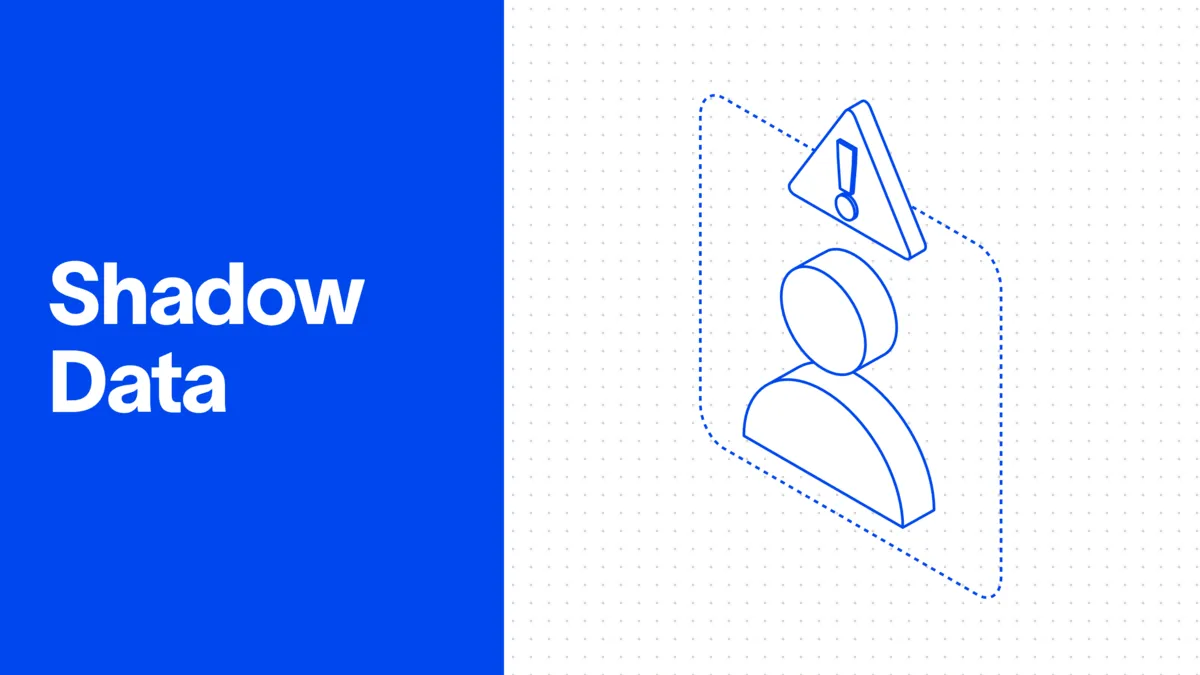
- Shadow data is any sensitive or business information that exists outside an organization's known, governed data environment.
- Cloud sprawl, SaaS exports, and AI experimentation all generate new copies of data that security teams never see.
- Security teams cannot apply data classification, access controls, or monitoring to data whose existence they don't know about.
- Shadow data and shadow IT are related but distinct problems: one describes ungoverned technology, the other describes ungoverned data.
- Reducing shadow data risk requires continuous discovery, not a one-time inventory.
What Is Shadow Data?
Shadow data is sensitive or business-critical information that exists outside an organization's known, governed data environment, invisible to the classification policies, access controls, and monitoring that protect sanctioned data.
Shadow data accumulates in forgotten database backups, unmanaged SaaS exports, abandoned cloud storage, and copies created for testing, analytics, or AI development. Because security teams cannot secure what they cannot see, shadow data is one of the most persistent blind spots in enterprise data security.
The term describes a data problem, not a technology problem: a company running entirely on approved applications can still accumulate shadow data the moment someone copies a production database into a test environment and nobody deletes it once the project ends.
Where Shadow Data Comes From
Shadow data typically forms in one of four ways:
- Decommissioned or migrated applications
Historical data is left behind in its original storage location rather than deleted. - Development and analytics copies
Production data is duplicated into test environments or warehouses, then never cleaned up. - Unmanaged SaaS and cloud storage
Employees export records into spreadsheets or personal cloud accounts, creating data with no formal owner. - AI development
Documents and records get copied into training sets, vector databases, or retrieval-augmented generation (RAG) repositories, often outside existing data governance.
Shadow Data vs. Shadow IT vs. Shadow AI
These three terms describe related but distinct problems.
- Shadow IT is the use of applications or services without IT approval.
- Shadow AI is a subset of shadow IT, referring to AI tools or models used outside established governance.
- Shadow data is different from both. It describes the data itself, and it can exist even inside fully approved systems.
Common forms include shadow datasets (exported customer lists or training corpora with no assigned owner), shadow databases (full copies or snapshots left live after a migration or test), and copies created for AI training or vector storage. An employee using an unapproved file-sharing tool is practicing shadow IT; pasting customer records into an unapproved AI assistant is shadow AI; the copy left behind in that assistant's logs is shadow data. Eliminating one doesn't automatically eliminate the others.
Why Shadow Data Matters for Data Security
Unaddressed shadow data creates risk in two connected areas.
- Data breaches: shadow data typically lacks the access controls and monitoring applied to its source, making it an easier target than actively managed data, and a data breach involving a forgotten copy exposes the same records without the same detection speed.
- Compliance exposure: regulations such as GDPR and HIPAA apply regardless of where data lives, and organizations that cannot locate a forgotten backup cannot demonstrate compliance or respond to data subject requests for it.
Common Challenges in Managing Shadow Data
- Discovery lags creation: New shadow data forms continuously, so a one-time inventory is outdated within weeks.
- Ownership is unclear: Copies often outlive the project that created them, leaving nobody accountable for securing or deleting them.
- Sensitivity isn't visible from location alone: A forgotten database with test data and one with real customer PII look identical from a storage inventory.
How to Detect and Reduce Shadow Data Risk
- Discover continuously, not periodically, across cloud, SaaS, on-premises, and AI environments.
- Classify what you find using data classification to flag sensitive or regulated content.
- Add ownership and access context so someone is accountable for each copy.
- Prioritize by risk, not volume: high sensitivity plus broad access first.
- Put shadow data monitoring in place so new copies are flagged as they form, not discovered months later.
How Cyberhaven Addresses Shadow Data
Cyberhaven addresses shadow data by tracing where sensitive information travels across its entire lifecycle, not just where it was last discovered. Data Lineage connects a forgotten backup or export back to the sensitive source it came from, letting security teams distinguish a low-risk duplicate from a high-risk exposure without inspecting every copy manually. Combined with DSPM discovery and classification and AI Security controls that track data moving into training sets and connected AI tools, Cyberhaven surfaces shadow data as it forms and ties it to the ownership context needed to act on it.
Frequently Asked Questions
What Is Shadow Data?
Shadow data is sensitive or business information that exists outside an organization's known, governed data environment, including forgotten backups, unmanaged SaaS exports, and copies created for testing or AI development.
What Is a Shadow Dataset?
A shadow dataset is a collection of records, such as an exported customer list or AI training corpus, that exists without an assigned owner or retention policy.
What Is a Shadow Database?
A shadow database is a full database copy or snapshot, often created for migration or testing, that remains live after its original purpose ends, carrying the same sensitivity as its source with weaker controls.
How Is Shadow Data Different From Shadow IT?
Shadow IT is technology used without IT approval. Shadow data is the data itself, which can exist outside governance even inside fully approved systems.
How Can Organizations Detect Shadow Data?
Through continuous data discovery across cloud, SaaS, on-premises, and AI environments, followed by classification and shadow data monitoring that flags new copies as they appear.

.avif)
.avif)