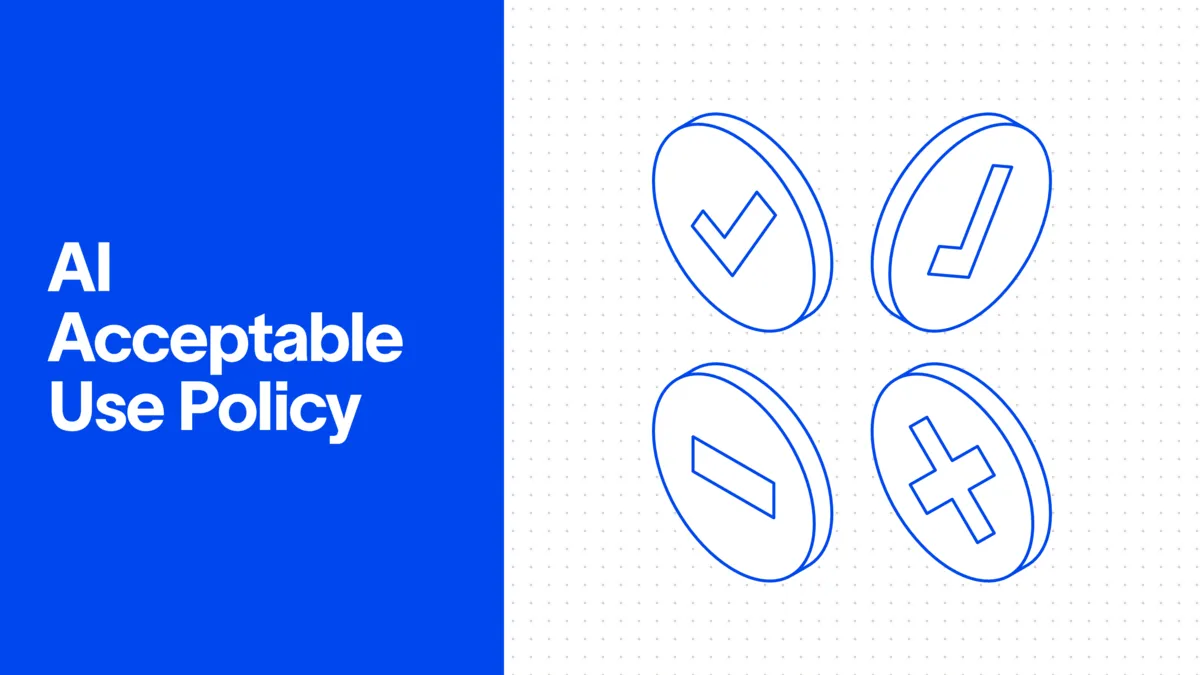
- An AI acceptable use policy defines which AI tools employees and AI agents may use, what data those tools may process, and who is accountable when the rules are broken.
- Data handling rules form the core of an AI AUP because most AI risk comes from sensitive information flowing into prompts, file uploads, and agent actions.
- Only 38% of organizations have a formal, fully developed AI policy, according to ISACA’s 2026 AI Pulse Poll, even though 90% of respondents say employees use AI tools.
- A written AI AUP sets expectations, and technical controls that see data moving into AI tools turn those expectations into enforceable rules.
- An effective AI AUP covers both generative AI tools used interactively and agentic AI systems that take actions on a user’s behalf.
What Is an AI Acceptable Use Policy?
An AI acceptable use policy (AI AUP) is a formal set of rules that defines how an organization’s employees, contractors, and automated systems may use artificial intelligence tools and the data those tools touch. It specifies approved tools, prohibited uses, data handling requirements, and accountability. Organizations use an AI AUP to adopt AI productively while protecting sensitive information.
An artificial intelligence acceptable use policy extends the long-standing acceptable use policy (AUP) to a new class of technology. Traditional AUPs govern email, internet access, and company devices. An AI AUP addresses the specific ways data moves when people work with AI: pasting text into a prompt, uploading a file for summarization, connecting an AI assistant to a corporate drive, or granting an agent permission to act inside business systems.
The need for AI AUPs grew quickly after generative AI tools reached the workplace in 2023. It grew again as organizations began deploying agentic AI systems that complete multistep tasks without step-by-step human direction.
Many employees adopted AI before any policy existed, which created shadow AI: AI tools in use without security review or approval. An AI AUP gives those employees a sanctioned path to keep using AI for work.
How an AI Acceptable Use Policy Works
An AI acceptable use policy works by translating an organization’s risk tolerance into rules that apply wherever people or systems interact with AI. Most AI AUPs operate as a repeating cycle:
- Inventory AI use: Security and IT teams identify the AI tools, browser extensions, embedded AI features, and agents already in use across the organization.
- Classify data: The organization maps which data categories (public, internal, confidential, and regulated) may enter which AI tools.
- Define rules: The governance team sets approved tools, permitted and prohibited uses, and conditions such as enterprise licensing or disabled model training on company inputs.
- Communicate and train: Employees acknowledge the policy and learn role-specific examples of acceptable and unacceptable use.
- Monitor and enforce: Technical controls observe data moving into AI tools and apply the policy in real time through user coaching, justification prompts, or blocking.
- Review and update: The governance team revisits the policy on a set cadence as new tools, models, and regulations emerge.
An AI AUP typically governs four layers of AI activity. The table below shows what each layer covers and a sample rule.
| Policy layer | What it governs | Example rule |
|---|---|---|
| Tool layer | Which AI applications, extensions, and agents are approved | Only the enterprise-licensed version of an AI assistant may be used for work tasks. |
| Data layer | Which data classifications may enter AI tools | Customer PII may never be pasted or uploaded into a public AI chatbot. |
| Action layer | What AI agents may do without human approval | Agents may draft external emails, and a person must approve them before sending. |
| Output layer | How AI-generated content is reviewed and used | Employees verify the accuracy of AI-generated content before publishing or sharing it. |
Key Components of an AI Acceptable Use Policy
The components of an AI acceptable use policy define who the policy covers, what is allowed, and how the policy stays current. There are eight core components of an AI AUP:
- Scope and applicability defines who the policy covers (employees, contractors, vendors, and AI agents) and which AI tools fall under it, including AI features embedded in existing software.
- Approved and prohibited tools lists sanctioned AI tools, the conditions for using them, and the categories of tools that are off-limits, such as consumer AI apps for processing company data.
- Data handling rules specify which data classifications may enter AI tools. Most policies prohibit personally identifiable information (PII), protected health information (PHI), source code, credentials, and unreleased financial data in unapproved tools.
- Acceptable and prohibited uses give concrete examples of permitted tasks and banned activities, such as using AI output for hiring or credit decisions without human review.
- Human oversight requirements define when a person must review AI output before it is used, published, or acted on.
- Agentic AI controls set the permissions AI agents receive, the actions that require human approval, and how agent activity is logged. These controls also address manipulation risks such as prompt injection.
- Tool request and approval process explains how employees request a new AI tool and the criteria used to evaluate it, including data retention, model training on customer inputs, and data residency.
- Accountability, reporting, and review names policy owners, defines how employees report suspected misuse, sets consequences for violations, and establishes a review cadence.
AI AUP vs. Traditional Acceptable Use Policy
An acceptable use policy (AUP) is a document that defines the rules users must follow when accessing an organization’s technology resources, such as networks, devices, email, software, and data. Employees usually acknowledge the AUP before receiving system access.
The key difference between an AI AUP and a traditional AUP is scope. A traditional AUP governs access to company resources, while an AI AUP governs how data flows into systems that interpret, transform, and act on it.
| Attribute | Traditional AUP | AI AUP |
|---|---|---|
| Primary focus | Appropriate use of devices, networks, and accounts | Appropriate use of AI tools and the data they process |
| Main risk | Misuse of company resources and unauthorized access | Sensitive data exposure through prompts, uploads, and agent actions |
| Users covered | Employees and contractors | Employees, contractors, and autonomous AI agents |
| Typical rules | No sharing credentials or installing unapproved software | No regulated data in unapproved AI tools; human review of AI output |
| Review cadence | Annual review is common | Quarterly or more frequent review as AI tools change |
| Enforcement | Network filtering and access controls | Data-aware controls that track content and context moving into AI tools |
Some organizations add AI-specific clauses to an existing AUP. Others publish a standalone AI AUP that references the general policy. Either approach works when the AI rules are specific enough for employees to apply in daily work.
Why an AI Acceptable Use Policy Matters for Data Security
An AI acceptable use policy matters for data security because AI tools have become a common destination for sensitive enterprise data. ISACA’s 2026 AI Pulse Poll of more than 3,400 digital trust professionals found that 90% say employees use AI tools, yet only 38% of organizations have a formal, fully developed AI policy and 25% have no AI policy at all.
Without clear rules, each employee decides what data is safe to share with AI. Those decisions vary, and the result is often AI data leakage: confidential information entering third-party models, logs, or training pipelines outside the organization’s control.
An AI AUP also speeds adoption. Employees who know which tools are approved and what data they can use spend less time guessing and have less reason to turn to unapproved tools.
AI Acceptable Use Policies and Regulatory Expectations
Regulators increasingly expect organizations to document how they govern AI. The EU AI Act places obligations on organizations that deploy AI systems, and the NIST AI Risk Management Framework (AI RMF) calls for defined policies and accountability for AI use. Existing regulations such as GDPR and HIPAA still apply when personal or health data enters an AI tool.
An AI AUP gives compliance teams a documented baseline to map against these frameworks and present to auditors. The policy’s data handling rules also align with data loss prevention (DLP) programs, and AI-related violations often surface in insider risk management (IRM) investigations.
Common Challenges in Enforcing an AI Acceptable Use Policy
Enforcing an AI acceptable use policy requires more effort than writing one, and organizations often run into the same gaps:
- AI features embedded in existing SaaS applications, browsers, and productivity suites rarely appear on approved-tool lists, so the policy misses a large share of real AI usage.
- Employees can access a sanctioned AI tool through a personal account that lacks enterprise data protections, and domain-based allowlists cannot tell the two apart.
- Sensitive content copied from a source file, edited, and pasted into a prompt no longer resembles the original document, which weakens controls that rely on pattern matching alone.
- AI agents act at machine speed and can move data between systems without a person reviewing each step.
- New models, tools, and features appear faster than annual policy reviews can track, so the policy drifts out of date.
How to Create and Enforce an AI Acceptable Use Policy
Organizations can build and enforce an AI acceptable use policy by following seven steps:
- Form a cross-functional governance group
Include security, IT, legal, privacy, HR, and business unit leaders so the policy reflects both risk and productivity needs. - Discover current AI usage
Measure which AI tools, accounts, and agents employees already use before deciding what to approve. Discovery often reveals tools the governance group did not expect. - Classify the data that matters
Identify the regulated, confidential, and proprietary data categories the policy must protect, and decide which may enter which tools. - Draft clear, example-driven rules
Write in plain language and include role-specific examples of acceptable and unacceptable prompts and uploads. - Publish the policy and train employees
Require acknowledgment, deliver training at onboarding and on a recurring basis, and name a contact for questions and tool requests. - Enforce the policy with technical controls
Apply controls that see data moving into AI tools and respond in real time with user coaching, justification prompts, or blocking for high-risk actions. - Measure and revise
Track violations, tool requests, and adoption trends, and update the policy at least quarterly.
How Cyberhaven Helps Enforce an AI Acceptable Use Policy
Cyberhaven helps organizations put an AI acceptable use policy into practice through a unified data security platform that combines Agentic Data Security, Data Lineage, and DLP. Cyberhaven traces the full lifecycle of your data, adapting protection to changing context. Security teams can enforce AI AUP rules based on where data came from and where it is going, in addition to what the content contains.
Agentic Data Security gives security teams visibility into the generative and agentic AI tools employees use, including unsanctioned tools and personal accounts on approved ones, so the approved-tool list reflects real usage. Data Lineage tracks data from its origin, so a paragraph copied from a confidential product roadmap keeps its sensitivity after it is edited and pasted into a prompt.
DLP then applies the policy’s data handling rules in real time. When regulated or confidential data heads toward an unapproved AI destination, Cyberhaven can coach the user, request a business justification, or block the action. Employees keep using the AI tools that make them productive, and security teams gain evidence that the policy is followed.
Frequently Asked Questions
What Is an Acceptable Use Policy (AUP)?
An acceptable use policy (AUP) is a document that sets the rules employees and other users must follow when using an organization’s technology, including networks, devices, email, software, and data. Users typically acknowledge the AUP before they receive access. An AI acceptable use policy applies the same concept to artificial intelligence tools and the data those tools process.
What Should an AI Acceptable Use Policy Include?
An AI acceptable use policy should include scope, approved and prohibited AI tools, data handling rules, examples of acceptable and prohibited uses, human oversight requirements, controls for AI agents, a process for requesting new tools, and accountability and review procedures. Data handling rules carry the most weight because most AI risk involves sensitive data entering AI tools.
How Is an AI AUP Different From a General Acceptable Use Policy?
A general acceptable use policy covers broad technology use such as email, internet access, and company devices. An AI AUP addresses risks specific to AI, including sensitive data entering prompts and uploads, inaccurate AI output, and autonomous actions taken by AI agents. Many organizations add AI clauses to an existing AUP or publish a standalone AI AUP.
Who Is Responsible for Creating an AI Acceptable Use Policy?
A cross-functional governance group typically creates an AI acceptable use policy. The group usually includes security, IT, legal, privacy, and human resources leaders, with input from business units that rely on AI. Security teams often own enforcement, while legal and compliance teams map the policy to regulatory obligations.
Does an AI Acceptable Use Policy Apply to AI Agents?
An AI acceptable use policy should apply to AI agents as well as human users. Agent-specific rules define which actions agents may take on their own, which actions require human approval, what data agents may access, and how agent activity is logged. These controls matter because agents can move data between systems faster than a person can review each step.
How Do Organizations Enforce an AI Acceptable Use Policy?
Organizations enforce an AI acceptable use policy by combining employee training with technical controls. Those controls discover which AI tools are in use, identify sensitive data moving toward them, and respond in real time by coaching the user, requiring justification, or blocking the action. Regular audits and policy reviews keep enforcement aligned with new tools.