How to Secure AI Agents in the Enterprise: A Practical Guide for CISOs

July 10, 2026
•
1 min

Building guardrails for AI agents sounds like a policy problem but it is actually a data problem.
You cannot enforce boundaries on behavior you cannot see. And you cannot govern identity for actors you have not discovered. That dependency chain is what most enterprise security programs miss in 2026, and it is where exposure quietly accumulates.
A human employee who mishandles sensitive data creates a containable event. An AI agent with the same permissions creates a different problem: It acts at machine speed, across every resource its inherited access allows, without the hesitation or friction that makes human behavior at least partially legible to your security team.
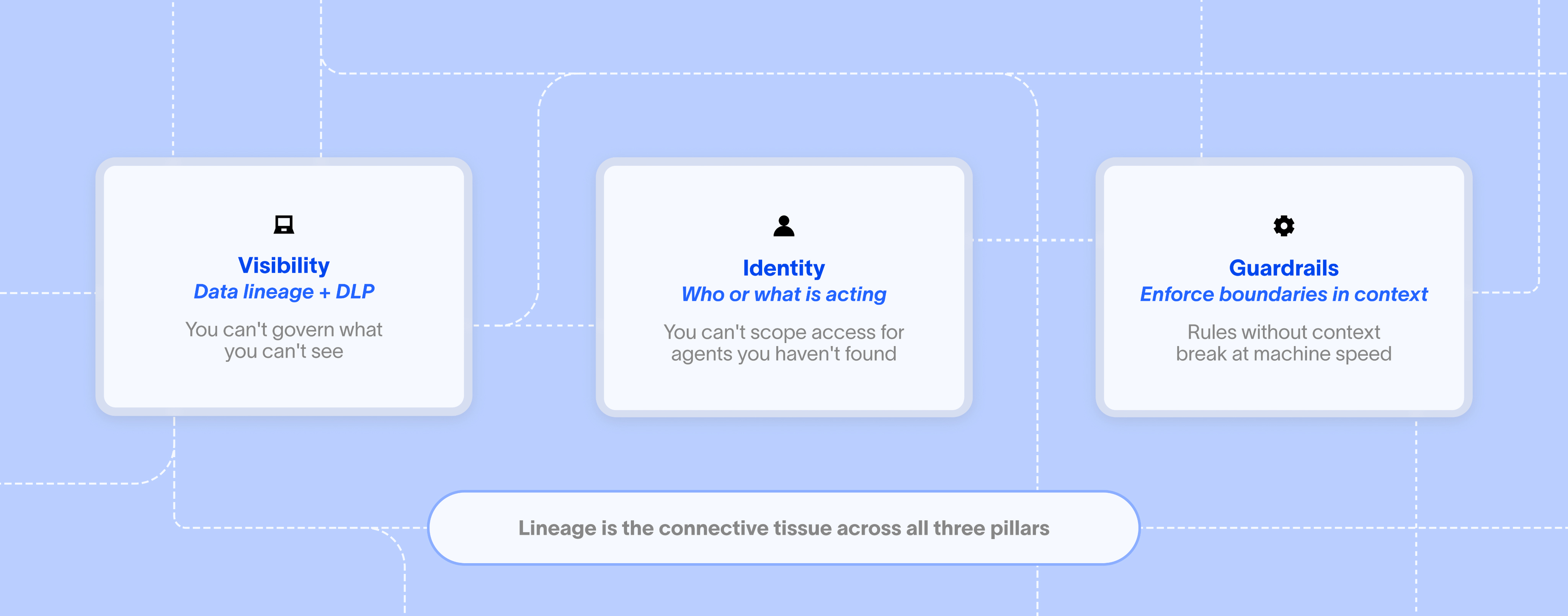
The architecture most programs are running was designed for the slower actor. What it takes to build one that works for both comes down to three pillars, each of which feeds the next. Visibility first. Identity second. Guardrails built on both.
Pillar 1: Data Visibility, From Where Data Lives to How It Moves
The first question any security program has to answer is: What is actually happening to your data?
That question has two parts, and most programs answer only one. Data security posture management (DSPM) tells you where sensitive data lives and whether it is properly controlled at rest. Endpoint DLP tells you what is happening to that data in real time, on the device, in the workflow. Posture without motion visibility is a static picture of a dynamic problem.
Why motion is the higher-risk surface
Consider how a single sensitive document moves in a typical modern workflow. An analyst opens it, a copilot summarizes it, a background agent pulls it into a local embedding store, and a coding assistant references it. The document never left the approved repository. Sensitive content has touched four systems in under a minute, two of which may sit entirely outside your governance perimeter. Legacy DLP, built to detect content in transit based on pattern matching, was not designed to track this.
The gap is not just coverage. It is timing. Without endpoint presence, security teams are reacting to events that have already concluded: Context that has already been captured, outputs that have already been generated, exfiltration that has already happened. Presence at the endpoint is what makes real-time visibility and enforcement possible. Without it, everything else in the program is downstream of events you could not stop.
What visibility actually requires
Visibility is not a set of alerts. It is a continuous record of what data was touched, by which user or agent, through which tools, at what time, in what sequence. That record is data lineage, and it is the connective tissue that makes every other security decision defensible.
Two organizations in the same industry running the same tools can have entirely different data movement patterns. Security that works has to reflect those differences. Generic policies applied against a theoretical model of how data should move produce false positives. Policies grounded in observed lineage reflect how the organization actually operates, including workflows a rule writer never anticipated.
This is why posture and motion visibility are complementary, not competing priorities. DSPM tells you whether the controls around data at rest are correct. Endpoint DLP, built on deep behavioral telemetry, tells you whether those controls are holding in practice. A CISO who has only one is making security decisions with half the available information.
Pillar 2: Identity, for Humans and for the Agents Acting on Their Behalf
Once you have visibility into what is happening to data, the second question is: Who or what is taking this action?
This is not a new category. Identity has been central to security programs for decades. What is new is that the actors now include AI agents that operate autonomously, inherit user permissions wholesale, and execute at machine speed without the cultural friction or observable deliberation that makes human behavior at least partially legible to access governance teams.
The distinction that matters
A human operating on sensitive data moves through cultural norms and friction. They hesitate, double check, or make judgment calls that slow them down. An agent executes. The moment it is authorized, it acts at full scope, across every resource its inherited permissions allow, without pausing to assess whether the action is appropriate.
Traditional identity and access management (IAM) was designed around deliberate, observable human requests. Agent identity is persistent, automated, and often invisible to the teams responsible for access governance. Most access policies in production today were not written with agents in mind. They were written for humans.
Permission creep as the root cause
When organizations first encounter the exposure risk from AI agents, the instinct is often to block the tools entirely. That instinct is understandable and operationally counterproductive. It drives adoption underground and eliminates the visibility that makes governance possible.
The underlying problem is not the agent. It is that access policies designed for humans grant far too much scope when inherited by agents. The answer is lineage. Traditional identity frameworks assume the person with access is the risk. In agentic environments, the person may have entirely appropriate permissions, and the agent acting on their behalf may be the one operating outside scope. That is a new kind of behavioral problem, and it cannot be solved with an exhaustive rule set or by forcing a tradeoff between access and productivity.
If you have a continuous record of what agents have actually done with the access they inherited, you do not need to enumerate every scenario in advance. Lineage gives you the feedback loop to observe, assess, and tighten controls iteratively, without blocking the work.
Why identity depends on visibility
Here is the practical dependency: you cannot apply least-privilege principles to an agent you have not discovered. And discovery requires endpoint presence.
The lineage record built through visibility is what makes identity-based controls feasible in practice. Because you can see everything agents are actually doing with the access they inherit, you can iterate on controls quickly and with precision. Understanding observed data behavior is what closes the feedback loop: you are not writing rules against a theoretical model of how agents should behave, you are adjusting controls based on how they actually behave. That distinction is what makes identity governance for agents operational rather than theoretical.
The challenges that have always existed around permission creep, over-provisioned service accounts, and access sprawl do not disappear in an agentic environment. They scale up. Every identity governance gap that was manageable with human users becomes a larger surface when agents can act on that gap at machine speed, across many simultaneous workflows, without any of the friction that made human misuse observable.
Pillar 3: Guardrails That Govern Agent Behavior in Context
The third pillar follows directly from the first two. Once you can see what data is moving and who or what is acting on it, the question becomes: how do you enforce boundaries without blocking the work?
This is where most organizations reach for blunt instruments and why blunt instruments fail.
Why rules-based guardrails break down
Rules-based systems have always been brittle. They work until the environment changes, a new agent framework appears, or a workflow develops that the rule writer did not anticipate. In a static environment, that brittleness is a maintenance burden. In an agentic environment, where the number of actors, tools, and data paths is expanding continuously, rules-based controls require updates faster than any security team can write them.
The deeper problem is that agents create exposure without intent. They do not pause before acting. If access is broad and instructions are ambiguous, exposure happens because the agent is doing exactly what it was authorized to do, just with data it should not have reached or in a context the authorization did not account for.
There are two specific risks that blunt rules cannot address. First, the persistent context window. Some endpoint agents maintain a local index of every file, interaction, and data fragment they have touched. That store accumulates, does not reset between sessions, and can sync to infrastructure outside your governance perimeter. A rule that blocks specific file types does nothing about context that has already been captured.
Second, the hallucination and inference risk. An agent synthesizing documents can surface sensitive content in outputs routed to the wrong place. This is not traditional exfiltration, but the outcome can be equivalent, customer PII in an external draft, proprietary methodology in a public summary. A pattern-matching rule cannot distinguish between an agent doing legitimate synthesis and one producing a harmful output, because the agent's behavior may look identical in both cases.
What effective guardrails actually require
Authorization is a point-in-time decision. Guardrails are continuous. They observe what an agent is actually doing with data and enforce boundaries in real time, based on context. This means knowing what the data is, where it came from, whether the behavior is consistent with approved workflows.
That contextual understanding is what separates effective guardrails from blunt rules. A guardrail that knows an agent accessed a file containing customer PII, synthesized it with an external API call, and routed the output to an unmanaged device can intervene on that specific chain of events. A rule that prohibits "customer data leaving the perimeter" cannot, because it has no view of the chain, only the endpoint.
This requires endpoint-level visibility. An API integration querying a SaaS application cannot observe what a locally running agent is doing at the operating system level. Guardrails without that foundation are perimeter-level controls in a world where the perimeter no longer contains the relevant activity.
The same pattern that holds across the other pillars holds here: the guardrails are only as effective as the data they reason over. Effective guardrails require lineage, because lineage is what makes context available at enforcement time.
How Cyberhaven Addresses All Three Pillars
These three pillars are not independent. They are a system, and the gaps between them are where most enterprise security programs currently have exposure.
Cyberhaven was built to follow the data rather than the perimeter, which is the only architecture that can address all three pillars from a single data model.
On visibility: AI-native endpoint DLP combined with DSPM produces a continuous lineage record across data at rest and data in motion. That record is not a set of alerts. It is the behavioral history that makes every other decision interpretable.
On identity: Cyberhaven's data lineage capability discovers and inventories agents running on endpoints, including local large language models (LLMs) and frameworks operating outside SaaS governance, and surfaces what access they have inherited. That inventory is the precondition for any identity-based control applied to agents.
On guardrails: Linea AI enforces real-time controls based on observed agent behavior, not just pre-authorized access. Because it operates on the endpoint and reasons over the full lineage record, it can distinguish between an agent doing legitimate work and one operating outside approved boundaries, in context, at the moment the boundary is being approached.
The strategic point is not that these are three separate capabilities. It is that they run on a single data model and produce a single source of truth about how data moves and where boundaries are being respected or crossed. That is what makes the program adaptive rather than reactive.

.avif)
.avif)

Insights for the agentic enterprise
New guides, reports, and insights on data security, sent as they publish.