SACR’s New ECP Framework: What It Means for AI and Data Security

September 3, 2026
•
1 min

A new report from Software Analyst Cyber Research (SACR), The CISO Guide to Endpoint Control and Prevention (ECP): The Next Architecture for Endpoint Security, outlines a new era of endpoint security shaped by AI agents, copilots, SaaS applications, browser-based workflows, and increasingly autonomous activity.
The report introduces Endpoint Control and Prevention (ECP) as a framework for understanding this shift and the new security capabilities it requires. The following takeaways highlight the implications for AI and data security.
1. AI Is Rewriting What the Endpoint Is
One of the report’s most important observations is that the endpoint itself is changing.
As SACR puts it, the endpoint has become the place where people, AI agents, applications, identities, and data meet. AI coding agents can read codebases, execute commands, install packages, and interact with other systems. MCP connected tools can dynamically connect agents to enterprise data and applications. Meanwhile, low code and no code AI tools are making it possible for employees far beyond engineering to build applications, agents, and automated workflows.
This means consequential activity increasingly happens through browser sessions, SaaS applications, APIs, plugins, agentic toolchains, and natural language instructions.
The risk is no longer limited to whether a malicious file executes. Security teams increasingly need to understand the interaction between a user, an AI agent, the tools it can access, and the data it can act on.
2. AI Security Requires Much More Context
This shift makes context significantly more important.
SACR states that modern security needs to understand who initiated an action, what prompted it, which tools were used, and whether the resulting behavior aligns with legitimate intent.
That is especially important with autonomous AI systems. A process tree may show that a command executed, but it may not explain whether the action originated from a person, an AI agent acting on that person’s behalf, a malicious prompt injection, or an automated workflow.
The report describes prompt-to-action attribution as an increasingly important capability, connecting the original prompt or instruction to the tools invoked and the actions that followed.
It also notes that cloud-based analysis and traditional human-in-the-loop response may struggle to keep pace as AI agents operate at machine speed. Security therefore needs to move closer to where the interaction occurs and make faster, more context-aware decisions.
3. The ECP Framework
SACR uses the term Endpoint Control and Prevention to describe this broader model.
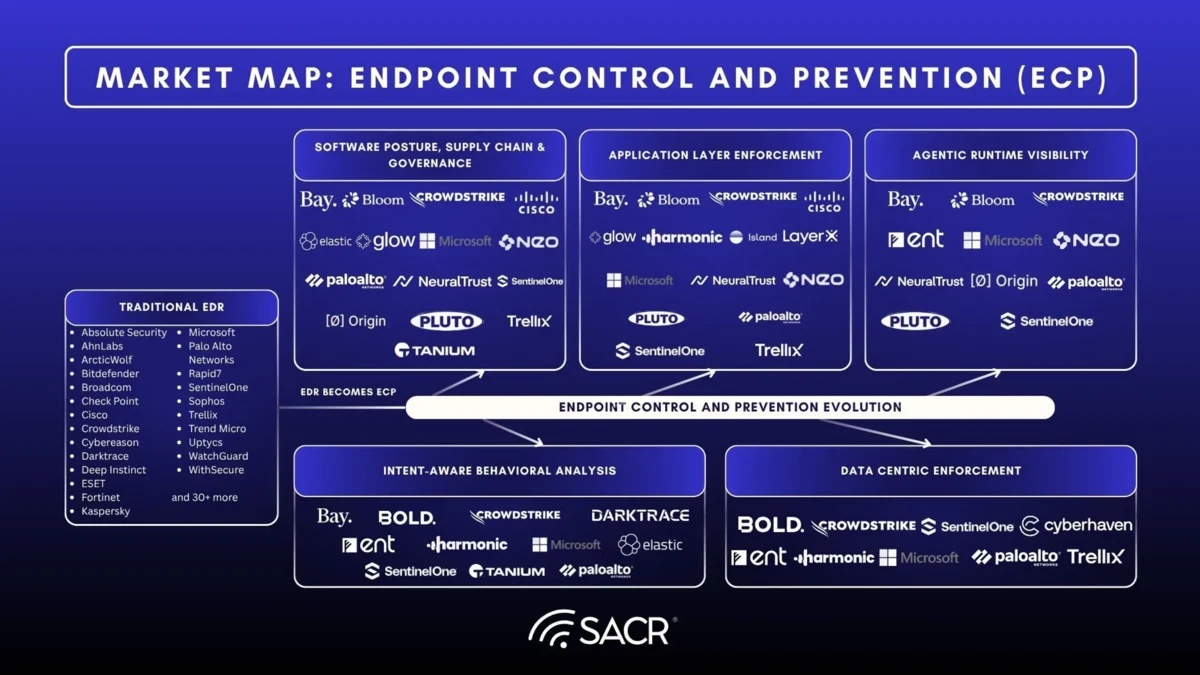
The report divides ECP into five zones spanning software posture, application layer enforcement, agent runtime visibility, intent-aware behavioral analysis, and data-centric enforcement.
The broader concept is that the endpoint serves as an active control plane governing interactions among humans, AI agents, applications, identities, and data.
Instead of only observing activity after it happens, security controls increasingly need to operate within the workflow itself, providing enough context to assess risk and intervene before a harmful action is completed.
As agents gain greater autonomy and access to enterprise systems, organizations need visibility and control at the same layer where prompts become actions.
4. Data Becomes Central to AI Security
This is where the report’s fifth zone, Data-Centric Enforcement, becomes particularly important.
AI systems do not operate in isolation. They access source code, customer information, financial records, intellectual property, credentials, internal documents, and other sensitive enterprise data.
As AI agents become more capable, the important security questions increasingly include: What data did the agent access? Where did that data originate? How was it transformed? Where did it move? And was that movement appropriate?
SACR describes Zone 5 as a security layer centered on classifying, tracing, and governing sensitive data as it moves across endpoints, browsers, SaaS applications, APIs, and AI workflows. SACR’s Zone 5 focuses on protecting sensitive data as it moves through the enterprise, using data lineage alongside classification and tracing to provide more context around that movement.
Data security therefore becomes an increasingly important component of AI security. Protecting AI is not only about securing models, prompts, or agents. It also requires understanding and controlling the sensitive data those systems interact with.
5. Where Cyberhaven Fits
In our view, Cyberhaven’s role in Data Centric Enforcement points to where the market is heading: securing data as it moves across users, applications, and AI systems.
The report highlights Cyberhaven’s approach to continuously tracking the origin, movement, and destination of sensitive data across endpoints, browsers, SaaS, and cloud environments. It also calls out browser-centric governance, visibility into AI tool data flows, cross-environment lineage, and investigation-grade evidence chains.
As AI changes how employees and autonomous systems interact with enterprise data, organizations need to understand those interactions with far greater context. Data lineage provides one way to connect users, agents, applications, and sensitive information into a coherent picture of what actually happened.
SACR’s ECP framework provides a useful lens for understanding how endpoint security may evolve as AI becomes more autonomous and more deeply embedded into everyday work.
For the complete five-zone framework, vendor landscape, and SACR’s recommendations for security leaders, read the full SACR report.



.avif)
.avif)

Insights for the agentic enterprise
New guides, reports, and insights on data security, sent as they publish.