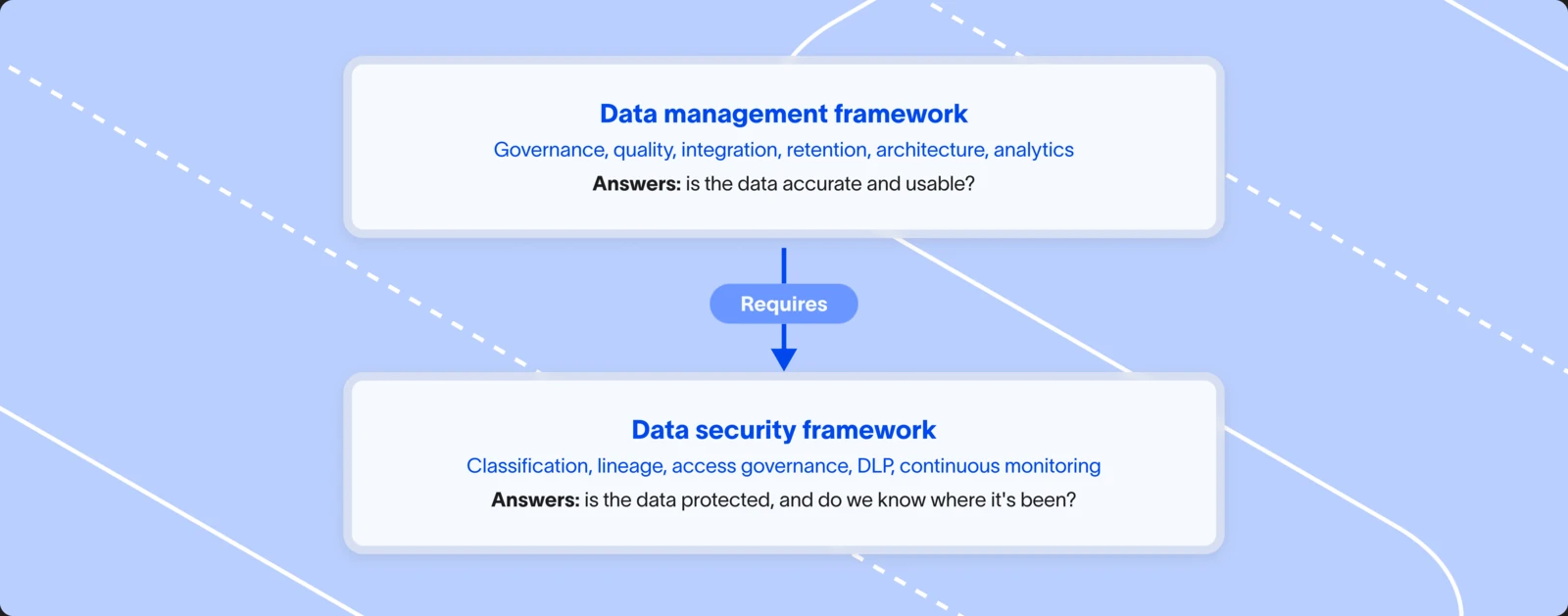
Most data management frameworks list security as one component among several, including governance, quality, integration, retention, architecture, and analytics. Security is often treated as an equally weighted checkbox on the same list as the others.
That framing is where data security programs start to break down.
Security is not a peer to data quality or data retention. It is the layer that determines whether the other seven components can be trusted at all. A data management framework can have clean, well-governed, well-integrated data and still leave that data exposed if access controls and lineage are not built in from the start. Organizations that treat security as one checkbox among many are the ones that find sensitive data sitting in the wrong place long after the framework was supposedly implemented.
What Is a Data Security Framework?
A data security framework is a structured set of policies, controls, and processes that govern how sensitive data is discovered, classified, accessed, and protected across its lifecycle. It defines who can touch which data, under what conditions, and how that access is monitored and enforced. Unlike a general data management framework, which spans quality, integration, and analytics, a data security framework has a single job: keeping sensitive data out of the wrong hands.
Why Data Security Frameworks and Data Management Frameworks Are Not the Same
Data management frameworks and data security frameworks often get bundled into the same conversation because they overlap in places, but they answer different fundamental questions.
A data management framework asks: is our data accurate, accessible, and useful?
A data security framework asks: is our data protected, and do we know where it has been?
That distinction fully matters in practice. A company can run a mature data management program, complete with governance councils, data quality dashboards, and a documented architecture, and still have no clear answer to a basic security question: which spreadsheet contains the unreleased earnings numbers, who has copied it, and where did those copies go?Data management frameworks are built to answer questions about structure and usability. They are not built to answer questions about exposure.
This is why folding security into a broader data management framework as a single line item under-serves both. Security needs its own controls, its own metrics, and its own accountability, not a shared checkbox with data retention policy.
The Core Components of a Data Security Framework
A data security framework typically includes five components, each addressing a different point in the data lifecycle.
- Data classification identifies what data exists and how sensitive it is, based on content and context rather than static labels applied once and never revisited.
- Data lineage tracks where sensitive data originated, how it has moved, and who has touched it along the way. Without lineage, security teams can see a snapshot of current access but not the history that explains how data reached a risky location.
- Access governance defines and enforces who can reach which data, removing standing access that no longer matches a legitimate business need.
- Data loss prevention (DLP) controls, monitors, and blocks the movement of sensitive data across endpoints, cloud apps, and email, based on what the data actually is rather than where it happens to sit.
- Continuous monitoring flags anomalous access or movement in real time, so a security team is not relying on a quarterly audit to catch exposure that happened months earlier.
Where Data Management Frameworks Fall Short on Security
Data management frameworks often address governance and access at a policy level: who is supposed to have access, and what the rules say should happen to data. That is necessary, but it is not the same as knowing what is actually happening to sensitive data in practice.
Governance frameworks can confirm that an access policy exists. They cannot confirm that a user with legitimate access did not copy a sensitive file into a personal cloud drive last week, or that an AI chat tool did not ingest a confidential document pasted into a prompt. That gap, between documented policy and actual data movement, is where most exposure happens.
Three scenarios show why policy visibility and movement visibility are not the same thing.
- Legitimate access, illegitimate destination: A finance analyst with proper, governance-approved access to a quarterly forecast downloads it to prepare a board deck, then uploads a copy to a personal Google Drive account to work from home. The access policy was followed exactly. The governance framework has no way to flag the copy, because it was never designed to track where a file goes after access is granted, only whether access was authorized in the first place.
- Contractor offboarding: A contractor's access is revoked on schedule, satisfying the governance requirement. But the contractor downloaded a customer database three weeks earlier, before the engagement ended, and that copy still exists on a device the organization no longer monitors. Revoking access closes the door after the data has already left.
- AI tools as a new exit point: An employee pastes a confidential contract into a public AI chat tool to get a quick summary. No file was moved, no access log was triggered, and no governance policy was technically violated if the tool was not explicitly disallowed. The sensitive content still left the environment.
None of these are policy failures. They are visibility failures: the data management framework recorded the correct access decision and missed the actual movement entirely. Closing that gap requires tracking sensitive data by its lineage and content, not just by the access logs attached to where it started out.
How Cyberhaven Supports Data Security Frameworks
Cyberhaven’s unified platform closes the gap that general data management frameworks leave open by tracking sensitive data through its full lifecycle rather than just at rest.
- Data Lineage traces sensitive data from its origin through every copy, edit, and transfer, so security teams can answer where data has been, not only where it sits today.
- DSPM discovers and classifies sensitive data across cloud, on-premises, and SaaS environments based on content and context, giving security teams an accurate, continuously updated map of exposure.
- DLP enforces controls at the point of movement, blocking risky transfers of sensitive data across endpoints, browsers, and AI tools without relying on static rules that flag everything or nothing.
- AI Security extends that same lineage and classification into GenAI tools, so a data management framework that already accounts for AI-driven workflows does not have a blind spot where prompts and outputs are concerned.
Together, these capabilities let a security team answer the questions a data management framework alone cannot: where sensitive data has traveled, who has touched it, and whether it left the environment it was supposed to stay in.
A data management framework organizes data. A data security framework protects it. Treating security as one checkbox among eight is how sensitive data ends up exposed inside a program that looks mature on paper. Data lineage, classification, and enforcement close that gap.
Learn more about the foundations of a comprehensive data security program with our on-demand webinar, “The Foundation of Durable Data Security: Presence, Lineage, and AI.”
Frequently Asked Questions
What is the difference between data governance and a data security framework?
Data governance sets policies for how data should be managed, including who is responsible for it and what standards apply. A data security framework enforces protection: classification, access control, and monitoring. Governance defines the rules; a security framework confirms they are actually followed.
How does data lineage fit into a data management framework?
Data lineage adds a historical record to a data management framework: where sensitive data originated, how it moved, and who touched it. Without lineage, a framework can describe current data structure but cannot explain how data reached a risky location.
Do data management frameworks include security by default?
Most data management frameworks list security as one component alongside quality, integration, and retention, but they typically treat it as a policy layer rather than an enforced, continuously monitored control. That gap is why organizations need a dedicated data security framework alongside their broader data management program.
What are the core components of a data security framework?
The core components are data classification, data lineage, access governance, data loss prevention, and continuous monitoring. Each addresses a different stage of the data lifecycle, from identifying sensitive data to controlling its movement and flagging anomalous activity.
How does DSPM support a data management framework?
DSPM gives a data management framework accurate, continuously updated visibility into where sensitive data lives and how exposed it is. That visibility feeds directly into governance and access decisions that a data management framework depends on but cannot generate on its own.
Can a data management framework work without a dedicated security layer?
It can function, but it leaves sensitive data exposed. A data management framework without a dedicated security layer can still be accurate and well-governed on paper while sensitive data moves through endpoints, cloud apps, and AI tools with no enforcement or visibility.
.avif)
.avif)