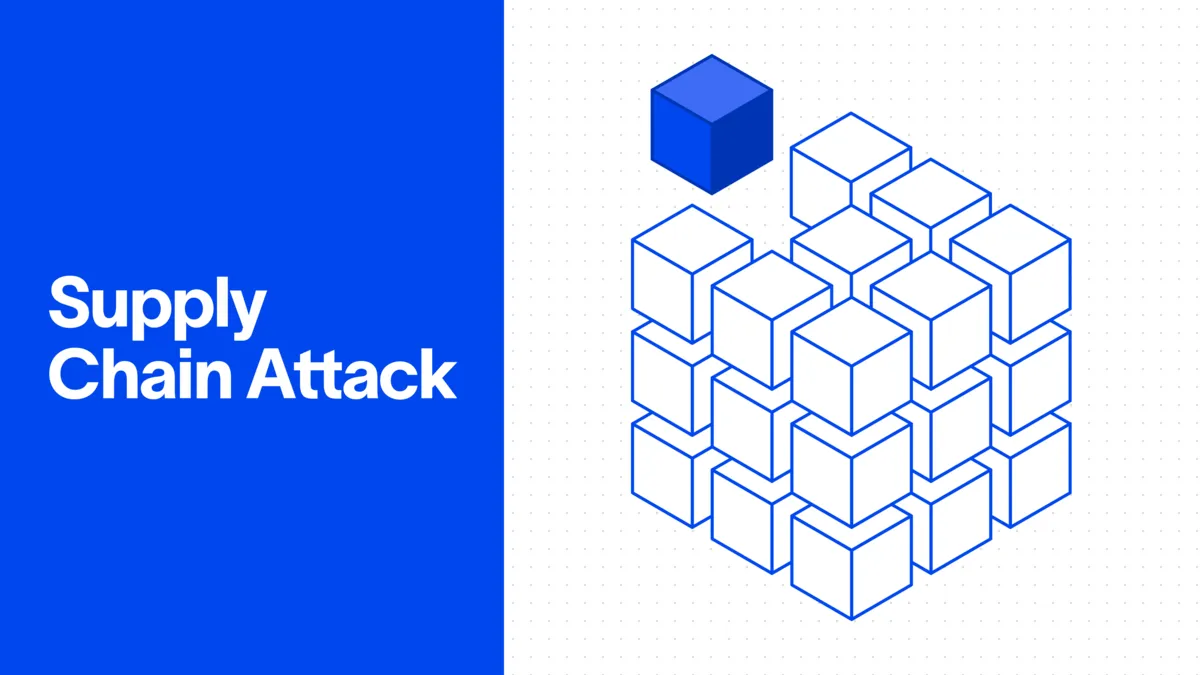
- A supply chain attack compromises a trusted vendor, software dependency, or update process to reach that vendor's downstream customers.
- Attackers favor supply chain attacks because one compromised dependency or update can affect thousands of organizations through a single point of entry.
- Common types include software supply chain attacks, open-source and dependency confusion attacks, CI/CD pipeline compromise, and stolen code-signing certificates.
- Supply chain attacks are difficult to detect because the malicious code arrives through a signed, trusted channel and often passes standard security checks.
- Defending against supply chain attacks requires vendor risk assessment, dependency visibility, and continuous monitoring of software behavior after installation.
What Is a Supply Chain Attack?
A supply chain attack is a cyber attack that compromises a trusted third-party vendor, software dependency, or update process in order to reach that vendor's downstream customers. Rather than attacking a target directly, the attacker infiltrates a supplier the target already trusts, then rides that trust into the target's systems and data.
The term originally described attacks on physical supply chains, where an attacker compromised a hardware component or a trusted business relationship to reach a larger trading partner. Software has since become the dominant vector. A typical application combines hundreds of open-source packages, third-party APIs, container images, and vendor-supplied updates rather than original code alone, and each one is a potential entry point. When an attacker compromises a single widely used dependency, every organization that installs it inherits the compromise, which is why one incident can cascade across thousands of victims. As organizations harden their own perimeters, attackers increasingly find it easier to compromise a shared vendor or package once and let normal software distribution do the rest.
How Supply Chain Attacks Compromise the Software Delivery Path
A supply chain attack unfolds in two stages: an upstream compromise and a downstream distribution.
- Gain access: The attacker targets a vendor, open-source maintainer, or build system, often through stolen credentials, an exposed CI/CD pipeline, or an unpatched vulnerability in the supplier's own infrastructure.
- Insert malicious code: Once inside, the attacker modifies source code, a build script, or an update package so the malicious payload travels alongside the legitimate software.
- Distribute through a trusted channel: The compromised update, package, or component is signed and released through the vendor's normal distribution process, so it looks identical to a legitimate release.
- Execute downstream: Customers install the update or dependency because they trust its source, which activates the payload on their own systems.
- Expand access: From there, attackers can execute code, steal data, establish persistence, or move laterally to additional systems inside the victim's environment.
Because the code travels through a channel the victim already trusts, it frequently passes signature checks and other perimeter controls built to flag unfamiliar files. A software product validated in the past can carry new risk after a single compromised update, so prior approval does not guarantee current safety. This is what makes a supply chain attack difficult to distinguish from a routine software release until unusual behavior appears after installation.
Types of Supply Chain Attacks
These are not the only forms a supply chain attack can take, but they cover the patterns most often cited in supply chain attack examples and incident reports.
Software Supply Chain Attacks vs. Vendor Supply Chain Attacks
The two terms overlap but describe different scopes.
- A vendor supply chain attack targets a trusted third-party provider or business relationship in general, which can include people, processes, or physical goods.
- A software supply chain attack narrows that scope to code, packages, development tools, or updates that an organization installs and runs.
Every software supply chain attack is a vendor supply chain attack, but not every vendor supply chain attack touches software. For most security teams today, the software variant carries the greater practical risk, since a single compromised package or update can propagate automatically to every downstream user without any additional action by the attacker.
Why Supply Chain Attacks Matter for Data Security
A supply chain attack rarely stops at the initial compromise. Once an attacker has a foothold through a trusted dependency or update, the real objective is usually the data that foothold can reach: customer records, credentials, source code, or the datasets feeding an organization's AI systems. This is increasingly true for AI security as well as traditional application security. Open-source AI frameworks and model repositories now carry the same dependency sprawl as any other software category, and poisoned packages targeting AI tooling have already reached production environments.
Because a compromised dependency can sit inside an environment for months before it acts, organizations need visibility into how data actually moves once a package, update, or AI tool is installed, not just an assessment of the vendor at onboarding. Without that visibility, a supply chain compromise can quietly become a Data Lineage gap: security teams cannot trace which data a compromised component touched, copied, or exfiltrated.
Common Challenges in Detecting Supply Chain Attacks
- Inherited trust: Malicious code arrives through a signed update or an approved dependency, so it can bypass controls built to catch unfamiliar files, sometimes enabling data exfiltration before defenders realize a compromise occurred.
- Dependency sprawl: Modern applications include hundreds of third-party components, and few organizations maintain a complete, current inventory of all of them.
- Delayed activation: Attackers often wait before triggering the payload, so the compromise can predate detection by weeks or months.
- Limited vendor visibility: Security teams can assess a vendor's policies at onboarding but rarely have ongoing insight into that vendor's own build systems or credentials.
- Resource asymmetry: A single compromised package can reach thousands of organizations at once, while each victim organization must investigate the incident individually.
How to Defend Against Supply Chain Attacks
- Inventory dependencies and vendors
Maintain a current software bill of materials (SBOM) covering packages, versions, and vendor relationships so a compromise can be traced quickly. - Assess third-party risk before and after onboarding
Require vendors to follow specific security policies, and reassess periodically rather than treating approval as permanent. - Apply staged rollout and cooldown periods
Hold newly published package versions before broad adoption, since compromised packages are often caught within the first 48 hours if given time to surface. - Monitor behavior continuously
Watch for unexpected child processes, unfamiliar network connections, new persistence mechanisms, or unusual data movement after an update, rather than relying on signature checks alone. - Apply zero trust and least privilege
Limit what any vendor, dependency, or automated process can access by default, so a single compromise cannot immediately reach sensitive data. - Build an incident response plan specific to supply chain scenarios
Know in advance how to isolate a compromised dependency, notify affected teams, and trace what data it could have touched.
How Cyberhaven Addresses Supply Chain Attacks
Cyberhaven addresses supply chain attacks through a unified data security platform that combines Data Lineage, DLP, and AI Security to reduce the blast radius once a vendor, package, or update is compromised. Unlike tools that stop at the perimeter and assume a signed update is safe, Cyberhaven's platform traces how data actually moves once a third-party component touches it, so a compromised dependency does not have to be caught at the point of entry to be caught at all.
Data Lineage maps where sensitive data has traveled and which processes touched it, which shortens investigation time when a vendor or package is later found to be compromised. DLP applies protection based on that context rather than static rules, so unusual movement after a trusted update still triggers a response. AI Security extends the same visibility to AI tools and frameworks, where poisoned packages and shadow AI adoption create a fast-growing version of the same risk.
Frequently Asked Questions
What is a supply chain attack in cybersecurity?
A supply chain attack in cybersecurity is an attack that compromises a trusted vendor, software dependency, or update process instead of attacking the target directly. The attacker uses the victim's trust in that third party to distribute malicious code, which can then execute, steal data, or grant further access once installed.
What is the difference between a supply chain attack and a direct attack?
A direct attack targets the victim's own systems and defenses. A supply chain attack targets a trusted third party first, such as a vendor or open-source dependency, and reaches the victim indirectly once that party's software or update is installed. This lets attackers bypass defenses built for direct intrusion attempts.
What are common examples of software supply chain attacks?
Common examples include a compromised software update that reaches thousands of customers through routine distribution, a poisoned open-source package pulled into many downstream projects, and a dependency confusion attack where a malicious public package replaces a private one by using a higher version number.
How is a supply chain attack carried out?
A supply chain attack typically starts with an upstream compromise, where the attacker gains access to a vendor, dependency, or build system. The attacker then inserts malicious code that travels through the vendor's normal distribution process. The downstream attack occurs when a customer installs the compromised update or package, activating the payload on their own systems.
Why are supply chain attacks hard to detect?
Supply chain attacks are hard to detect because the malicious code arrives through a channel the victim already trusts, such as a signed update or an approved dependency, and often passes standard signature-based security checks. Detection typically requires monitoring software behavior after installation rather than relying on trust in the source alone.
How can organizations prevent supply chain attacks?
Organizations can reduce supply chain attack risk by maintaining a current inventory of dependencies and vendors, assessing third-party risk on an ongoing basis, applying staged rollout periods for new package versions, and monitoring software behavior continuously for signs of compromise after installation.
.avif)
.avif)